Love Tarot: Ten of Wands and Nine of Cups
- Arcana
- Ten of Wands — Minor Arcana, Wands; Nine of Cups — Minor Arcana, Cups
- Elements
- Ten of Wands — Fire; Nine of Cups — Water
- Elemental interaction
- Opposing elements — energies create tension
- Numerology
- 10 + 9 = 19 → 1
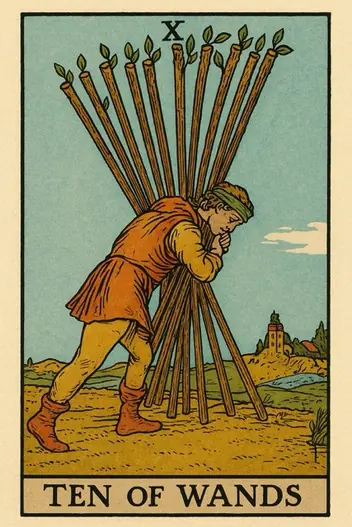
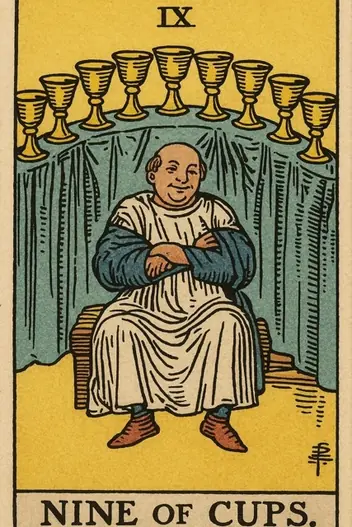
The intersection of the Ten of Wands and Nine of Cups presents a powerful psychological paradox. The Nine of Cups, often called the "Wish Card," represents emotional satisfaction, contentment, and the realization of a deeply held desire. In stark contrast, the Ten of Wands embodies the weight of responsibility, overextension, and the physical exhaustion that comes from carrying too many burdens.
When these two archetypes collide, the core question becomes: Can you truly enjoy your success when you are too exhausted to appreciate it? This combination suggests a moment of peak achievement, but one that comes with a hidden cost—your vitality. The seeker may have worked tirelessly to reach a goal, only to find that the victory feels hollow because the process has drained them. This is not a prophecy of failure, but a strategic warning about sustainability and the psychological toll of chasing satisfaction without managing your resources.
Ten of Wands and Nine of Cups Combination Meaning
The psychological state created by this pairing is one of cognitive dissonance between accomplishment and burnout. You have likely achieved something significant—a promotion, a stable relationship, or a long-term goal. The Nine of Cups confirms that this achievement should bring you joy and fulfillment. However, the Ten of Wands reveals that you are currently operating at maximum capacity, perhaps even beyond it. The reward is in your hands, but your hands are too full to hold it properly.
This dynamic often manifests as a fear of delegating or letting go. The individual may believe that if they stop carrying the load, the wish will vanish. This is a cognitive bias known as the sunk cost fallacy: the belief that because you have invested so much, you must continue at the same unsustainable pace. The key insight here is that the wish is already fulfilled. The Nine of Cups signals that the goal is secure. The only question is whether you will collapse before you can enjoy it. Your next strategic move is to redistribute the weight—not to abandon your success, but to protect your capacity to savor it.
Your pair is already on the table. Ask your question and draw the clarifying card
or simply focus on it
What Do Ten of Wands and Nine of Cups Indicate for Your Career?
Strategic Opportunities:
Leverage your current success to negotiate for support. Now that you have proven you can deliver results, request an assistant, a reduced workload, or a flexible schedule. Your bargaining power is at its peak.
Strategic Opportunities:
Automate or outsource low-value tasks. The Nine of Cups confirms your core project is viable. Free up your mental bandwidth by removing repetitive, non-essential work.
Calculated Risks:
Avoid taking on additional projects, even if they seem lucrative. The Ten of Wands warns that your capacity is already maxed out. Saying "yes" to more work now will lead to diminished quality and physical burnout.
Professionally, this pairing signals a critical inflection point in your career trajectory. You have likely just completed a major milestone—a product launch, a successful quarter, or a long-term contract. The Nine of Cups validates your competence and the value of your work. However, the Ten of Wands is a clear warning against over-optimism in your capacity. The most common financial mistake here is mistaking a single success for a sustainable workload. You may be tempted to capitalize on your momentum by taking on more clients, more hours, or more responsibilities. This is a trap. Instead, use this moment to consolidate your gains. Implement systems that protect your time and energy. If you are self-employed, consider raising your rates to filter out low-value clients. If you are an employee, document your workload and present a case for additional resources before you agree to future commitments. The goal is not to stop working, but to shift from a reactive, burdened state to a proactive, strategic one.
Ten of Wands and Nine of Cups in Love Tarot
If you are single:
This combination suggests you may attract a partner who appears to fulfill your wishes, but the relationship will require significant emotional labor or compromise. Evaluate whether the initial satisfaction is worth the ongoing effort.
If you are in a relationship:
You and your partner may have built a comfortable life together, but one of you is carrying the emotional or logistical weight of the partnership. The risk is resentment hiding behind contentment.
In the context of relationships, the Ten of Wands and Nine of Cups often indicate a power imbalance masked by surface-level happiness. One partner may feel they are doing all the heavy lifting—managing finances, household duties, or emotional support—while the other enjoys the benefits without sharing the burden. The Nine of Cups can represent the partner who is content, while the Ten of Wands represents the one who is exhausted. The most important relationship advice here is to initiate a clear conversation about responsibilities. Do not assume that because the relationship "works," it is equitable. Acknowledge the burden openly and negotiate a redistribution of tasks. If you are the one feeling overloaded, recognize that your silence is enabling the imbalance. If you are the one enjoying the comfort, ask yourself if you are truly seeing your partner’s struggle.
Uncover hidden insights
Let our advanced Tarot system interpret these archetypes specifically for your personal path.
Reversed Positions: What Changes?
If the Ten of Wands is reversed:
The burden has been shed, but irresponsibly. You have abandoned your commitments too abruptly, leaving chaos in your wake. This could be quitting a job without a plan or ending a relationship without explanation. Advice: Do not confuse freedom with escape. You need not just to drop the load, but to hand it over to responsible hands; otherwise, guilt (the shadow of the Nine of Cups) will return you to the same trap.
If the Nine of Cups is reversed:
Internal resistance to success. You are subconsciously sabotaging your own satisfaction. Instead of rejoicing in an achievement, you find flaws in it. This is the cognitive distortion of the "imposter." Advice: Stop seeking approval. The reversed Nine of Cups says: "No one will give you permission to be happy." Take it for yourself.
If BOTH are reversed:
Complete imbalance. You have shed responsibility but have not found peace. A state of apathy and loss of meaning. You don't want to carry the burden, but you also don't know what to do with the freed-up time. A logical way to correct this: Start small. Take on one simple commitment (e.g., a daily walk) and see it through to the end. This will restore a sense of control without burnout.
Ten of Wands and Nine of Cups: Warning Signs
The shadow manifestation of this combination is a self-destructive cycle of achievement and exhaustion. The seeker may have a deep-seated belief that they must suffer to deserve success, or that rest is a form of laziness. This is a cognitive distortion known as "all-or-nothing thinking": the idea that if you are not giving 100%, you are failing. The Nine of Cups becomes a mirage—always just out of reach because the Ten of Wands prevents you from ever pausing long enough to appreciate it.
Another significant pitfall is martyrdom and passive-aggressive resentment. The individual may complain about their burden but refuse to delegate, secretly enjoying the moral superiority of being the one who "does everything." This behavior sabotages genuine connection and collaboration. If you recognize this pattern in yourself, the psychological work is to confront the fear of being ordinary or unnecessary. The Nine of Cups does not require you to be a hero. It only requires you to be present enough to enjoy the life you have built. The shadow warns that if you continue on this path, you will achieve your wish only to find yourself too numb to feel it.
What Is the Overall Message of Ten of Wands and Nine of Cups?
Constructive use of this dynamic requires a strict separation of work and rest. The energy of the Ten of Wands is a powerful engine, but without brakes (the Nine of Cups), it leads to a crash. Your task is not to drop all obligations, but to optimize them according to your actual resources. Ask yourself: "What of what I am carrying truly brings me joy (the Nine of Cups)?" If the answer is "nothing," you are in a trap.
Strategic advice: Use the "one burden" principle. Choose one area of life (career, relationships, health) where you are willing to bear the maximum load. Delegate or simplify everything else. The Nine of Cups in a healthy state is the ability to enjoy the small things, not to demand superhuman results from yourself. Allow yourself to be "good enough," not perfect.
Deep insight: This combination teaches that satisfaction is not a reward for suffering. It is the result of proper energy distribution. Stop being the hero who saves everyone. Become the strategist who manages only what they can realistically change. Then the Ten of Wands will become your tool, and the Nine of Cups, your rightful claim to rest.
Applying This to Your Situation
The core message of the Ten of Wands and Nine of Cups is a call for strategic recalibration. You have earned your success, but you are at risk of losing the ability to enjoy it. Your task is not to abandon your goals, but to redesign your approach to them. Ask yourself: What can I release? Who can I trust to share the load? How can I protect my energy without sacrificing my standards? These questions are not weaknesses; they are the foundation of sustainable achievement.
While this analysis provides a deep understanding of the general archetype, the true power of Tarot lies in its application to your specific life context. The meaning of these cards shifts based on your unique question, emotional state, and circumstances. To get a personalized, in-depth interpretation of the Ten of Wands and Nine of Cups for your exact situation, use the Fortune Cards app. You can access it on the web or download it now to receive a tailored reading that addresses your relationship, career, or personal growth question with precision and insight. Don't settle for generic advice—get the clarity you deserve.
Interpretation by the Fortune Cards editorial team, based on the Rider–Waite tradition and Jungian archetypes. About our methodology · Updated: 2026-08-26
Other Combinations with Ten of Wands
Other Combinations with Nine of Cups
Explore Individual Card Meanings
Table of Contents
- Ten of Wands and Nine of Cups Combination Meaning
- What Do Ten of Wands and Nine of Cups Indicate for Your Career?
- Ten of Wands and Nine of Cups in Love Tarot
- Reversed Positions: What Changes?
- Ten of Wands and Nine of Cups: Warning Signs
- What Is the Overall Message of Ten of Wands and Nine of Cups?
- Applying This to Your Situation
Ready to find answers to your questions?
Start your first reading now and look at your situation with fresh clarity. The cards are ready to reveal deeper meaning.