Nine of Cups and Knight of Swords Meaning in Tarot
- Arcana
- Nine of Cups — Minor Arcana, Cups; Knight of Swords — Minor Arcana, Swords
- Elements
- Nine of Cups — Water; Knight of Swords — Air
- Elemental interaction
- Neutral elements — energies coexist without conflict
- Numerology
- 9 + 12 = 21 → 3
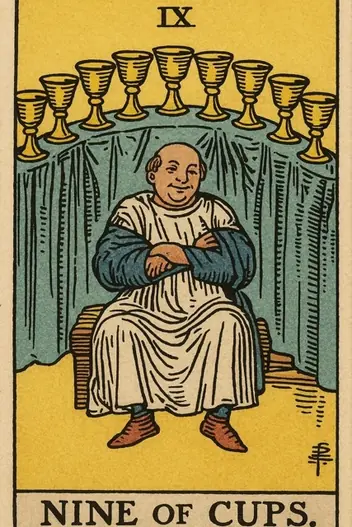
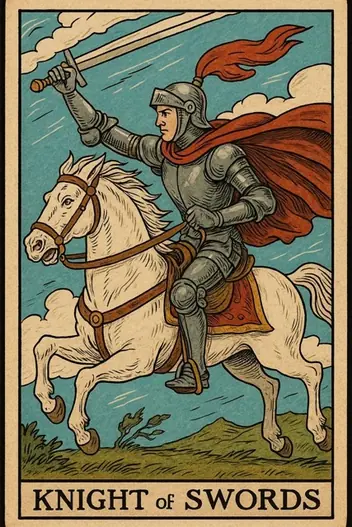
When the Nine of Cups—the card of emotional fulfillment, wish fulfillment, and self-satisfaction—collides with the Knight of Swords—the archetype of rapid action, intellectual clarity, and aggressive pursuit—the result is a potent psychological cocktail. This pairing represents the tension between having what you want and the restless urge to chase something more. On the surface, the Nine of Cups suggests contentment, but the Knight of Swords brings a sharp, analytical energy that refuses to settle. In real life, this combination often appears when you have achieved a significant goal, yet feel an internal push to reassess, refine, or even abandon it for a higher ambition.
The core conflict here is between emotional stability and intellectual restlessness. The Knight of Swords charges forward with logic and speed, while the Nine of Cups sits back, savoring the reward. When these energies merge, you may find yourself in a state of drive-driven satisfaction—where you appreciate your accomplishments but cannot ignore the next challenge. This is not a passive moment; it is a call to strategically leverage your current success as a launching pad for a calculated, high-speed pursuit of a new goal. The psychological key is to avoid letting the Knight’s impulsiveness undermine the Nine’s hard-won peace.
Nine of Cups and Knight of Swords Card Meaning Explained
At its psychological core, this combination represents the Jungian tension between the Self and the Shadow’s ambition. The Nine of Cups embodies the fulfilled ego—the part of you that feels whole, appreciated, and in control of your emotional world. The Knight of Swords, however, is the unconscious drive for mastery—a sharp, focused energy that cuts through complacency with the clarity of a blade. Together, they create a mindset where satisfaction is not an endpoint but a resource. You are not meant to rest; you are meant to use your current success as fuel for a targeted, strategic move forward.
The real-world implications are significant. This pair often signals a pivotal decision point where emotional and rational priorities collide. For example, you might feel deeply content in a relationship or career, yet a new opportunity—or a sharp insight—demands immediate action. The danger lies in over-optimizing: the Knight of Swords can push you to act before the Nine of Cups has fully integrated its rewards. Your psychological task is to hold both energies in balance—to appreciate what you have while maintaining the intellectual discipline to pursue what’s next. Bold action is warranted, but only after a cold-eyed assessment of risks.
Nine of Cups and Knight of Swords Love Outcome
If you are single:
This combination suggests you may be approaching potential partners with a goal-oriented mindset, seeking someone who matches your intellectual standards. Be cautious of turning love into a checklist; emotional connection requires patience, not just logic.
If you are in a relationship:
Expect a dynamic where one partner feels fulfilled while the other pushes for change or growth. Open, honest communication is critical to avoid the Knight’s sharp words undermining the Nine’s emotional security.
In relationships, the Nine of Cups and Knight of Swords create a push-pull dynamic between contentment and critique. The Nine of Cups partner may feel they have everything they need, while the Knight of Swords partner—or energy within you—sees flaws, inefficiencies, or untapped potential. This is a recipe for conflict unless both sides are acknowledged. The key relationship advice is to use the Knight’s analytical power to enhance, not dismantle, the Nine’s emotional foundation. If you are the one feeling restless, ask yourself: Is my dissatisfaction valid, or am I chasing an ideal that ignores real, present happiness? Bold suggestion: Schedule a structured conversation where each partner lists what they value and what they want to improve. This turns the Knight’s sharpness into a constructive tool rather than a weapon.
Your pair is already on the table. Ask your question and draw the clarifying card
or simply focus on it
Nine of Cups and Knight of Swords for Career and Money
Strategic Opportunities:
This is an excellent time to launch a new project or pitch a bold idea—your confidence (Nine of Cups) and clarity (Knight of Swords) are aligned. Use your current reputation as leverage.
Strategic Opportunities:
Re-negotiate contracts or seek a promotion now. The Knight’s decisiveness combined with the Nine’s self-assurance makes you formidable in negotiations.
Calculated Risks:
Avoid impulsive financial moves—the Knight of Swords can lead to hasty investments or overspending on “rewards.” Get a second opinion before committing funds.
Professionally, this pairing signals a high-stakes period of achievement and acceleration. You likely feel a surge of confidence from past wins (Nine of Cups), but the Knight of Swords demands you strike while the iron is hot. This is not a time for passive enjoyment of success; it’s a time to redirect your momentum into a clear, strategic goal. For example, if you’ve just completed a major project, immediately start networking for the next one. The financial warning here is clear: do not let the Knight’s speed outpace the Nine’s patience. Bold strategic tip: Create a 90-day plan with specific milestones. This channels the Knight’s urgency into a structured approach, ensuring you don’t burn bridges or overshoot your resources. The combination favors aggressive, well-researched moves, not reckless gambles.
When Nine of Cups and Knight of Swords Signal Trouble
The shadow of this combination manifests when the Knight of Swords overwhelms the Nine of Cups, leading to compulsive dissatisfaction. You may achieve a goal, only to immediately devalue it and charge after the next—a cognitive bias known as the “arrival fallacy.” This creates a cycle of never feeling truly fulfilled, no matter how much you accomplish. Alternatively, the Nine of Cups’ complacency can seduce the Knight into arrogant overconfidence, where you believe you’ve “arrived” and stop listening to feedback. Self-sabotage also appears as a conflict between heart and head: you might intellectually know a decision is right, but emotionally resist it because it disrupts your comfort. The risk is acting on pure logic without honoring your emotional needs, or vice versa. To avoid this, practice mindful reflection before acting: ask, “Am I moving toward growth, or just running from stillness?”
Get a personalized interpretation
Unlock the combined meaning of your cards in the context of your unique question — for free.
Nine of Cups and Knight of Swords Reversed Meaning
When cards are reversed, the dynamic becomes distorted, but does not disappear.
If the Nine of Cups is reversed:
Inner dissatisfaction, hidden behind a facade of success. You feel you have achieved something other than what you truly wanted. The Knight of Swords (upright) in this context becomes useless aggression. You attack because you are angry at the inner emptiness. Warning: Do not try to achieve fulfillment through winning an argument. This will not solve the problem.
If the Knight of Swords is reversed:
Inner resistance, an inability to act. You feel satisfaction (the Nine), but are afraid to defend it. This is a state of "paralysis of the will." You allow others to devalue your success because you fear conflict. Advice: You need to consciously take on the role of the Knight, even if it is uncomfortable. One confident response will protect your boundaries.
If BOTH are reversed:
Complete imbalance. You are dissatisfied with life (the Nine) and have no strength to change it (the Knight). This is a state of learned helplessness. The only way to correct the situation is to start small: acknowledge one thing you are genuinely pleased with, and take one small but assertive action (for example, writing that specific letter or voicing a complaint).
Nine of Cups and Knight of Swords: Tarot Advice
Constructive use of this combination requires conscious inhibition. Your task is not to suppress the Knight, but to direct his intellect toward defense rather than attack. The Nine of Cups is your foundation, your emotional fuel. The Knight of Swords is the tool for its protection.
Strategically, you need to ask yourself three questions: "What am I defending?", "What is the true cost of this battle?" and "Do I have the resources to win?" If the answers are not obvious—do not enter the conflict. The best strategy is the demonstration of strength without its application. Show that you are confident (the Nine) and that you are ready to respond (the Knight), but do not fire the first shot.
This union of cards teaches us "armed peace." You can be satisfied yet remain vigilant. You can be kind but not weak. The key clarity this combination provides: your success requires no justification, but it does require protection. Use intellect to strengthen your position, not to create new enemies. Only then can you transform conflict into growth, not destruction.
Where to Go From Here
The Nine of Cups and Knight of Swords together urge you to harness your contentment as a platform for deliberate, intelligent action. You have earned the right to feel satisfied, but the Knight’s energy insists you don’t stop there. The core message is this: success is not a destination, but a launchpad. To navigate this tension wisely, you must understand how these archetypes play out in your specific life—your unique goals, fears, and relationships.
While this article provides a solid framework, the true power of Tarot lies in personal application. Your exact situation deserves a tailored interpretation. That’s where the Fortune Cards app comes in. Use it on the web or download it to receive a deep, personalized reading of this exact combination for your specific question—whether about love, career, or inner growth. Click here to get your custom insight now.
Interpretation by the Fortune Cards editorial team, based on the Rider–Waite tradition and Jungian archetypes. About our methodology · Updated: 2026-09-17
Other Combinations with Nine of Cups
Other Combinations with Knight of Swords
Explore Individual Card Meanings
Table of Contents
- Nine of Cups and Knight of Swords Card Meaning Explained
- Nine of Cups and Knight of Swords Love Outcome
- Nine of Cups and Knight of Swords for Career and Money
- When Nine of Cups and Knight of Swords Signal Trouble
- Nine of Cups and Knight of Swords Reversed Meaning
- Nine of Cups and Knight of Swords: Tarot Advice
- Where to Go From Here
Ready to find answers to your questions?
Start your first reading now and look at your situation with fresh clarity. The cards are ready to reveal deeper meaning.