Two of Swords and Knight of Swords Together in Tarot
- Arcana
- Two of Swords — Minor Arcana, Swords; Knight of Swords — Minor Arcana, Swords
- Elements
- Two of Swords — Air; Knight of Swords — Air
- Elemental interaction
- Same element — energies intensify each other
- Numerology
- 2 + 12 = 14 → 5
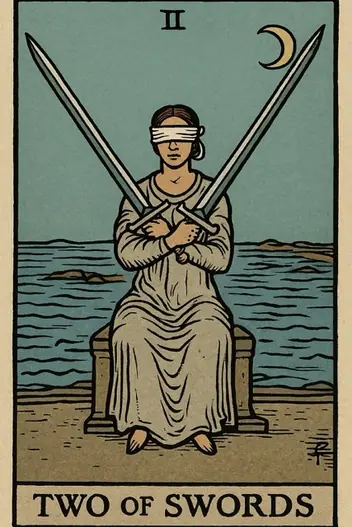
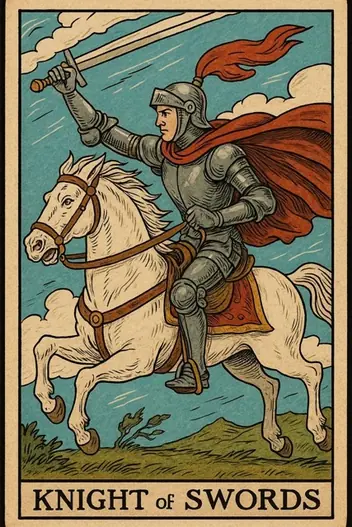
The intersection of the Two of Swords and the Knight of Swords represents a psychological collision between paralyzing indecision and reckless acceleration. The Two of Swords embodies a state of deliberate blindness—a conscious choice to avoid a painful truth or a difficult choice. The Knight of Swords, conversely, is the archetype of the intellectual crusader, charging forward with sharp logic and unyielding determination, often without considering the consequences.
When these two archetypes meet in a reading, the core dynamic is a forced breakthrough. The Knight’s energy cuts through the Two’s defensive fog, demanding immediate action. This is not a gentle awakening; it is a cognitive dissonance event where the seeker can no longer maintain their comfortable stalemate. The psychological challenge is to channel the Knight’s drive into a strategic, rather than impulsive, decision—using clarity as a tool, not a weapon.
Core Dynamics & Interpretation
The central psychological state created by this combination is urgent ambivalence. You simultaneously know you must act and feel terrified of the consequences of that action. The Two of Swords represents the mind’s attempt to compartmentalize conflicting information—holding two opposing truths at bay to maintain the illusion of control. The Knight of Swords then arrives as the intrusive thought or external event that shatters that illusion.
In practical terms, this manifests as a situation where delaying a decision is no longer an option. A deadline looms, a truth is exposed, or a person forces the issue. The Knight’s energy can be constructive here if you consciously choose to use logic and direct communication to cut through the stalemate. However, the risk is high: the Knight’s speed can lead to premature commitment or a verbal attack that damages relationships. The key insight is to harness the Knight’s clarity without adopting its ruthlessness. Recognize that your paralysis (Two of Swords) is often rooted in a fear of making the wrong choice, while the Knight’s charge is fueled by the belief that any choice is better than none. The integrated path involves a rapid, honest assessment of the facts you have been avoiding, followed by a decisive but measured next step.
Your pair is already on the table. Ask your question and draw the clarifying card
or simply focus on it
What Do Two of Swords and Knight of Swords Indicate for Your Career?
Strategic Opportunities:
This energy is excellent for breaking through bureaucratic deadlock or launching a new initiative that has been stalled. Use the Knight’s directness to send a decisive email or make a critical phone call.
Strategic Opportunities:
It favors roles requiring rapid analysis and clear communication, such as crisis management, legal work, or competitive strategy. Leverage your sharp instincts to identify a market gap.
Calculated Risks:
Avoid signing contracts or making major financial commitments while in this energy. The Knight’s speed can lead to overlooking fine print or undervaluing long-term risk. Do not let impatience override due diligence.
In the professional realm, this card combination is a double-edged sword. The Two of Swords often appears when you are weighing two career paths or avoiding a difficult conversation with a boss or colleague. The Knight of Swords then provides the mental energy to finally decide—but the quality of that decision depends entirely on your emotional state. Financially, this is a time for decisive action, not paralysis. If you have been sitting on cash or delaying an investment, the Knight’s energy may push you to act. The critical financial warning is to separate speed from recklessness. Use the Knight’s analytical power to rapidly gather data, but impose a 24-hour rule before executing any major transaction. In negotiations, you will be sharp and persuasive, but risk coming across as combative or dismissive. Frame your arguments as solutions, not attacks. The best career advice is to choose the option that offers the most clarity, even if it is the harder path.
Deepen your understanding
Find out exactly what this reading means for your current life situation with our oracle.
What Do Two of Swords and Knight of Swords Say About Love?
If you are single:
This combination suggests you may be idealizing or avoiding a potential partner. The Knight of Swords warns against rushing into a relationship based on intellectual attraction alone. Take a calculated pause: is this genuine chemistry, or just a desire to end your emotional stalemate?
If you are in a relationship:
Expect a confrontation or a forced conversation. One partner (or the dynamic itself) is pushing for a resolution on a long-ignored issue. Beware of using harsh words as a defense mechanism.
In relationships, the Two of Swords and Knight of Swords combination signals a crisis of communication. The Two of Swords indicates someone who is emotionally unavailable or actively refusing to see the truth about the partnership. The Knight of Swords then represents the partner who demands answers or the external event that exposes the lie. The most important relationship advice here is to avoid the trap of "winning the argument." The Knight excels at debate, but relationships require emotional safety, not intellectual victory. If you are the Knight figure, slow down and ask open-ended questions. If you are the Two of Swords, recognize that your silence is a form of aggression. The path forward requires a structured, honest dialogue where both parties agree to temporarily set aside blame and focus on shared facts. This combination often appears before a breakup or a major renegotiation of terms—it is a turning point, not an end point.
Two of Swords and Knight of Swords: Warning Signs
The shadow of this combination is intellectual arrogance and cognitive rigidity. When the Knight’s energy is blocked or misdirected, the seeker becomes a dogmatic ideologue—using logic to justify harmful actions or to silence valid emotional concerns. The Two of Swords’ shadow, meanwhile, is passive-aggressive avoidance or willful ignorance. Together, they create a perfect storm of self-sabotage through over-analysis or rash judgment.
A common pitfall is the cognitive bias of false urgency. The Knight of Swords creates a sense of crisis, but the Two of Swords’ paralysis often stems from a deeper fear that has nothing to do with the present situation. You may act impulsively to escape the discomfort of not knowing, rather than to solve the actual problem. Another shadow manifestation is the "truth bomb" —using the Knight’s directness to hurt someone under the guise of honesty. Beware of confusing cruelty with clarity. If you feel a compulsion to "tell it like it is" without regard for timing or empathy, you are in the shadow. The psychological corrective is to integrate the Two of Swords' need for reflection with the Knight’s drive for action. Ask yourself: "Is this decision driven by a genuine need, or by a fear of remaining in limbo?"
What If Two of Swords or Knight of Swords Appears Reversed?
When cards appear in reversed positions, the dynamics become distorted, but they do not disappear. These are not "bad" cards, but rather an indication that the energy is working against you.
If the Two of Swords is reversed:
This is a removal of the blindfold, but not toward clarity—toward panic. The defense has collapsed, and you see a reality you are not prepared for. Advice: do not give in to the urge to immediately run and fix everything. First—acknowledge the scale of it.
If the Knight of Swords is reversed:
This is sabotage and chaos. The impulse to act is present, but it is directed inward (self-criticism) or into a void (pointless busyness). Warning: this is the "hamster wheel" state—you are very busy, but achieving nothing. A complete stop is required.
If BOTH are reversed:
Complete imbalance—paralysis of will. You can neither make a decision (Two) nor take action (Knight). Method of correction: artificially lower the bar. Your task is not a great breakthrough, but one micro-action: write one letter, make one phone call. Break the cycle of inaction through minimal effort.
What Is the Overall Message of Two of Swords and Knight of Swords?
How to constructively use this energy? You need to transform the Two of Swords from a source of paralysis into a tool of focus, and the Knight of Swords from a destroyer into a creator. The strategy here is "Controlled Breakthrough." You must consciously limit your time for reflection. Give yourself 24 hours for analysis (Two), and once that time is up—act without looking back (Knight). Do not wait for the perfect moment; it does not exist.
A deep strategic piece of advice: use the Knight's energy for "clearing the rubble." Often, we cannot make a decision because we have too many options. The Knight of Swords is the ideal tool for surgically removing everything superfluous. Reject three out of five options. Fire the client who drains resources. Shut down the unpromising project. When you cut away the excess, the Two of Swords ceases to be a problem—you will simply see the one true path, and the Knight will lead you along it at maximum speed.
The key to synthesis lies in the discipline of choice. Do not let the Knight's impulse control you, but do not let the Two's fear paralyze you either. Become the one who consciously chooses: "I see the risks (Two), and I consciously embrace them (Knight)." Only in this union is true power born—the power of conscious, swift, and precise action.
Applying This to Your Situation
The core message of the Two of Swords and Knight of Swords is that you can no longer afford to stay in the middle ground. A decision is being forced upon you, and while the Knight’s energy offers speed, the Two of Swords reminds you that true clarity requires a willingness to see what you have been avoiding. Your next step is to identify one specific truth you have been ignoring and address it with direct, honest communication—not as an attack, but as a necessary move toward resolution.
This article provides the general archetype, but the true magic happens when Tarot is applied to your unique situation. The Fortune Cards app can give you a deep, personalized interpretation of this exact combination for your specific question right now. Whether you are facing a career crossroads, a relationship crisis, or an internal block, the app helps you move from abstract meaning to actionable insight. Use it on the web or download it now to get the clarity you need.
Interpretation by the Fortune Cards editorial team, based on the Rider–Waite tradition and Jungian archetypes. About our methodology · Updated: 2026-08-26
Other Combinations with Two of Swords
Other Combinations with Knight of Swords
Explore Individual Card Meanings
Table of Contents
- Core Dynamics & Interpretation
- What Do Two of Swords and Knight of Swords Indicate for Your Career?
- What Do Two of Swords and Knight of Swords Say About Love?
- Two of Swords and Knight of Swords: Warning Signs
- What If Two of Swords or Knight of Swords Appears Reversed?
- What Is the Overall Message of Two of Swords and Knight of Swords?
- Applying This to Your Situation
Ready to find answers to your questions?
Start your first reading now and look at your situation with fresh clarity. The cards are ready to reveal deeper meaning.