Three of Cups and Two of Swords Tarot as Feelings

- Arcana
- Three of Cups — Minor Arcana, Cups; Two of Swords — Minor Arcana, Swords
- Elements
- Three of Cups — Water; Two of Swords — Air
- Elemental interaction
- Neutral elements — energies coexist without conflict
- Numerology
- 3 + 2 = 5
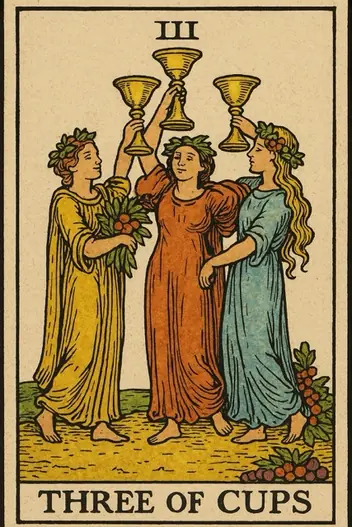
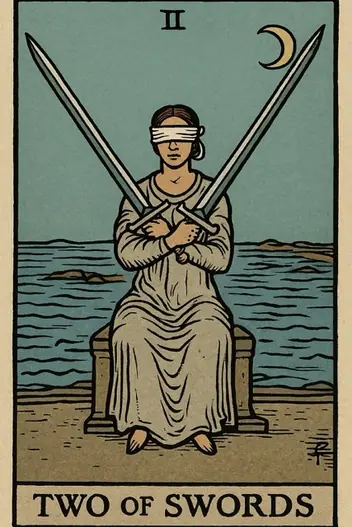
This combination presents a powerful psychological paradox: the Three of Cups represents emotional connection, shared joy, and social bonding, while the Two of Swords embodies deliberate isolation, mental stalemate, and the refusal to see or choose. When these archetypes collide, the seeker is often caught between the desire for communal warmth and the need for protective distance.
The core conflict here is not between people, but within the self. You may be attending the party while wearing a blindfold—physically present but emotionally unavailable. This is a state of cognitive dissonance, where your social self performs harmony while your inner critic demands a decision. The strategic question is: are you protecting yourself from a painful truth, or are you avoiding the vulnerability required for genuine connection?
What Do Three of Cups and Two of Swords Mean Together?
The psychological state created by this pairing is one of selective blindness in a social context. The Three of Cups energy wants to celebrate, network, and enjoy mutual support, but the Two of Swords energy insists on a pause. This is not a time for spontaneous joy; rather, it is a strategic retreat into observation. You are likely weighing the cost of emotional exposure against the safety of social distance.
This combination often appears when a person is managing a public persona that masks private confusion. You may have a supportive friend group or a loving family, yet feel profoundly alone in your decision-making. The key insight here is that your refusal to choose is itself a choice—one that keeps you in a holding pattern. The Two of Swords demands that you eventually lower your defenses and see clearly, but the Three of Cups offers the safety net of community to catch you when you do.
The real-world implication is a conflict between loyalty and truth. You may be avoiding a difficult conversation with a friend or partner because you fear disrupting the group’s harmony. However, this avoidance only deepens the internal divide. The healthiest path forward is to use your social support system as a sounding board, not a hiding place. Let trusted allies help you remove the blindfold, rather than pretending the blindfold isn’t there.
Career and Finances
Strategic Opportunities:
Leverage your network for objective advice. A trusted colleague or mentor can help you see the blind spots in a current project or negotiation.
Strategic Opportunities:
Use team meetings to break a decision deadlock. The Three of Cups energy can turn a solitary analysis into a collaborative solution.
Calculated Risks:
Avoid making financial commitments based on social pressure. Do not invest in a venture just because friends are involved. The Two of Swords warns you to verify facts independently.
In a professional context, this combination signals a clash between collaboration and confidentiality. You may be part of a high-functioning team (Three of Cups) yet feel paralyzed by a confidential decision you must make alone (Two of Swords). This is common in leadership roles, creative partnerships, or startup environments where group morale depends on your individual clarity.
The strategic tip is to separate process from outcome. Use the group for brainstorming and emotional support, but reserve the final decision for yourself. Financially, this is a red flag for groupthink. If everyone around you is celebrating a deal, but your gut says pause, trust the Two of Swords’ instinct to wait. Do not let camaraderie override due diligence. A delayed decision is better than a regretful one.
Your pair is already on the table. Ask your question and draw the clarifying card
or simply focus on it
Love and Relationships
If you are single:
This pair suggests you are evaluating a potential partner through a filter of past disappointments. You may be attending social events but keeping everyone at arm’s length, waiting for proof of trust that you refuse to request.
If you are in a relationship:
There is likely an unspoken tension regarding a third party (a friend, family member, or ex). You and your partner may be avoiding a critical discussion about boundaries or social obligations.
The relationship dynamics here are defined by emotional intelligence under duress. One partner may be craving more social integration (Three of Cups), while the other is withdrawing into a defensive shell (Two of Swords). This is a classic pursuer-distancer pattern that, if unaddressed, can erode intimacy. The key relationship advice is to schedule a neutral, low-stakes conversation about your social needs and fears. Do not wait for the perfect moment; the Two of Swords thrives on procrastination.
Bold action required:
If you feel stuck, write down the specific question you are avoiding. Then, ask your partner to read it without judgment. This externalizes the decision and breaks the stalemate. Remember, the Three of Cups can heal the Two of Swords’ isolation, but only if you let your guard down intentionally.
Three of Cups and Two of Swords: Warning Signs
The shadow of this combination manifests as performative happiness masking deep indecision. You may smile at the party while your mind screams for escape. This is a form of emotional dishonesty that can lead to burnout or passive-aggressive behavior. The cognitive bias at play is the “spotlight effect” —you believe everyone is watching you, so you fake joy to avoid scrutiny.
Self-sabotage arises when you use social obligations as an excuse to avoid personal choices. You might stay in a draining relationship because “the group expects us to be together,” or accept a job offer because “everyone thinks it’s a great opportunity.” The Two of Swords’ blindness becomes willful ignorance. The pitfall is letting external harmony replace internal truth.
Another risk is over-reliance on others for validation. The Three of Cups can become a crutch, where you seek consensus before making any move. This dilutes your personal authority and prolongs the stalemate. If you find yourself constantly asking, “What would my friends do?” instead of “What do I want?”—you are in the shadow of this pair.
Get a personalized interpretation
Unlock the combined meaning of your cards in the context of your unique question — for free.
What If Three of Cups or Two of Swords Appears Reversed?
If the Three of Cups is reversed:
The social instinct turns into toxic loneliness or envy. You are not just avoiding a decision — you are actively sabotaging the successes of others. Instead of feeling joy for your friends, you feel bitterness. Advice: Stop comparing yourself to others. Your indecisiveness is not a weakness, but a signal that you are not on your true path.
If the Two of Swords is reversed:
The protective paralysis shifts to impulsive, ill-considered action. You tear the blindfold from your eyes, but instead of gaining a clear view, you make a rash move that you will later regret. Warning: Do not act rashly. Your sudden decision is a reaction to accumulated tension, not the result of analysis.
If BOTH are reversed:
This is a complete imbalance — social isolation combined with panic. You simultaneously refuse the support of friends and are unable to make a decision. A logical way to correct it: Artificially create a deadline for yourself. Tell someone that you will make a decision in 3 days. This will force you to act, even if you don't feel ready.
Three of Cups and Two of Swords Combined Message
How can the energy of the Three of Cups be used constructively to balance the Two of Swords? The answer lies in reprogramming the social instinct. Instead of seeking oblivion in the company of friends, use them as a focus group for your decision. Gather 2-3 trusted individuals (not the whole company, but those whose judgment you respect) and conduct a structured discussion. But before that — write your decision down on paper. This is crucial: you must come to them not with the question "What should I do?", but with the statement "I plan to do X, what do you think about it?". This shifts you from victim mode (Two of Swords) to leader mode (Three of Cups).
Your strategic task is to transform social pleasure into social capital. The Three of Cups is not about mindless fun, but about building alliances. Use these alliances to test hypotheses. Ask yourself: "What decision would I make if I didn't care what others thought?". Write down the answer. Then ask: "What decision would I make if I wanted to maximize benefit for everyone?". Compare the two answers. The gap between them is your growth zone. It is in this zone that the Two of Swords ceases to be paralysis and becomes a tool for a balanced, ethical, and socially intelligent choice. You are neither a victim of circumstance nor a passive partygoer — you are the architect of your social environment.
Your Next Step: Personal Context Matters
The core message of Three of Cups and Two of Swords is this: you can be surrounded by love and still feel paralyzed by a single decision. The solution is not to choose between people and solitude, but to use your community as a lens, not a shield. Remove the blindfold, speak your truth, and trust that the bonds you’ve built can handle the weight of your honesty.
This article offers a general archetype, but your specific question deserves a personalized reading. The Fortune Cards app allows you to apply this exact combination to your unique situation—whether it’s a relationship dilemma, a career crossroads, or a financial decision. You can use the app on the web or download it to get a deep, tailored interpretation right now. Stop analyzing in isolation; let the cards speak directly to your life.
Interpretation by the Fortune Cards editorial team, based on the Rider–Waite tradition and Jungian archetypes. About our methodology · Updated: 2026-08-26
Other Combinations with Three of Cups
Other Combinations with Two of Swords
Explore Individual Card Meanings
Table of Contents
Ready to find answers to your questions?
Start your first reading now and look at your situation with fresh clarity. The cards are ready to reveal deeper meaning.