Two of Swords
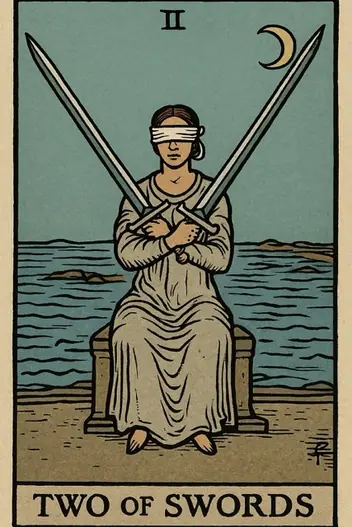
- Arcana
- Minor Arcana, Suit of Swords
- Element
- Air
- Decan
- the Moon in Libra
- Numerology
- 2
The Two of Swords represents a critical psychological crossroads: the moment when an individual consciously chooses to ignore a painful truth in order to maintain a fragile internal peace. From a Jungian perspective, this card embodies the Shadow of Denial—where the conscious mind erects a barrier against uncomfortable realities, creating a state of suspended judgment. This is not a card of ignorance, but of deliberate avoidance, a strategic retreat from decision-making that carries significant long-term costs.
The core challenge of the Two of Swords is the illusion of safety through inaction. While the figure sits blindfolded, holding two crossed swords, she appears balanced—but this balance is static, not dynamic. It represents a stalemate in the psyche, where opposing forces are held in check at the expense of forward momentum. The card asks a brutal question: What are you refusing to see, and what is the price of that blindness?
Main Dynamics and Interpretation
The Two of Swords depicts a psychological state of defensive neutrality. The subject has withdrawn sensory input (the blindfold) to avoid the emotional pain of choosing between two equally difficult options. This is a coping mechanism, not a solution. The crossed swords symbolize a logical impasse—two valid arguments that cannot be reconciled without deeper self-awareness. In practical terms, this card signals a period where the mind prioritizes internal stability over external reality.
The resource this card offers is temporary respite. It allows for a pause to gather strength, but only if the pause is recognized as temporary. The danger lies in mistaking this hiatus for a permanent state. The strategic action here is to acknowledge the blindfold for what it is: a self-imposed limitation. The card urges you to identify the core fear driving the avoidance—whether it is fear of loss, fear of conflict, or fear of failure. The longer you delay, the more the crossed swords will weigh on your psyche, creating chronic anxiety and decision paralysis.
Ask your question and flip the cards
or simply focus on it
Two of Swords: Yes or No?
No.. The Two of Swords embodies a stalemate—a conscious refusal to choose between two equally fraught options, making a clear “yes” impossible. Psychologically, this card represents the defense mechanism of emotional numbing: the querent has bandaged their eyes to avoid seeing a painful truth, and until that blindfold is removed, action is paralyzed. In a yes/no reading, the energy is one of deliberate suspension, not consent or forward movement. Reversed, the answer shifts to Leaning yes, as the blindfold begins to slip, forcing a confrontation with reality and a decision that, while uncomfortable, breaks the impasse. Critical caveat: the outcome depends entirely on whether the querent is willing to tolerate the short-term pain of clarity over the long-term stasis of avoidance.
Uncover hidden insights
Let our advanced Tarot system interpret these archetypes specifically for your personal path.
What Does Two of Swords Mean for Your Day?
The Two of Swords signals a day where your mind will be split between two competing priorities or loyalties, demanding a choice you are not ready to make. Focus on gathering all relevant information without rushing to judgment—this is a day for observation, not action. Your task is to name the emotional weight behind each option, not to decide which one to carry. Avoid the trap of pretending the conflict doesn’t exist by staying busy or numbing out with distractions, as this only deepens the impasse. Beware of projecting decisiveness onto others to avoid your own internal work.
Love and Relationships
If you are not in a relationship:
This card suggests you are protecting yourself from vulnerability by maintaining emotional distance. You may be avoiding potential partners because you fear the conflict that intimacy requires. The blindfold here is a shield against rejection, but it also blocks genuine connection.
If you are in a relationship:
You are likely in a stalemate with your partner, avoiding a difficult conversation about a core issue—trust, commitment, or values. The crossed swords represent unspoken grievances that are growing heavier.
In relationships, the Two of Swords manifests as emotional gridlock. Both parties may be waiting for the other to make the first move, creating a silent standoff. The key practical advice here is to name the elephant in the room. Avoidance does not resolve conflict; it merely postpones it, often making it more explosive when it finally surfaces. Schedule a structured conversation where both partners agree to speak without interruption, using "I feel" statements to avoid blame. This card rewards emotional courage, not tactical silence.
Two of Swords as Feelings: What They Think of You
This person perceives you as a figure of unresolved tension—someone who holds the key to a decision they are terrified to make. You evoke both deep intellectual respect and emotional distance; they see you as calm and composed, possibly even icy, which makes them feel both drawn to your stability and intimidated by your potential to force a confrontation. Their hidden intention is to keep you at arm’s length, using a cordial but guarded demeanor to avoid revealing their own vulnerability or preference. Underneath, they fear that if they let you in, they will lose the illusion of control over the situation—and they are not ready to face what that loss would mean. There is a sharp internal conflict: they want your clarity, but they also dread that your presence will shatter the comfortable ambiguity they have built around themselves.
What Does Two of Swords Mean for Work and Money?
Strategic Opportunities:
Leverage this pause for data collection. Use the stalemate to gather more information, consult mentors, or run scenarios. The Two of Swords offers a window for calculated observation before action.
Resource Management:
Re-evaluate your professional boundaries. This card often appears when you are overcommitted or stuck in a role that conflicts with your values. The blindfold may be hiding a career misalignment that needs addressing.
Calculated Risks:
Avoid making major financial commitments during this period. The indecision of the Two of Swords can lead to impulsive choices when pressure mounts. Do not sign contracts or invest capital until the blindfold is removed.
In professional settings, this card signals a decision bottleneck—either you are avoiding a difficult choice (e.g., firing a problematic employee, pivoting a project) or you are paralyzed by competing priorities. The practical framework is to break the decision into smaller, reversible steps. For instance, instead of choosing between two job offers, negotiate a trial period with one. Bold financial warning: Do not let the comfort of indecision drain your resources through missed deadlines or lost opportunities. The cost of inaction is often higher than the cost of a wrong choice.
Reversed Positions: What Changes?
When the Two of Swords appears reversed, the blindfold is ripped off—but not always by choice. This reversal signals a forced confrontation with the reality you have been avoiding. The psychological state shifts from denial to overwhelm. Information that was suppressed now floods in, creating a crisis of clarity. The reversed card often appears when an external event—a betrayal, a financial loss, or a medical diagnosis—shatters the illusion of control.
The blocked potential here is the inability to integrate new information without panic. Instead of the stagnant balance of the upright card, the reversed Two of Swords brings emotional turbulence. You may feel exposed, vulnerable, and pressured to act before you are ready. The corrective action is to slow down the processing speed. Do not make snap decisions; instead, use a structured decision-making framework (e.g., list pros and cons, consult a trusted advisor, set a 48-hour cooling-off period). The warning is clear: Do not let the shock of truth push you into reactive choices that compound the original problem.
The Shadow Side of Two of Swords
The shadow of the Two of Swords is willful ignorance elevated to a lifestyle. This manifests as cognitive dissonance—holding two contradictory beliefs without attempting to resolve them. For example, knowing a relationship is toxic but staying because of fear of being alone, or knowing a job is unsustainable but refusing to update a resume. The psychological cost is chronic low-grade anxiety and a weakened sense of agency.
Another shadow manifestation is intellectualization—using logic to avoid emotional engagement. The crossed swords become a defense mechanism where you analyze endlessly without acting, mistaking analysis for resolution. This can lead to perfectionism, where you wait for the "perfect" option that never arrives. The cognitive bias at play is status quo bias: the tendency to prefer the current state over change, even when change is beneficial. To counter this, set a hard deadline for your decision and commit to making a choice, even if imperfect. The paralysis of the Two of Swords is a luxury you cannot afford indefinitely.
Synthesis: What It All Adds Up To
The Two of Swords is a card of necessary discomfort. Its energy is not meant to be a permanent residence but a temporary shelter. To use it constructively, you must recognize the strategic value of the pause while simultaneously planning your exit strategy. The blindfold is a tool, not a solution—use it to filter out noise, not to block out truth. The key insight is that true peace comes from resolution, not avoidance.
Your next step is to identify the single decision you are avoiding and break it down into actionable components. Ask yourself: What is the worst-case scenario if I choose? What is the cost of not choosing? Often, the fear of the unknown is worse than the reality of a wrong decision. The Two of Swords rewards calculated courage—the willingness to remove the blindfold, face the swords, and choose anyway. Remember: the crossed swords are not weapons; they are tools. You are the one holding them.
Your Next Step: Personal Context Matters
This psychological and strategic breakdown provides a deep understanding of archetypes. However, Tarot is never universal for everyone. To understand exactly how this dynamic applies to your specific situation, a reading tailored exclusively to you is necessary.
Download the Fortune Cards app or visit our platform to get a deep AI interpretation of your unique spread. Don't just read about the cards—use Fortune Cards to find out exactly what step you need to take next.
Try Tarot Spreads with Two of Swords
Interpretation by the Fortune Cards editorial team, based on the Rider–Waite tradition and Jungian archetypes. About our methodology · Updated: 2026-08-26
Top Combinations with Two of Swords
Discover how Two of Swords interacts with other major cards in the deck to form powerful messages.
All 77 Combinations with Two of Swords
Discover how this card interacts with every other card in the Tarot deck and reveal hidden meanings.
Table of Contents
- Main Dynamics and Interpretation
- Two of Swords: Yes or No?
- What Does Two of Swords Mean for Your Day?
- Love and Relationships
- Two of Swords as Feelings: What They Think of You
- What Does Two of Swords Mean for Work and Money?
- Reversed Positions: What Changes?
- The Shadow Side of Two of Swords
- Synthesis: What It All Adds Up To
- Your Next Step: Personal Context Matters
Explore Tarot Universe
Ready to find answers to your questions?
Start your first reading now and look at your situation with fresh clarity. The cards are ready to reveal deeper meaning.