Two of Swords and Eight of Swords Together in Tarot
- Arcana
- Two of Swords — Minor Arcana, Swords; Eight of Swords — Minor Arcana, Swords
- Elements
- Two of Swords — Air; Eight of Swords — Air
- Elemental interaction
- Same element — energies intensify each other
- Numerology
- 2 + 8 = 10 → 1
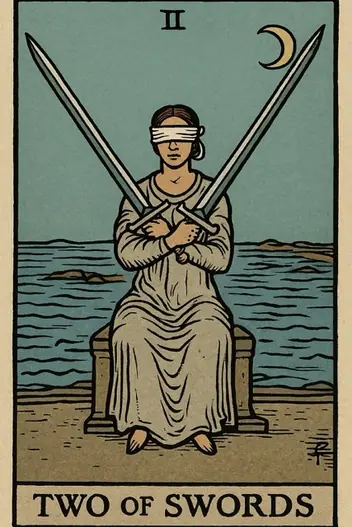
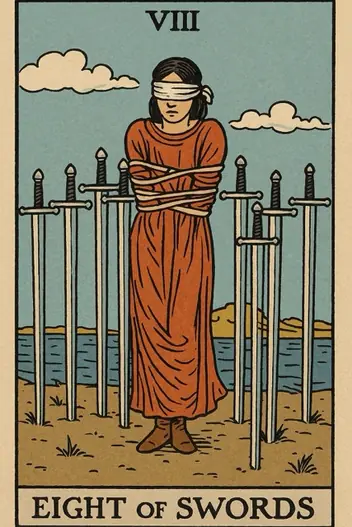
When the Two of Swords—the card of willful blindness and blocked decision-making—collides with the Eight of Swords—the card of self-imposed restriction and victim mentality—we encounter a potent psychological trap. This pairing represents a mind that is both refusing to see and actively imprisoning itself. The core conflict is not external circumstance, but an internal war between fear of choice and fear of consequence.
In practical terms, this combination often appears when a person knows they must make a decision (Two of Swords) but feels so bound by their own limiting beliefs that they believe no good options exist (Eight of Swords). The result is cognitive paralysis: a state where the seeker’s intellect is weaponized against itself, creating a feedback loop of inaction and self-blame. The swords here are not tools of clarity, but bars of a mental cage.
Two of Swords and Eight of Swords Combination Meaning
The psychological state of the Two of Swords plus Eight of Swords is best described as "analysis paralysis meets learned helplessness." The Two of Swords represents a deliberate turning away from facts—the seeker may have their hands over their ears, refusing to hear the truth. The Eight of Swords adds the belief that escape is impossible, that they are trapped by forces beyond their control. Together, they create a narrative of voluntary victimhood: the person is both the jailer and the prisoner.
This is not a time for external action; it is a time for internal cognitive restructuring. The key insight is that the perceived "swords" blocking the path are often mental constructs—past traumas, social conditioning, or irrational fears. The real barrier is the refusal to look at the situation objectively. The Eight of Swords suggests the seeker has tied themselves up with their own beliefs about what they "cannot" do, while the Two of Swords indicates they are refusing to even examine those knots.
For practical growth, the seeker must first acknowledge that their sense of entrapment is largely self-generated. The Eight of Swords’ blindfold is self-applied; the Two of Swords’ blindfold is a choice. The path forward requires a brutal, compassionate honesty: "What am I refusing to see, and why am I so afraid to see it?" Once this question is answered, the swords can become tools of liberation rather than confinement.
Career Meaning of Two of Swords and Eight of Swords
Strategic Opportunities:
Identify which "rules" or "limitations" in your current job or project are real and which are self-imposed. Challenge one limiting belief per week (e.g., "I can't ask for a raise" → "What if I prepared a case and asked?").
Strategic Opportunities:
Use the paralysis as a signal to gather more data. Schedule a "truth audit" —review your finances or career path with a mentor, therapist, or spreadsheet. Clarity kills fear.
Calculated Risks:
Avoid making any major financial or career decisions while in this state. Do not quit, invest, or commit under duress. The Eight of Swords warns that your perception of "no options" is distorted.
Professionally, this combination warns against decision-making from a place of perceived scarcity. The Two of Swords suggests you may be ignoring warning signs in a job, contract, or financial plan because you fear the consequences of acting. The Eight of Swords amplifies this by convincing you that you have no leverage or alternatives. The practical truth is that most career "traps" are actually self-constructed. You may feel stuck in a job, but you are likely undervaluing your own skills or failing to network. Financially, avoid the trap of "all or nothing" thinking—you do not need to solve everything at once. Start with one small, concrete action (e.g., update your resume, call a recruiter, or audit your spending) to break the mental gridlock.
Your pair is already on the table. Ask your question and draw the clarifying card
or simply focus on it
Two of Swords and Eight of Swords in Love Tarot
If you are single:
This combination suggests you are avoiding a difficult truth about a potential partner or your own readiness. Your fear of rejection is masquerading as "not being ready." The real barrier is your unwillingness to face the vulnerability of a new connection.
If you are in a relationship:
You and your partner may be stuck in a cycle of unspoken resentments and perceived powerlessness. One or both of you are refusing to address a core issue, believing that change is impossible or that the other person will not listen.
In relationships, this pairing often manifests as emotional stalemate. The Two of Swords indicates a deliberate avoidance of conflict—perhaps you know a difficult conversation is needed but you "choose" not to see it. The Eight of Swords suggests you feel trapped by the relationship dynamics, yet you cannot see how your own inaction maintains the prison. The most important relationship advice here is this: your silence is not protecting you; it is prolonging your suffering. The solution is to name the unspoken issue, even if it feels terrifying. The fear of the conversation is almost always worse than the conversation itself. Boundaries are not walls; they are doors you choose to open.
What Are the Risks of Two of Swords and Eight of Swords?
The shadow of this combination is cognitive dissonance and self-sabotage. The seeker may unconsciously prefer the pain of the known (feeling stuck) over the fear of the unknown (making a choice). This manifests as rationalizing inaction: "I can't leave because of X," "I'm not ready because of Y," or "It's not the right time." These are the Eight of Swords’ bindings, reinforced by the Two of Swords’ refusal to examine them.
Common cognitive biases here include confirmation bias (only seeing evidence that supports your helplessness) and catastrophizing (imagining worst-case scenarios that justify inaction). The seeker may also fall into learned helplessness, where past failures convince them that future efforts are futile. The most dangerous pitfall is mistaking self-protection for self-preservation. By refusing to see the truth, you are not protecting yourself; you are ensuring the problem persists. The shadow also includes passive-aggressive behavior in relationships—silently punishing a partner for a situation you refuse to address.
Ask your specific question
Don't rely on generic meanings. Get a customized reading tailored specifically to your energies.
What If Two of Swords or Eight of Swords Appears Reversed?
If the Two of Swords is reversed:
The blindfold falls, but not by your will. The truth you have been ignoring comes crashing down upon you. This may be painful, but it is your only chance for a breakthrough. Do not try to close your eyes again — use the information for a leap forward.
If the Eight of Swords is reversed:
You have realized your limitations are an illusion, but have fallen into another extreme — recklessness. You are cutting the "binding swords" without thinking of the consequences. Advice: Take action, but do not burn your bridges. Use your newfound freedom for a strategic maneuver, not for chaotic flight.
If BOTH are reversed:
Complete imbalance. You have emerged from your stupor, but are acting impulsively and inconsistently. Correction: You need a pause, not for avoidance, but for structuring the chaos. Create a 3-step plan and follow it strictly, without giving in to emotions.
What Is the Overall Message of Two of Swords and Eight of Swords?
Constructive use of this energy requires a radical shift in focus from "why" to "how". The Two of Swords is fixated on causes and effects, the Eight on impossibility. Your task is to break this loop by asking yourself a single question: "What is the smallest step I can take right now?"
Do not attempt to solve the entire problem at once. Remove the blindfold by taking a micro-action: send one email, ask one question, write down one idea. This act will shatter the illusion of powerlessness. As soon as you see that the world hasn't collapsed, the cage of the Eight of Swords will vanish.
Strategically, the Two of Swords must become a scalpel, not a shield. Use your analytical skills not to avoid, but to precisely and swiftly cut away non-viable options. Your strength now lies in the speed of decision-making, not its depth. Depth will come later, after the first step.
Your Next Step: Personal Context Matters
The core message of the Two of Swords and Eight of Swords is that your prison is largely of your own making, and your freedom begins with a single, honest look at your own mind. The swords are not your enemies; they are tools for cutting through illusion. The question is not "How do I escape?" but "What am I refusing to see?" The answer will unlock the door.
While this article provides a deep, archetypal understanding of this combination, the true power of Tarot lies in its personal application. Your specific situation—your relationships, your career, your fears—adds layers of meaning that no general interpretation can capture. To get a deep, personalized interpretation of the Two of Swords and Eight of Swords for your exact question, use the Fortune Cards app. Whether on the web or downloaded, it applies these psychological insights to your unique context, helping you break free from paralysis and take your next step with clarity.
Interpretation by the Fortune Cards editorial team, based on the Rider–Waite tradition and Jungian archetypes. About our methodology · Updated: 2026-08-26
Other Combinations with Two of Swords
Other Combinations with Eight of Swords
Explore Individual Card Meanings
Table of Contents
- Two of Swords and Eight of Swords Combination Meaning
- Career Meaning of Two of Swords and Eight of Swords
- Two of Swords and Eight of Swords in Love Tarot
- What Are the Risks of Two of Swords and Eight of Swords?
- What If Two of Swords or Eight of Swords Appears Reversed?
- What Is the Overall Message of Two of Swords and Eight of Swords?
- Your Next Step: Personal Context Matters
Ready to find answers to your questions?
Start your first reading now and look at your situation with fresh clarity. The cards are ready to reveal deeper meaning.