Two of Swords and Four of Swords Meaning in Tarot
- Arcana
- Two of Swords — Minor Arcana, Swords; Four of Swords — Minor Arcana, Swords
- Elements
- Two of Swords — Air; Four of Swords — Air
- Elemental interaction
- Same element — energies intensify each other
- Numerology
- 2 + 4 = 6
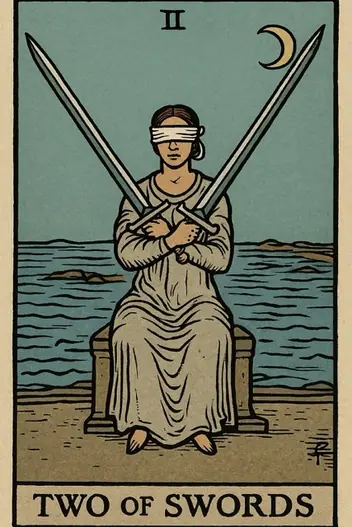
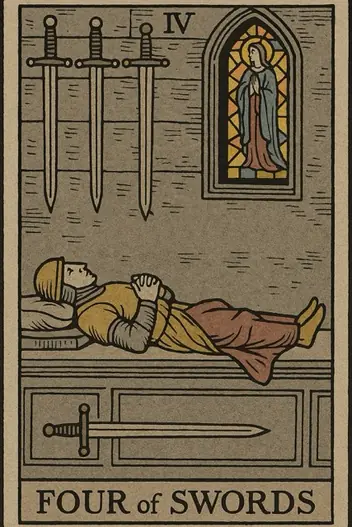
When the Two of Swords—a card of deliberate blindness and forced choice—meets the Four of Swords—a card of mental retreat and recuperation—the result is a powerful psychological impasse. This combination signals a period where the mind is overwhelmed by a binary decision, yet the unconscious demands a complete shutdown before any progress can be made. It is not a time for action, but for strategic withdrawal to avoid self-inflicted mental injury.
In pragmatic terms, this pairing describes a situation where you know you must choose between two paths, but your cognitive resources are depleted. The Four of Swords insists that you cannot think your way out of this; you must rest your way into clarity. This is the archetype of the wounded analyst—someone who has over-analyzed a problem to the point of paralysis, now forced into a period of enforced stillness.
Two of Swords and Four of Swords Together: Meaning
The core dynamic here is a battle between conscious reasoning and the need for unconscious integration. The Two of Swords represents a mind holding two conflicting truths at arm's length, refusing to see the full picture. The Four of Swords then steps in to say, "Stop trying to see. You are too exhausted to perceive accurately." This is not a failure of logic, but a necessary circuit-breaker for the psyche.
Psychologically, this combination reveals a cognitive dissonance so strong that the ego chooses numbness over resolution. The seeker may be avoiding a painful truth (Two of Swords) by retreating into mental isolation (Four of Swords). The key insight is that this retreat is not cowardice; it is triage. You are protecting your mental bandwidth from further depletion. The real work is not to force a decision, but to restore your capacity to make one.
The practical implication is clear: do not make any irreversible decisions while in this state. Your judgment is clouded by fatigue and avoidance. Instead, use this time to create strict boundaries around your mental energy. Limit exposure to the triggering situation. This is a time for controlled disengagement, not surrender.
Your pair is already on the table. Ask your question and draw the clarifying card
or simply focus on it
Two of Swords and Four of Swords as Feelings
If you are single:
This combination suggests you are emotionally unavailable because you are mentally exhausted, not because of disinterest. Do not force a connection. You need to heal your own internal conflict before you can see a new partner clearly.
If you are in a relationship:
You and your partner may be locked in a silent standoff, each refusing to break the deadlock. The relationship needs a ceasefire, not a winner. Prioritize a period of low-contact emotional rest before attempting any difficult conversation.
In relationships, the Two of Swords and Four of Swords point to a dangerous dynamic of emotional avoidance. One or both partners are choosing to "not see" a core issue (Two of Swords) by retreating into separate mental or physical spaces (Four of Swords). This is not a healthy boundary; it is a wall built from fear. The relationship will not survive if this becomes a permanent pattern.
The key relationship advice is to agree on a structured break. Rather than ignoring the problem, set a specific time (e.g., 48 hours) where both parties agree to not discuss the conflict. Use this time for sleep, exercise, and solo activities. Re-convene with the explicit goal of speaking only about facts, not feelings, to break the emotional logjam. This pragmatic approach respects the Four of Swords’ need for rest while honoring the Two of Swords’ need for a decision.
Two of Swords and Four of Swords: Career and Money
Strategic Opportunities:
This is the perfect time to delegate a difficult decision to a trusted colleague or mentor. Your objectivity is compromised. Let someone else analyze the data.
Strategic Opportunities:
Use this period to audit your workload and eliminate non-essential tasks. The Four of Swords demands you clear your plate. Treat this as a strategic downsizing of your mental commitments.
Calculated Risks:
Do not sign contracts or accept new projects. Your ability to assess risk is impaired. The potential for choosing the wrong path (Two of Swords) is high because you are too tired to see the fine print.
In a professional context, this combination is a red flag for burnout-driven decision making. You may be facing a choice between two job offers, two investment strategies, or two project paths. The danger is that you will choose based on which option requires less mental effort right now, rather than which is more strategically sound. This is a classic error of cognitive conservatism.
The most pragmatic financial advice is to create a 'quarantine period' for any major financial move. Put the decision on ice for exactly one week. During that week, focus exclusively on sleep, nutrition, and physical activity—not on the decision itself. When you return to the choice, you will likely find that one option has become clearly visible, or a third, better option has emerged. Do not let the urgency of the Two of Swords trick you into acting before your mind has healed.
Ask your specific question
Don't rely on generic meanings. Get a customized reading tailored specifically to your energies.
Negative Meaning of Two of Swords and Four of Swords
The shadow side of this pairing is self-induced paralysis masquerading as wisdom. The seeker may convince themselves they are "being strategic" by pausing, when in reality they are frozen by fear of making the wrong choice. This is a cognitive bias known as analysis paralysis, amplified by the Four of Swords' tendency to isolate. The result is a spiral: the more you rest, the more you worry; the more you worry, the more you need to rest.
Another major pitfall is using the Four of Swords as a justification for cowardice. The Two of Swords often represents a truth you don't want to see—such as a failing business or a toxic relationship. The shadow energy here says, "I'll just rest until the problem goes away." It will not. The Four of Swords is a temporary hospital, not a permanent residence. If you stay too long, you will atrophy. The danger is mistaking a strategic retreat for a permanent surrender.
Finally, watch for passive-aggressive behavior. The Two of Swords' refusal to communicate, combined with the Four of Swords' withdrawal, can manifest as a cold silence that punishes others. This is not a healthy boundary; it is a weapon. The shadow asks: Are you resting to heal, or resting to punish?
Two of Swords and Four of Swords Reversed Meaning
The reversed position of the cards breaks the static and introduces an element of chaos, which can be both destructive and liberating.
If the Two of Swords is reversed:
Breaking the "blindfold". You can no longer maintain neutrality or remain diplomatically silent. This is a moment of truth when the truth, however bitter, bursts forth. Warning: do not confuse impulsiveness with clarity. Your sudden urge to confess everything or make a choice may be driven by hysteria rather than awareness. Take a 24-hour pause before any statement.
If the Four of Swords is reversed:
Insomnia and anxiety. The state of "rest" becomes impossible. You cannot relax, plagued by insomnia or obsessive thoughts. This is a sign that the psyche demands immediate release. Advice: replace passive rest with active rest—sports, a walk, any physical exertion. The body must become tired so the mind can shut down.
If BOTH are reversed:
Complete imbalance and chaos. This is a state of "armor without a soldier." You have shed your defenses (reversed Two) but found no peace (reversed Four). The logical way to correct this is the artificial creation of structure. You need to take a time-out from decision-making for 3 days, but with a strict schedule: work, meals, sleep by the clock. You must simulate a healthy rhythm until the psyche restores homeostasis.
Overall Meaning of Two of Swords and Four of Swords
How can the energy of this pair be used constructively? The key lies in shifting the focus from "why" to "how". The Two of Swords constantly asks: "Why can't I choose?", "Why is this so difficult?". The Four of Swords responds with silence. A vicious cycle. It can be broken by asking the question: "How can I create the conditions for quality rest, so that I can then make a choice?".
The paradox is that the Four of Swords can become not an enemy, but an ally. True rest is not an escape from the problem, but a system reboot for solving it. If you use the state of the Two of Swords to clearly formulate the dilemma, and then consciously "switch off" with the Four of Swords, trusting your brain to process the information during sleep or in the background, you turn a weakness into a superpower.
A profound strategic advice: introduce a "evening protocol" practice. 30 minutes before sleep, write down two columns on paper: "For" and "Against" regarding your main question. Do not try to find a solution. Simply unload the data. Then burn the sheet or close the notebook. This is a ritual of handing over the task to the subconscious. In the morning, after complete rest (Four of Swords), you will wake up with an insight that logic (Two of Swords) could not produce. This is the synthesis: conscious intention + unconscious processing.
Your Next Step: Personal Context Matters
The core message of the Two of Swords and Four of Swords is clear: you cannot make a good decision with a depleted mind. Your only task right now is to restore your cognitive and emotional reserves. The choice will still be there when you return. Stop trying to see through the fog; instead, wait for the fog to lift. This is not a time for action, but for disciplined inaction.
While this analysis provides a powerful archetypal framework, the true meaning of any Tarot combination is deeply personal. The cards speak differently depending on your specific question, your life history, and the surrounding cards. For a reading tailored to your unique situation—your relationship, your career crossroads, your personal block—use the Fortune Cards app. Get a deep, personalized interpretation of this exact combination for your specific question right now. You can use it on the web or download it to your device. Your clarity is just one reading away.
Interpretation by the Fortune Cards editorial team, based on the Rider–Waite tradition and Jungian archetypes. About our methodology · Updated: 2026-10-15
Other Combinations with Two of Swords
Other Combinations with Four of Swords
Explore Individual Card Meanings
Table of Contents
- Two of Swords and Four of Swords Together: Meaning
- Two of Swords and Four of Swords as Feelings
- Two of Swords and Four of Swords: Career and Money
- Negative Meaning of Two of Swords and Four of Swords
- Two of Swords and Four of Swords Reversed Meaning
- Overall Meaning of Two of Swords and Four of Swords
- Your Next Step: Personal Context Matters
Ready to find answers to your questions?
Start your first reading now and look at your situation with fresh clarity. The cards are ready to reveal deeper meaning.