Eight of Cups and Four of Swords Reversed in Tarot

- Arcana
- Eight of Cups — Minor Arcana, Cups; Four of Swords — Minor Arcana, Swords
- Elements
- Eight of Cups — Water; Four of Swords — Air
- Elemental interaction
- Neutral elements — energies coexist without conflict
- Numerology
- 8 + 4 = 12 → 3
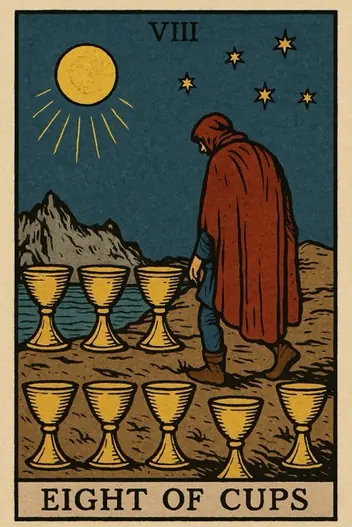
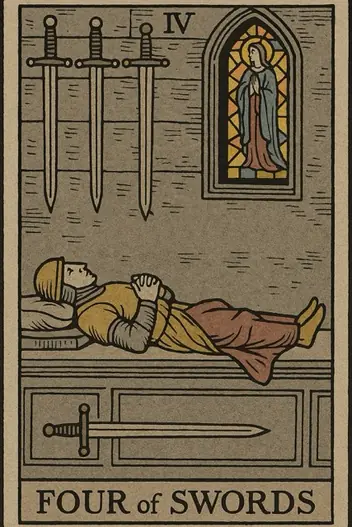
When the Eight of Cups—the card of walking away from emotional investment—intersects with the Four of Swords—the card of enforced rest and mental sanctuary—the result is a powerful directive to pause, reassess, and retreat from a draining situation. Psychologically, this pairing signals that your psyche is demanding a break from a path that no longer serves your growth. The Eight of Cups represents the conscious decision to leave behind what is familiar but unfulfilling, while the Four of Swords insists that this departure must be accompanied by active mental recovery rather than impulsive escape. In real life, this combination often appears when you have exhausted the emotional returns of a relationship, job, or belief system and now require solitude to process the cost of staying.
Eight of Cups and Four of Swords Together: Meaning
The core dynamic here is a calculated withdrawal—not a defeat, but a strategic retreat for psychological preservation. The Eight of Cups embodies the archetype of the Seeker, someone willing to abandon comfort for authenticity, while the Four of Swords introduces the archetype of the Hermit, emphasizing introspection and rest. Together, they create a state where action is temporarily suspended in favor of reflection. This is not a time for hasty decisions; rather, it is a moment to step back from emotional turbulence and evaluate what truly matters.
The psychological state this combination produces is one of conscious disengagement. You may feel a strong urge to walk away from a situation—a job, a relationship, or a personal project—but the Four of Swords warns against doing so without first creating a mental buffer. The key insight here is that leaving is necessary, but it must be done with intention. Rushing out the door without processing the emotional fallout only leads to repeating the same patterns elsewhere. Real-world implications include taking a sabbatical, setting firm boundaries, or temporarily stepping away from social obligations to recharge your cognitive resources. The Eight of Cups provides the motivation to leave; the Four of Swords provides the method—quiet, deliberate stillness.
Your pair is already on the table. Ask your question and draw the clarifying card
or simply focus on it
Eight of Cups and Four of Swords for Career and Money
Strategic Opportunities:
Use this period to reassess your career trajectory without pressure. Submit your resume or explore new fields, but delay accepting offers until you feel mentally clear.
Strategic Opportunities:
Consider investing in professional development that requires solitude, such as online courses or certifications, to build skills for your next move.
Calculated Risks:
Avoid quitting your job impulsively unless you have a financial cushion. The Four of Swords warns against burning bridges during burnout—you may need the stability while you plan.
In the professional realm, this combination signals a crucial pause in your career momentum. The Eight of Cups suggests that your current role or industry is no longer emotionally fulfilling, but the Four of Swords advises against rash resignations. Instead, treat this as a strategic retreat—use vacation time, request a sabbatical, or negotiate a temporary reduction in responsibilities. Bold financial warning: Do not make major investments or career changes while feeling depleted. The risk of poor judgment is high. Frame your decision-making around resource management: calculate how much savings you need to afford a three-month break, and then plan your exit accordingly. This is a time for objective analysis of your professional situation—ask yourself: “What would I do if I were not exhausted?” The answer will guide your next steps without emotional distortion.
Eight of Cups and Four of Swords Love Outcome
If you are single:
This combination suggests you are emotionally exhausted from past patterns and need to withdraw from active dating to heal. Do not pursue new connections until you have fully processed why previous ones failed.
If you are in a relationship:
You and your partner may be stuck in a cycle of emotional withdrawal. One or both of you are considering walking away, but this card pair advises taking a structured break rather than a permanent exit. Communicate your need for space clearly to avoid misunderstandings.
In relationships, the Eight of Cups and Four of Swords point to a crisis of emotional investment. The Eight of Cups represents the feeling of having given too much without receiving adequate reciprocity, while the Four of Swords insists on temporary isolation to regain perspective. Key relationship advice is to avoid ultimatums and impulsive decisions. Instead, propose a designated period of low-contact—perhaps a week or two—where both parties can reflect individually on what they truly want. This is not about punishment; it is about creating space for clarity. If you are the one considering leaving, use this time to journal about what you are actually seeking, not just what you are fleeing. Bold emotional intelligence requires distinguishing between healthy boundaries and defensive avoidance. If your partner is the one withdrawing, resist the urge to chase—give them the solitude they need, and use the time to examine your own attachment style.
Get a personalized interpretation
Unlock the combined meaning of your cards in the context of your unique question — for free.
The Shadow Side of Eight of Cups and Four of Swords
The shadow of this combination manifests as chronic avoidance disguised as self-care. The Eight of Cups can become a pattern of running away whenever discomfort arises, while the Four of Swords can devolve into paralyzing inertia. Cognitive biases to watch for include the sunk cost fallacy—staying in a bad situation because you’ve already invested so much—and confirmation bias—interpreting every sign as validation for leaving, even when a repair might be possible. Self-sabotage appears when you withdraw without communicating, alienating people who could have supported you. The greatest risk is mistaking exhaustion for clarity: you may convince yourself that leaving is the only option when what you truly need is rest and perspective. If you find yourself repeatedly using “I need space” as a default response, question whether you are protecting yourself from growth rather than from harm.
Eight of Cups and Four of Swords Reversed: What Changes?
If the Eight of Cups is Reversed:
You are stuck in a "leave-stay" cycle. You realize you need to go, but fear of loneliness or guilt paralyzes your will. This is a state of blocked potential. Instead of a strategic retreat, you choose self-destructive patience. Advice: acknowledge that your inaction is also a choice with consequences. You are not a victim, but a co-author of your stagnation.
If the Four of Swords is Reversed:
This is a signal of internal resistance to rest. Your psyche demands peace, but the ego spurs you into action. You cannot sleep, meditate, or simply sit still. This leads to burnout and a nervous breakdown. Warning: you are on the verge of physical exhaustion. Ignoring this card will cause your body to "shut you down" itself—through illness or injury.
If BOTH are Reversed:
Complete imbalance. You are simultaneously unable to leave (reversed Eight) and unable to rest (reversed Four). This is a formula for chaos and panic. You are thrashing about, making stupid mistakes, lashing out at loved ones. The corrective measure is forced isolation. Give yourself a "digital detox" for 48 hours. Turn off your phone. Remove all triggers. Only complete sensory deprivation can "reboot" the system.
Overall Meaning of Eight of Cups and Four of Swords
Constructive use of this dynamic requires iron discipline. The Eight of Cups gives you the energy for a break, and the Four of Swords gives you the wisdom for a pause. Your task is not to let these energies consume each other. Use the withdrawal not as a final point, but as the beginning of a new cycle.
The action plan: first, you withdraw (Eight of Cups). You clearly define boundaries: "I am stopping this. I am not discussing this. I am not going back." Then, you enter the Four of Swords mode: create a schedule of complete inaction. Clearly outline hours for sleep, walks, reading, and total idleness. Your goal is not to find answers, but to clear the mental space of noise.
A deep strategic advice: do not try to "let go" of the situation. Simply stop holding onto it. This is a subtle but critical distinction. "Letting go" is an action requiring effort. "Stopping holding" is ceasing useless tension. Imagine you have unclenched a fist that held nothing but emptiness. It is this state—active stillness—that is the key to the right decision. When the noise subsides, you will see where to go next.
Applying This to Your Situation
The Eight of Cups and Four of Swords together deliver a clear message: honor your need to withdraw, but do so with discipline. This is not a license to disappear; it is a prescription for strategic recovery. Your psyche is asking you to stop pouring energy into empty vessels and instead fill your own reserves. The core takeaway is that leaving is not enough—you must also rest, reflect, and realign before you can move forward authentically.
While this article provides the general archetype of this card pair, the true power of Tarot lies in personalization. Your specific question—whether about love, career, or inner conflict—deserves a reading tailored to your unique circumstances. Use the Fortune Cards app on the web or download it now to get a deep, personalized interpretation of this exact combination for your situation. Stop guessing; start understanding what your psyche is truly telling you.
Interpretation by the Fortune Cards editorial team, based on the Rider–Waite tradition and Jungian archetypes. About our methodology · Updated: 2026-08-26
Other Combinations with Eight of Cups
Other Combinations with Four of Swords
Explore Individual Card Meanings
Table of Contents
- Eight of Cups and Four of Swords Together: Meaning
- Eight of Cups and Four of Swords for Career and Money
- Eight of Cups and Four of Swords Love Outcome
- The Shadow Side of Eight of Cups and Four of Swords
- Eight of Cups and Four of Swords Reversed: What Changes?
- Overall Meaning of Eight of Cups and Four of Swords
- Applying This to Your Situation
Ready to find answers to your questions?
Start your first reading now and look at your situation with fresh clarity. The cards are ready to reveal deeper meaning.