Four of Swords
- Arcana
- Minor Arcana, Suit of Swords
- Element
- Air
- Decan
- Jupiter in Libra
- Numerology
- 4
The Four of Swords represents the Jungian archetype of the Recluse or the Wounded Healer—a state of forced stillness where the conscious mind must surrender to recuperation. This card is not about laziness or passivity; it is a critical survival mechanism for the psyche after prolonged stress, conflict, or intellectual exhaustion. It signals a necessary pause in the cycle of action to prevent burnout and cognitive collapse.
Fundamentally, the Four of Swords challenges the modern obsession with constant productivity. It asks: What happens when you refuse to rest? The answer is diminished decision-making capacity, emotional volatility, and physical depletion. This card offers a strategic withdrawal—a calculated retreat to reorganize your mental resources before re-engaging with the world.
Four of Swords: Core Meaning and Interpretation
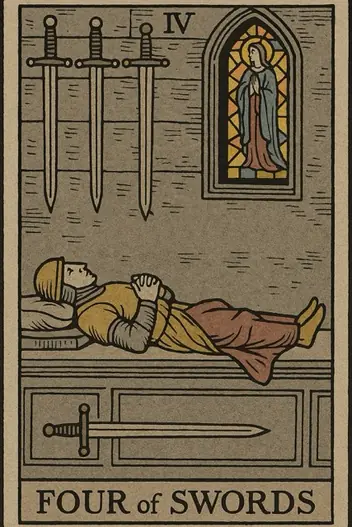
The Four of Swords depicts a knight lying in repose on a tomb, with three swords hanging above and one beneath. This imagery symbolizes the suspension of active conflict and the need for introspection. Psychologically, this card represents a state of cognitive conservation: the mind is processing past traumas, integrating lessons, and recalibrating its priorities. It is not a time for new ventures but for consolidation and recovery.
In practical terms, this card dictates a moratorium on decision-making. The most intelligent action you can take is to step back, rest, and observe. Pushing forward now would be a waste of energy and could lead to poor judgment. The Four of Swords is a resource management strategy: you are conserving mental energy to ensure you have the clarity and strength for future challenges. It is a diagnostic pause—a time to assess what is truly important and what can be discarded.
The key insight is that isolation here is not a punishment but a prescription. It allows the unconscious mind to surface unresolved issues without the noise of external demands. This card rewards patience and self-discipline, punishing those who rush back into action prematurely.
Ask your question and flip the cards
or simply focus on it
Is Four of Swords a Yes or a No?
Leaning Yes — but only through stillness.. The Four of Swords represents a necessary pause, not a resolution. In a yes/no context, the card signals that the answer is "yes" only if you refrain from pushing, forcing, or demanding clarity right now. The crossed arms of the knight and the stained-glass window above him depict a mind seeking sanctuary, not action. Reversed, the card suggests mental restlessness or premature re-engagement — shifting the answer toward No, because the foundation for a clear decision is not yet stable. The critical condition: the outcome depends entirely on whether you can tolerate the ambiguity of waiting without self-reproach; premature movement will collapse the answer.
Uncover hidden insights
Let our advanced Tarot system interpret these archetypes specifically for your personal path.
Card of the Day
The energy of the Four of Swords today is one of enforced withdrawal — your psyche is demanding a temporary ceasefire from mental overstimulation. Focus specifically on doing less: postpone non-urgent decisions, turn off notifications, and allow your mind to wander without a goal. The trap to avoid is mistaking stillness for laziness or guilt-inducing idleness; the day is not about productivity but about neural restoration. Avoid any conversation that requires emotional defense or strategic thinking — your cognitive reserves are low. Instead, use the day for solitary activities like reading, napping, or walking without a destination.
Four of Swords in Love and Relationships
If you are not in a relationship:
This card suggests a necessary period of solitude to heal from past relational wounds. Seeking a partner now would be a distraction from self-repair. Focus on rebuilding your own psychological foundation.
If you are in a relationship:
The Four of Swords indicates a need for temporary emotional distance to prevent conflict escalation. This is not a breakup—it is a strategic timeout. Use this space to reflect on your own needs and boundaries.
In relationships, this card warns against emotional overextension. If you have been giving too much without receiving, the Four of Swords demands you withdraw to reset the balance. The primary practical advice is to establish clear boundaries and communicate that you need time to think. Do not make any major relationship decisions while under this card's influence; clarity will come after the rest period ends.
What Does Four of Swords Say About Their Feelings?
Through the lens of the Four of Swords, this person perceives you as a source of mental rest — but also as someone they feel compelled to keep at a distance. You evoke a sense of calm stability in their inner world, yet this very calm triggers an unconscious fear of vulnerability; they associate you with a peace they are not ready to fully inhabit. Their hidden intention is to preserve you as a mental refuge, not a lived relationship — they are more likely to think about you when alone than to initiate contact. The fear is that engaging with you directly would disrupt the quiet they have constructed around your image. Internally, they are conflicted: they value your presence as a soothing anchor, but resist letting you see the chaos they are trying to escape.
Career and Finance
Strategic Opportunities:
Use this time to audit your professional life—review your goals, past performance, and future plans without pressure to act. This is a planning phase.
Resource Management:
Rest to sharpen your focus. A well-rested mind makes better decisions. Consider taking a short break or delegating tasks to reduce cognitive load.
Calculated Risks:
Avoid launching new projects, making investments, or negotiating contracts. The risk of oversight is high. Do not mistake stillness for failure—it is a calculated pause.
Professionally, the Four of Swords advises de-escalation. If you are in a conflict at work, step back rather than engage. Financially, this is a time for preservation, not growth. Review your budget, pay down debts, and avoid speculative moves. The bold warning is this: any financial decision made under stress or fatigue will likely be regretted. Wait until your mind is clear.
Four of Swords Reversed: What Changes
When reversed, the Four of Swords indicates blocked recovery—the individual is refusing to rest or is unable to find peace. This manifests as chronic burnout, insomnia, or obsessive rumination. The psychological state is one of inner resistance: you know you need a break, but you push through, believing productivity is the only virtue. This is a dangerous trap. The mind will force a collapse if you do not voluntarily pause.
The reversed card also suggests premature return to action. You may feel you have rested enough, but deeper issues remain unaddressed. The imbalance here is a lack of self-awareness. To correct it, you must force yourself into a structured break—set a specific time for rest, meditation, or therapy. Do not trust your own judgment about when to resume; let an external schedule guide you. The reversal warns that ignoring this need will lead to physical illness or severe anxiety.
What Are the Pitfalls of Four of Swords?
The shadow of the Four of Swords is pathological withdrawal—using rest as an excuse to avoid responsibility or emotional intimacy. This manifests as cognitive biases like avoidance and rationalization. You may convince yourself you are "recharging" when you are actually procrastinating on necessary confrontations.
Another pitfall is perfectionism in isolation: you wait until you are "fully ready" to act, which never comes. This leads to self-sabotage through over-analysis. The shadow also includes fear of vulnerability—staying in your mental fortress to avoid the risk of being hurt again. The irrational behavior here is mistaking isolation for safety. True growth requires re-engagement, but the shadow keeps you frozen.
The key error in judgment is believing that rest is the goal, not the means. The Four of Swords is a tool, not a lifestyle. If you dwell here too long, you become disconnected from reality and miss opportunities that require timely action.
Synthesis: Strategic Conclusion
To constructively use the energy of the Four of Swords, you must treat it as a tactical retreat with a clear objective. Define what you are resting for: is it to heal a specific wound, to plan a strategic move, or to simply regain energy? Set a time limit for this pause—whether it is a day, a week, or a month—and commit to reviewing your progress at the end.
The strategic advice is to practice active rest. This is not mindless scrolling or numbing with entertainment. Instead, engage in structured introspection: journaling, meditation, therapy, or nature walks. Use this time to identify your core priorities and discard what drains you. The Four of Swords is an opportunity to prune your commitments so your energy is focused on what truly matters.
Finally, reintegrate slowly. When you emerge, do not rush back to full capacity. Test the waters with small actions. The ultimate wisdom of this card is that strategic withdrawal strengthens your ability to engage effectively. By respecting your limits, you build resilience. The Four of Swords is not an ending—it is a preparation for a more powerful return.
Applying This to Your Situation
This psychological and strategic breakdown provides a deep understanding of archetypes. However, Tarot is never universal for everyone. To understand exactly how this dynamic applies to your specific situation, a reading tailored exclusively to you is necessary.
Download the Fortune Cards app or visit our platform to get a deep AI interpretation of your unique spread. Don't just read about the cards—use Fortune Cards to find out exactly what step you need to take next.
Try Tarot Spreads with Four of Swords
Interpretation by the Fortune Cards editorial team, based on the Rider–Waite tradition and Jungian archetypes. About our methodology · Updated: 2026-08-26
Top Combinations with Four of Swords
Discover how Four of Swords interacts with other major cards in the deck to form powerful messages.
All 77 Combinations with Four of Swords
Discover how this card interacts with every other card in the Tarot deck and reveal hidden meanings.
Table of Contents
- Four of Swords: Core Meaning and Interpretation
- Is Four of Swords a Yes or a No?
- Card of the Day
- Four of Swords in Love and Relationships
- What Does Four of Swords Say About Their Feelings?
- Career and Finance
- Four of Swords Reversed: What Changes
- What Are the Pitfalls of Four of Swords?
- Synthesis: Strategic Conclusion
- Applying This to Your Situation
Explore Tarot Universe
Ready to find answers to your questions?
Start your first reading now and look at your situation with fresh clarity. The cards are ready to reveal deeper meaning.