Five of Wands and Four of Swords Together in Tarot

- Arcana
- Five of Wands — Minor Arcana, Wands; Four of Swords — Minor Arcana, Swords
- Elements
- Five of Wands — Fire; Four of Swords — Air
- Elemental interaction
- Friendly elements — energies support each other
- Numerology
- 5 + 4 = 9
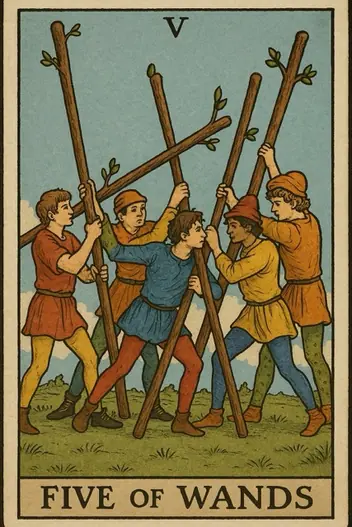
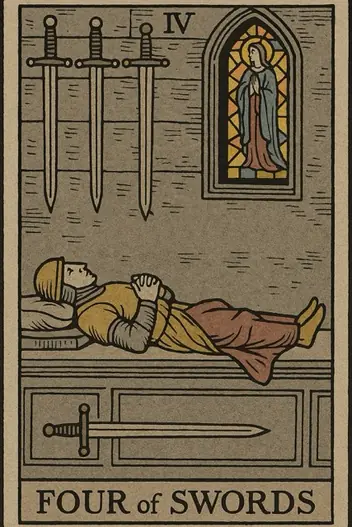
The collision of the Five of Wands and the Four of Swords creates a powerful psychological paradox. The Five of Wands represents chaotic competition, clashing egos, and the raw energy of conflict. It is the archetype of the battlefield, where every voice demands to be heard. The Four of Swords, in stark contrast, is the archetype of strategic withdrawal, mental rest, and enforced stillness. It is the hospital bed or the meditation chamber.
When these two cards appear together, they are not a prediction of simple peace. Instead, they describe a critical decision point: the mind is overwhelmed by external friction, and the only viable path forward is a deliberate, tactical pause. This combination forces the seeker to recognize that fighting harder is no longer a solution; the real battle is now internal, requiring cognitive restructuring rather than further external engagement.
Five of Wands and Four of Swords Combination Meaning
The primary dynamic here is the transition from reactive chaos to mindful recovery. The Five of Wands energy often manifests as a scattered, adrenaline-fueled state where the seeker is trying to "win" every argument, meet every demand, or outpace every competitor. This creates a cognitive load that eventually triggers the Four of Swords’ need for shutdown. The combination suggests that the seeker has been over-fighting—investing energy in conflicts that are unproductive or unwinnable.
Psychologically, this pair represents a necessary withdrawal from social comparison and ego battles. The Five of Wands thrives on status anxiety and the fear of being left behind. The Four of Swords intervenes to say: "Stop. You are not thinking clearly. You need distance from the noise to see the pattern." This is not a defeat; it is a strategic retreat to reassess resources, goals, and priorities. The key insight is that rest is not weakness—it is the foundation for a more effective strategy. The seeker must learn to distinguish between a fight worth having and a fight that only drains their reserves.
Love and Relationships
If you are single:
This combination suggests you are caught in a cycle of petty competition or comparison in your dating life. You may be chasing validation from multiple sources or arguing with yourself about what you truly want. The advice is to step back from the dating "arena" and take a week (or more) of intentional solitude to clarify your own needs before engaging again.
If you are in a relationship:
The partnership may be experiencing a period of bickering, power struggles, or emotional exhaustion. One or both partners are "fighting for airtime." The Four of Swords urges a temporary ceasefire. Agree to a "no-argument" period for 24-48 hours to allow rational thinking to return.
In relationships, this card pair highlights the danger of escalating minor disagreements into major conflicts. The Five of Wands energy can turn a simple difference of opinion into a competition for who is "right". The Four of Swords offers a mature alternative: agree to disagree and take space. The most psychologically sound advice is to establish a "time-out" protocol. When you feel the heat of the Five of Wands rising, state clearly: "I need to pause. Let’s revisit this tomorrow." This is not avoidance; it is emotional regulation. It prevents the relationship from accumulating resentment and allows each partner to process their feelings independently before returning to the negotiation table.
Your pair is already on the table. Ask your question and draw the clarifying card
or simply focus on it
Career Meaning of Five of Wands and Four of Swords
Strategic Opportunities:
Identify the real opponent. Is it a rival colleague, a market trend, or your own perfectionism? The Five of Wands often distracts you with the wrong target. Use the Four of Swords' clarity to pinpoint the actual source of friction.
Strategic Opportunities:
Schedule a "thinking retreat." Block out 2-3 hours of absolute silence on your calendar to review your current projects. This is your chance to reprioritize and cut low-value tasks that are fueling unnecessary competition.
Calculated Risks:
Do not make major financial or career moves while exhausted. The combination warns against "fighting for a promotion" or "arguing for a raise" when you are mentally depleted. You will lose leverage. Wait until you have regained mental clarity.
In a professional context, this is a high-risk, high-reward combination that demands careful navigation. The Five of Wands indicates a competitive environment—perhaps office politics, a bidding war, or a saturated market. The Four of Swords warns that charging in blindly will lead to burnout. Instead, the pragmatic strategy is to observe before acting. Use the Four of Swords energy to gather intelligence rather than to simply sleep. Analyze your competitors' weaknesses while you are mentally refreshed. Financially, this is not the time for aggressive investments or speculative bets. The best financial move is to consolidate, review your budget, and build a cash reserve. The combination suggests that the current "battle" is not worth your capital—either emotional or financial.
Deepen your understanding
Find out exactly what this reading means for your current life situation with our oracle.
Shadow Side & Pitfalls
The shadow of the Five of Wands and Four of Swords combination is passive-aggressive avoidance or chronic indecision. The seeker may use the Four of Swords’ "need for rest" as a rationalization to permanently retreat from necessary confrontation. This leads to unresolved conflicts festering in the background, which eventually erupt with greater force. Another pitfall is rumination—the mind is "resting" but actually replaying the Five of Wands arguments on a loop, which is not true rest but a form of cognitive self-sabotage.
The cognitive bias at play here is the sunk cost fallacy: the seeker feels they have invested too much in a conflict to stop now, even though the Four of Swords clearly signals that continuing is futile. The shadow also manifests as martyrdom—the seeker may wear their exhaustion as a badge of honor, refusing to step back because they believe "only I can fight this battle." This is a dangerous ego trap. The combination warns that if you refuse to take a voluntary pause, life will force one upon you—through illness, a sudden failure, or a complete mental breakdown. The healthy path is to recognize the ego's need to fight and consciously choose to withdraw anyway.
Reversed Five of Wands and Four of Swords Explained
Five of Wands Reversed:
The conflict goes underground. You are not arguing openly, but engaging in sabotage and intrigue. Instead of healthy competition, there is passive resistance. Warning: Your "silence" is not peace. It is a hidden war that drains you more than an open fight. You need to either exit the conflict or state your grievances directly.
Four of Swords Reversed:
You are categorically refusing to rest. You are working yourself to the bone, ignoring your body's signals of overload. Advice: This is a direct path to psychosomatic illness. Your productivity is currently illusory—you are taking many actions, but with low efficiency. Recovery is not a luxury, but a mandatory condition for survival.
BOTH Reversed:
Complete imbalance. You are simultaneously provoking conflicts and denying yourself the chance to recover. This is a self-destruct mode. The only logical way to rectify the situation is artificial isolation. Remove the triggers: unsubscribe from the news, turn off notifications, take sick leave. Your nervous system requires an emergency reboot.
Synthesis: Strategic Conclusion
How can the energy of the Five of Wands be used constructively to balance the Four of Swords? The answer lies in the discipline of rest. Your task is not to suppress the desire to compete, but to channel it into a mode of planned preparation. Perceive the Four of Swords not as weakness, but as a strategic headquarters where you devise your battle plan. Rest is not an escape from reality, but the accumulation of ammunition.
The Five of Wands provides you with the energy to analyze mistakes and identify weak points in your strategy. Use it not for quarrels with people, but for conflict with your own inefficient habits. Make a list of three specific actions you stopped doing due to fatigue, and begin implementing them one per day.
The main strategic advice: do not try to solve a problem in the same state of consciousness in which you created it. You need to first recover (Four of Swords) in order to then attack effectively (Five of Wands). Separate these processes in time. Dedicate 3-5 days to complete disconnection, and then to the assault. Attempting to combine rest and struggle will guaranteed fail at both tasks.
Your Next Step: Personal Context Matters
The core message of the Five of Wands and Four of Swords is deceptively simple: Stop fighting the wrong battles to save your energy for the right ones. The chaos you are experiencing is a signal, not a curse. It is telling you that your current strategy is draining your resources faster than it is producing results. The pause is not a luxury; it is a strategic necessity for survival and future success. The question is not if you should rest, but how you can rest intentionally so that you return with a sharper mind and a clearer plan.
While this analysis provides the archetypal framework, the true power of Tarot lies in its application to your specific life. The Fortune Cards app allows you to input your exact situation—whether it’s a specific relationship conflict, a career crossroads, or a personal dilemma—and receive a deep, personalized interpretation of this exact card combination. You can use the app on the web or download it directly to your device. Stop guessing. Get the clarity you need for your unique path, right now.
Interpretation by the Fortune Cards editorial team, based on the Rider–Waite tradition and Jungian archetypes. About our methodology · Updated: 2026-08-26
Other Combinations with Five of Wands
Other Combinations with Four of Swords
Explore Individual Card Meanings
Table of Contents
Ready to find answers to your questions?
Start your first reading now and look at your situation with fresh clarity. The cards are ready to reveal deeper meaning.