Two of Swords and Three of Swords Tarot Combination
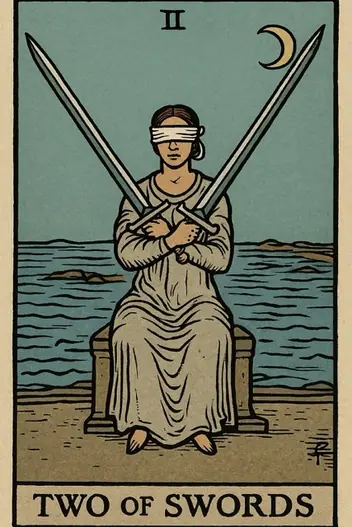
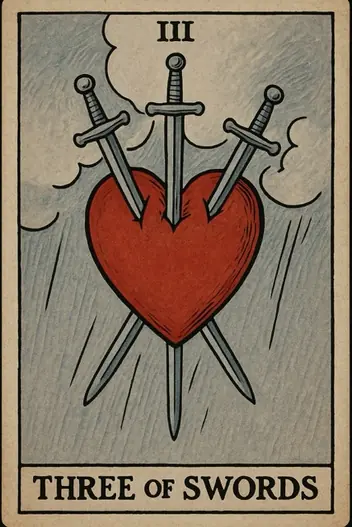
- Arcana
- Two of Swords — Minor Arcana, Swords; Three of Swords — Minor Arcana, Swords
- Elements
- Two of Swords — Air; Three of Swords — Air
- Elemental interaction
- Same element — energies intensify each other
- Numerology
- 2 + 3 = 5
When the Two of Swords meets the Three of Swords, we witness a psychological standoff between denial and emotional rupture. The Two of Swords represents a deliberate, often anxious, suspension of judgment—a mental blockade where the seeker refuses to see what is already true. The Three of Swords signifies the inevitable consequence of that repression: a sharp, piercing emotional wound that demands acknowledgment. In real life, this combination describes a person who has been avoiding a painful truth for so long that the truth now arrives as a crisis. The mind’s attempt to maintain neutrality (Two of Swords) is shattered by the heart’s raw reality (Three of Swords). This is not a gentle awakening; it is a brutal, necessary confrontation with facts that have been ignored. The core psychological conflict here is between cognitive dissonance and the compulsion to integrate reality.
Two of Swords and Three of Swords: How These Energies Interact
The dynamic between these two cards creates a feedback loop of avoidance and pain. The Two of Swords energy is defensive: it builds walls of indecision, rationalization, and emotional numbness to protect the ego from discomfort. The Three of Swords energy is disruptive: it breaks through those walls with a surge of grief, betrayal, or disappointment. Together, they reveal a pattern where the longer you delay a difficult decision, the more painful the eventual resolution will be. This is not about fate punishing you; it is about psychological pressure building until it must be released.
From a Jungian perspective, the Two of Swords represents the shadow of the “neutral observer” —the part of you that believes you can avoid suffering by staying detached. The Three of Swords is the anima/animus call to integrate feeling—the unconscious demanding that you stop splitting your mind from your heart. When these archetypes clash, the seeker often experiences a crisis of authenticity: you know what you need to do, but you lack the courage to act. The practical implication is clear: inaction is now more costly than action. The longer you sit on the fence, the more damage you will incur—both internally and in external relationships. This combination demands that you stop waiting for perfect clarity and instead choose the lesser pain of truth over the greater pain of sustained illusion.
Two of Swords and Three of Swords in Love and Relationships
If you are single:
This pair suggests you are currently attracted to unavailable or emotionally complicated people, or you are avoiding your own feelings about a past wound. The solution is to stop analyzing and start feeling. A new connection cannot thrive if you are still nursing a hidden heartbreak or refusing to see red flags.
If you are in a relationship:
You and your partner are likely locked in a cycle of silence and sudden conflict. One or both of you is withholding truth to avoid a fight, only to have that truth explode later. Immediate, honest communication is non-negotiable.
In relationships, this combination points to a power struggle between intellectual control and emotional vulnerability. The Two of Swords person often rationalizes their partner’s behavior or their own dissatisfaction, saying things like “I just need more time to think.” The Three of Swords person feels the distance acutely and may lash out or withdraw in pain. The key insight here is that this is not a conflict of values, but a conflict of courage. One partner is afraid to speak their truth; the other is afraid to hear it. The boldest move you can make is to initiate the difficult conversation first. Ask direct questions: “What are we avoiding?” “What have I been refusing to see?” The goal is not to assign blame, but to dismantle the wall of silence before it collapses into a wound. If you are single, this combination warns against using intellectual analysis as a shield against intimacy. You cannot think your way into love; you must risk emotional exposure.
Your pair is already on the table. Ask your question and draw the clarifying card
or simply focus on it
Two of Swords and Three of Swords: Career and Money
Strategic Opportunities:
A difficult decision you have postponed is now ripe for resolution. If you have been weighing two job offers, a promotion, or a business pivot, the data is sufficient. Act now to prevent a crisis. This is the moment to cut losses on a failing project or partnership.
Strategic Opportunities:
Use the emotional shock of recent setbacks as fuel for clarity. If you have been laid off, criticized, or passed over, that pain contains information. Let it guide you to a more authentic career path. The Three of Swords can actually be a powerful catalyst for change if you stop resisting it.
Calculated Risks:
Do not make major financial decisions while feeling betrayed or humiliated. The Three of Swords can trigger revenge spending, impulsive investments, or quitting in anger. Wait 48 hours after an emotional blow before signing any contract or making a large purchase.
In a professional context, this combination signals a crisis of alignment between your role and your values. You may be staying in a job that requires you to suppress your ethics or creativity (Two of Swords), and the Three of Swords represents a recent failure, critique, or layoff that has shattered your illusion of security. The strategic response is to treat this pain as objective data about your environment. Ask: “What is this loss teaching me about what I actually want?” The Two of Swords’ indecision here is often rooted in loss aversion—fear of losing status, income, or identity. But the Three of Swords confirms that the status quo is already causing damage. Financially, this is a time to prioritize liquidity over loyalty. Do not double down on a sinking ship. Instead, use the emotional shock to reassess your risk tolerance and exit strategy. If you are self-employed, this combination warns against ignoring client feedback or market signals. The pain of a bad review or lost contract is a gift if you use it to course-correct.
Get a personalized interpretation
Unlock the combined meaning of your cards in the context of your unique question — for free.
Negative Meaning of Two of Swords and Three of Swords
The shadow manifestation of this pairing is self-sabotage through intellectualization. The seeker may become hyper-analytical, dissecting every detail of a situation to avoid feeling the emotional weight. This is a defense mechanism that turns wisdom into paralysis. Another common pitfall is projection: blaming the other person for the pain (Three of Swords) when, in truth, the Two of Swords’ refusal to choose created the conditions for the wound. Cognitive biases at play include confirmation bias (only seeing evidence that supports staying stuck) and sunk cost fallacy (believing you have invested too much to walk away). The most dangerous shadow behavior is emotional numbing through work, substances, or avoidance. This combination can lead to a state of learned helplessness, where the seeker believes that no decision will be good enough, so they choose none. The result is a chronic state of low-grade depression and resentment. If you find yourself saying “I don’t care anymore,” you are likely in the shadow of these cards—caring too much to face the truth, and too little to change it.
Two of Swords and Three of Swords Reversed: What Changes?
When cards appear in a reversed position, the dynamic becomes more chaotic, yet also more manageable.
If the Two of Swords is reversed:
This removes the blockage. Paralysis of will gives way to recklessness. You may make a decision too quickly, without weighing the risks, leading to even greater pain. Advice: slow down by one step. Your intuition is correct, but it lacks analysis. Use the Three of Swords as a signal that you need to act, but not to rush.
If the Three of Swords is reversed:
This points to internal resistance to healing. You have experienced pain but refuse to process it, getting stuck in the role of the victim. Warning: do not cultivate suffering. A reversed Three of Swords is the poison you drink, expecting your enemy to die. You need to consciously shift from analyzing the past to planning the future.
If BOTH are reversed:
This is a complete imbalance. You are simultaneously paralyzed and suffering, yet unable to draw conclusions. This is a state of "toxic reflection." The only way to correct the situation is to introduce an external observer: a psychologist, coach, or mentor. You need someone to speak the obvious truth that you refuse to see.
Overall Meaning of Two of Swords and Three of Swords
Constructive use of this pair's energy requires the courage to acknowledge that you have already lost the battle to preserve the status quo. Your task is not to win, but to minimize losses and learn the lesson. The Two of Swords grants you clarity of vision (you see both sides of the coin), and the Three of Swords is the price you pay for insight.
Strategically, you must act like a surgeon: coldly, swiftly, and precisely. Identify exactly which truth is causing you pain, and speak it aloud. This could be an admission that you do not love your partner, or that your business plan has failed. Once you do this, the paralysis (Two of Swords) will dissolve, and you can begin the process of recovery.
A deeper piece of advice: use the Three of Swords not as an endpoint, but as a bifurcation point. This pain is not punishment, but information. It reveals where your psyche was most vulnerable. Fortify that place. Do not try to "forget" or "forgive" — try to understand the structure of your mistake. Your next step is not a return to the past, but the creation of a new "self" that will no longer allow itself to freeze in the illusion of safety at the cost of truth.
Your Next Step: Personal Context Matters
The core message of the Two of Swords and Three of Swords is that clarity is painful, but avoidance is more destructive. You must stop waiting for the perfect moment or the perfect answer. The pain you feel is not a punishment—it is a signal that your current strategy of denial is no longer sustainable. The only way out is through: acknowledge the wound, make the hard choice, and trust that your integrity will hold you together.
While this article provides a deep understanding of the archetypes, every situation is unique. The true power of Tarot comes when it is applied to your specific question, relationship, or career crossroads. Use the Fortune Cards app to get a personalized, in-depth reading of this exact combination for your life right now. Whether on the web or through the app, you will receive tailored insights that address your precise circumstances—turning general wisdom into actionable guidance. Download Fortune Cards today and stop avoiding your truth.
Interpretation by the Fortune Cards editorial team, based on the Rider–Waite tradition and Jungian archetypes. About our methodology · Updated: 2026-09-17
Other Combinations with Two of Swords
Other Combinations with Three of Swords
Explore Individual Card Meanings
Table of Contents
- Two of Swords and Three of Swords: How These Energies Interact
- Two of Swords and Three of Swords in Love and Relationships
- Two of Swords and Three of Swords: Career and Money
- Negative Meaning of Two of Swords and Three of Swords
- Two of Swords and Three of Swords Reversed: What Changes?
- Overall Meaning of Two of Swords and Three of Swords
- Your Next Step: Personal Context Matters
Ready to find answers to your questions?
Start your first reading now and look at your situation with fresh clarity. The cards are ready to reveal deeper meaning.