Two of Swords and Six of Swords Meaning in Tarot
- Arcana
- Two of Swords — Minor Arcana, Swords; Six of Swords — Minor Arcana, Swords
- Elements
- Two of Swords — Air; Six of Swords — Air
- Elemental interaction
- Same element — energies intensify each other
- Numerology
- 2 + 6 = 8
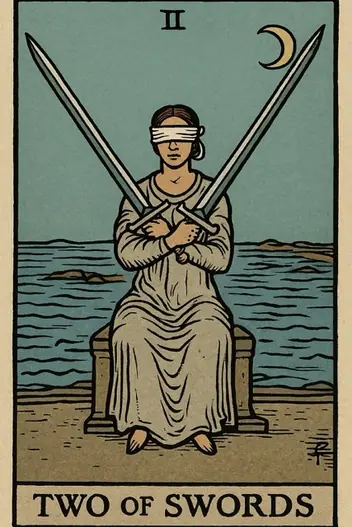
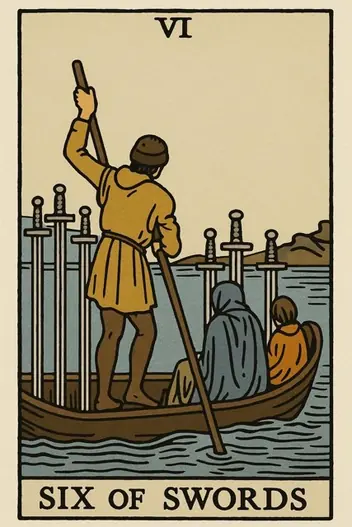
When the Two of Swords meets the Six of Swords, we witness a psychological transition from a state of deliberate indecision to a calculated escape. The Two of Swords represents a mental stalemate—a blindfolded figure holding two crossed blades, symbolizing a conscious refusal to see or choose. The Six of Swords, conversely, depicts a ferryman carrying a family across murky waters, representing movement through difficulty toward a safer shore. Together, they map a critical juncture: the moment you must stop weighing options and start executing a departure.
This combination is not about sudden clarity or emotional resolution. It is about strategic surrender—accepting that perfect information will never arrive, and that the cost of inaction now outweighs the risk of moving forward. Psychologically, this mirrors the Jungian concept of "the transcendent function," where the tension of opposites (the Two's conflict) forces a new, third path (the Six's journey). The message is pragmatic: you have analyzed enough; now you must navigate away from the storm, even if you cannot yet see the shore.
Two of Swords and Six of Swords Card Meaning Explained
The core dynamic here is the release of cognitive dissonance through deliberate action. The Two of Swords often signals a person trapped in analysis paralysis—weighing pros and cons, fearing the wrong choice, and using logic as a shield against emotional discomfort. The Six of Swords then acts as the psychological "escape hatch," compelling a move that may feel like retreat but is actually strategic repositioning. Together, they describe a mind that has exhausted its internal debate and now must trust the process of motion over the illusion of certainty.
In practical terms, this pair suggests you are leaving a situation you have outgrown, not because you have resolved all conflicts, but because staying is no longer viable. The blindfold of the Two of Swords indicates you may be ignoring key emotional data—perhaps your own feelings or the true motives of others. The Six of Swords demands you stop looking back and focus on the logistics of departure. The key insight: clarity comes after the move, not before it. This is a time for calculated risk, not perfect knowledge.
Bold takeaway:
The combination warns against waiting for a "sign" or a "perfect plan." The psychological shift required is from "What if I'm wrong?" to "What if this is the only way forward?" The journey ahead may be uncomfortable, but it is the path of least resistance to growth.
Your pair is already on the table. Ask your question and draw the clarifying card
or simply focus on it
Two of Swords and Six of Swords Love Outcome
If you are single:
This combination suggests you are avoiding a decision about a potential partner or past relationship. You may be weighing their flaws against hope, but the Six of Swords urges you to move on from a dead-end dynamic. Do not confuse emotional attachment with compatibility.
If you are in a relationship:
You and your partner may be stuck in a pattern of avoidance—silent disagreements, unspoken needs. The cards signal a need for one partner to initiate a difficult conversation or physically leave a toxic space to break the stalemate.
Detailed interpretation:
In relationships, the Two of Swords often manifests as emotional denial—a refusal to see the cracks in the foundation. The Six of Swords then appears as the inevitable separation, whether physical or emotional. This is not necessarily a breakup; it can be a strategic pause or a relocation of emotional boundaries. Key relationship advice in bold: Do not wait for the other person to change or for a perfect moment. Initiate the difficult move yourself. If you are feeling stuck, ask: "What am I refusing to see about this dynamic?" The answer may be that you are both clinging to a version of the relationship that no longer exists. The most loving action may be to let go gracefully rather than force a resolution through more arguments.
Your unique Tarot reading
See how these cards interact with your destiny. Start a free personal reading now.
Two of Swords and Six of Swords in Career Readings
Strategic Opportunities:
Pivot to a new role or industry even if it feels like a step back. The Six of Swords rewards strategic retreat over stubborn persistence.
Strategic Opportunities:
Delegate or automate the tasks causing your mental gridlock. The Two of Swords says you are overthinking; let someone else handle the operational details.
Calculated Risks:
Do not sign a contract or commit to a major investment until you have physically moved away from the current situation. The blindfold warns of hidden clauses or unspoken risks.
Practical analysis:
In career terms, this combination often points to a job or project that has run its course. You may be stuck in a "golden handcuffs" scenario—weighing salary against misery. The Six of Swords advises you to start planning your exit now, even if it means a temporary pay cut or a lateral move. Bold important financial warnings: The Two of Swords warns against cutting off your nose to spite your face. Do not resign impulsively, but do stop pouring energy into a sinking ship. Financially, this is a time for liquidity over leverage—keep cash reserves to fund your transition. Strategic tip: Use the Six of Swords' energy to network in new circles or acquire new skills before you leave. The move is not a leap of faith; it is a calculated crossing.
Two of Swords and Six of Swords Reversed Meaning
When cards appear reversed, the dynamic of "blind flight" transforms into more complex scenarios.
If the Two of Swords is reversed:
The blindfold falls off, but not by your own will. You will be forced to see the truth you have been ignoring. This can be a painful revelation (betrayal, collapse of illusions) that destroys your escape plan. Advice: do not try to close your eyes again. Use this shock as fuel for real, not illusory, change.
If the Six of Swords is reversed:
Movement is blocked. You are stuck in a situation you want to leave but cannot. The boat does not depart. This is a state of paralysis caused by fear and an unwillingness to pay the price for the transition. The way out is to acknowledge that your current position of "neither here nor there" is the most disadvantageous. Take one small step forward, even if it feels wrong.
If BOTH are reversed:
A total crisis. You are simultaneously unable to see the truth (reversed Two) and unable to move from your spot (reversed Six). This is a state of acute stress and chaos. The best strategy is to seek external help (coach, psychologist, trusted friend). You need a "navigator" to point the direction while you are blinded by panic.
When Two of Swords and Six of Swords Signal Trouble
The shadow of this combination is emotional cowardice disguised as pragmatism. The Two of Swords can become a rationalization for inaction—you tell yourself you are "gathering more data" when you are actually terrified of the unknown. The Six of Swords, twisted, can become a pattern of running away without learning the lesson. You may leave one situation only to recreate the same dynamic elsewhere. Cognitive bias to watch for: the "sunk cost fallacy." You stay in a bad relationship or job because you have already invested so much time, energy, or money. The cards warn: past investment is not a reason to continue a losing strategy.
Another pitfall is emotional suppression. The blindfold of the Two of Swords can indicate you are ignoring your own grief, anger, or fear about the move. The Six of Swords then becomes a cold, dissociative journey—you leave physically but remain emotionally stuck. Self-sabotage manifests as: over-analyzing the decision until the opportunity passes, or making a dramatic exit that burns bridges unnecessarily. The shadow solution: Acknowledge the pain of leaving without letting it derail your plan. The most dangerous move is the one you make without feeling the weight of it.
Two of Swords and Six of Swords: Tarot Advice
Constructive use of this combination requires conscious paradox: you must move, yet simultaneously stop. In practical terms, this manifests as a "pause in motion." You make the decision to leave (Six of Swords), but before taking the first step, you remove the blindfold (Two of Swords) for one final, honest look at the situation. This is not a cancellation of the decision, but its calibration.
Your task is to transform irrational flight into a strategic retreat. Imagine you are a commander withdrawing troops from the battlefield. You are not simply fleeing; you are analyzing: where the attack came from, what resources were lost, where it is safer to redeploy. The key strategic advice: write a "Farewell Letter" to your current situation. Without censorship, list exactly what you are leaving behind (problems, people, fears). This will become your map of the terrain. Then, burn the letter. The ritual is not for mysticism, but for the psychological closure of the gestalt. After this, you can sail — but now with a clear understanding of where and why.
Where to Go From Here
The Two of Swords and Six of Swords together deliver a singular, urgent message: stop waiting, start moving. You have the intellectual clarity to know what must change, but you are stuck in the emotional fog of "what if." The ferryman is waiting, but he will not row forever. Your next step is to identify one concrete action—a conversation, a resignation, a boundary—that breaks the stalemate. Do not seek perfect closure; seek forward momentum.
While this article maps the general archetype, your specific situation—your relationship history, career stage, and hidden fears—will shape how these cards apply to you. The true magic of Tarot is in the personal connection.
Ready for a deep, personalized reading of this exact combination for your unique question? Use the Fortune Cards app—available on the web or for download—to get a tailored interpretation that factors in your context, other cards in your spread, and your specific life circumstances. Click here to start your journey from paralysis to purpose.
Interpretation by the Fortune Cards editorial team, based on the Rider–Waite tradition and Jungian archetypes. About our methodology · Updated: 2026-08-26
Other Combinations with Two of Swords
Other Combinations with Six of Swords
Explore Individual Card Meanings
Table of Contents
- Two of Swords and Six of Swords Card Meaning Explained
- Two of Swords and Six of Swords Love Outcome
- Two of Swords and Six of Swords in Career Readings
- Two of Swords and Six of Swords Reversed Meaning
- When Two of Swords and Six of Swords Signal Trouble
- Two of Swords and Six of Swords: Tarot Advice
- Where to Go From Here
Ready to find answers to your questions?
Start your first reading now and look at your situation with fresh clarity. The cards are ready to reveal deeper meaning.