Love Tarot: The Chariot and Two of Swords
- Arcana
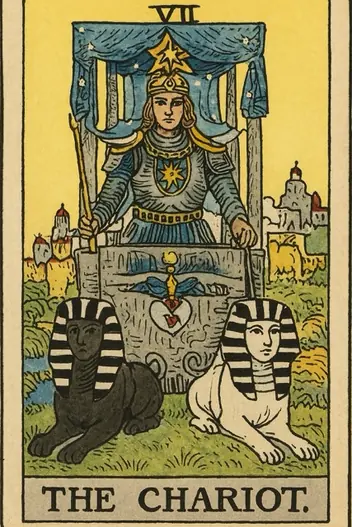
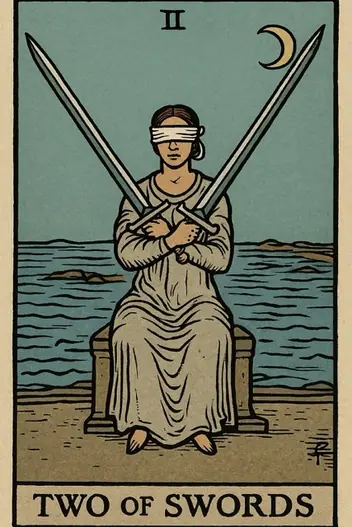
- The Chariot — Major Arcana; Two of Swords — Minor Arcana, Swords
- Elements
- The Chariot — Water; Two of Swords — Air
- Elemental interaction
- Neutral elements — energies coexist without conflict
- Numerology
- 7 + 2 = 9
Imagine a powerful engine revving, ready to surge forward, but the driver is frozen, blindfolded, and clutching the wheel. That is the psychological landscape of The Chariot paired with the Two of Swords. The Chariot represents raw willpower, victory through discipline, and the drive to conquer external obstacles. The Two of Swords represents a state of deliberate stalemate, where the mind chooses not to see the truth to avoid making a painful choice. When these two collide, you are not lacking motivation; you are lacking clarity. The core conflict is between the impulse to act and the need for a strategic pause.
This combination forces a critical question: Is your willpower driving you toward a goal, or is it merely pushing you harder into a dead end? In Jungian terms, The Chariot is the ego’s active, assertive principle—the Hero archetype. The Two of Swords is the Shadow of indecision, a defense mechanism that protects you from emotional pain by creating cognitive dissonance. The practical challenge is to use the Chariot's discipline not to charge forward blindly, but to deliberately remove the blindfold and make the hard decision you’ve been avoiding.
What Do The Chariot and Two of Swords Mean Together?
The central psychological state here is high tension with low visibility. You possess immense energy and a clear sense of direction (The Chariot), but you are paralyzed by a conflicting internal debate (Two of Swords). This is not a passive state; it is an active holding pattern. You are likely aware of a critical choice that requires both courage and a sacrifice of one option. The danger is that you will burn out your willpower by maintaining this stalemate, exhausting yourself without moving an inch.
The key insight is that the Two of Swords is a card of willful ignorance. You are choosing not to see a crucial piece of information—perhaps a partner's true feelings, a financial risk, or a career dead-end. The Chariot's energy, when misapplied here, becomes a force of stubbornness. Instead of charging toward victory, you are charging toward a wall. The recommended psychological strategy is to halt the forward motion and use the Chariot's discipline to conduct a ruthless internal audit. Ask yourself: "What truth am I avoiding for the sake of comfort?" The answer is the key to unlocking this gridlock.
Practically, this combination suggests a need for controlled confrontation. Do not let go of the reins, but do not snap them either. You must steer this energy into a structured decision-making process. Create a pros-and-cons list, seek a neutral third party’s opinion, or set a firm deadline for your decision. The Chariot’s strength lies in its ability to overcome obstacles; here, the obstacle is your own mind. Master it by forcing clarity, not by forcing action.
Career and Finances
Strategic Opportunities:
Use your drive to finalize a stalled project by gathering the missing data. Your willpower is best applied to research and analysis, not blind execution.
Strategic Opportunities:
This is an ideal time to negotiate a truce or a middle ground in a workplace conflict. The Chariot gives you the confidence to speak, while the Two of Swords reminds you to listen carefully.
Calculated Risks:
Avoid signing any contract or making a major investment until you have all the information. The Two of Swords warns of hidden terms or overlooked details. Do not let your desire for a quick win override your judgment.
In a professional context, this combination often appears when you are trapped between two viable options—a promotion with more responsibility versus a lateral move with better work-life balance, or staying in a stable job versus launching a risky venture. The Chariot urges you to "go for it," but the Two of Swords demands a risk assessment. Your career is not a battlefield to be conquered; it is a chessboard to be played.
A critical financial warning:
Be wary of "analysis paralysis." The Two of Swords can lead to missed opportunities because you waited for perfect clarity that never came. The Chariot, however, can lead to impulsive losses. The strategic middle ground is to set a clear deadline for your decision. Give yourself one week to gather the necessary data, then act. Use the Chariot’s discipline to enforce that deadline. Do not let fear of the wrong choice keep you from making any choice at all. A bad decision is often better than no decision, as it provides data for the next move.
Your pair is already on the table. Ask your question and draw the clarifying card
or simply focus on it
What Do The Chariot and Two of Swords Say About Love?
If you are single:
This pair suggests you are attracted to someone who represents a conflict. You are drawn to their strength or ambition (The Chariot), but you are ignoring red flags or a fundamental incompatibility (Two of Swords). Stop idealizing the potential and see the present reality.
If you are in a relationship:
You and your partner may be in a cold war. There is a clear power struggle or a major unresolved issue that both of you are avoiding. One of you wants to force a resolution (The Chariot), while the other is stonewalling (Two of Swords).
The relationship dynamic here is one of defensive control. One partner may be aggressively pushing for a decision—marriage, moving in, ending the relationship—while the other is retreating into a position of "I need time to think." This is not a healthy dialogue; it is a battle of wills disguised as a debate. The Two of Swords often indicates a partner who is deliberately keeping their cards close to their chest, using silence as a weapon.
To break this cycle, emotional intelligence is paramount. The aggressive partner (Chariot) must learn that willpower cannot force intimacy. The defensive partner (Two of Swords) must recognize that avoidance is a form of aggression. The most important advice is to schedule a neutral, time-boxed conversation. Agree to discuss the elephant in the room for 30 minutes, with no interruptions, and no expectation of an immediate resolution. The goal is not to win, but to remove the blindfold together. If one partner refuses to engage, that is your answer.
Ask your specific question
Don't rely on generic meanings. Get a customized reading tailored specifically to your energies.
What If The Chariot or Two of Swords Appears Reversed?
If The Chariot is Reversed:
Your will is suppressed or channeled destructively. You feel like a victim of circumstance, unable to move forward. The Two of Swords in its upright position amplifies this state, making you a hostage to your own fears. Advice: Refrain from any aggressive actions. Instead of storming the gates, engage in "mental housekeeping": write down all your fears and doubts to see their true contours.
If the Two of Swords is Reversed:
The blindfold has fallen, and you see the truth, but it is too painful. This is a moment of "terrible illumination" that paralyzes The Chariot. You know what needs to be done, but you fear the consequences. Warning: Do not panic. The information you have received is not a verdict, but a map of the terrain. Use the energy of The Chariot to develop a plan for retreat or regrouping, not for a reckless attack.
If BOTH are Reversed:
A complete imbalance of dynamics: apathy and self-deception. Not only do you not know where to go, but you also do not want to know. This is a state of deep internal sabotage, where you unconsciously destroy your own plans. The logical way to correct this: a complete stop. Cease all active projects for a week. Change your environment. Your task is not to "fix" the situation, but to re-establish contact with your own desires. Only after this can you begin to build new goals.
What Are the Risks of The Chariot and Two of Swords?
The shadow of this combination is paralyzed aggression. You feel the urge to fight, but you have no target. This manifests as irritability, passive-aggressive behavior, or self-sabotage. You might start a project with great enthusiasm, only to abandon it when you hit the first difficult decision. The cognitive bias at play is the ostrich effect—you are burying your head in the sand to avoid a painful truth, while simultaneously running in place to feel productive.
Another major pitfall is projection. You may see the "blindness" in others (a partner who won't commit, a boss who won't decide) while ignoring your own willful ignorance. The Chariot’s shadow is arrogance; the Two of Swords’ shadow is denial. Together, they create a person who is loudly wrong. You are convinced of your own righteousness (The Chariot) but refuse to examine the evidence that contradicts your position (Two of Swords). The result is a cycle of conflict without resolution, where you "win" arguments but lose relationships.
Synthesis: Strategic Conclusion
How can the energy of the Chariot be used constructively to balance the Two of Swords? The answer lies in redefining the goal. Your task is not to "choose once and for all" (which paralyzes), but to "begin moving in one direction to receive feedback." The Chariot gives you the speed to quickly test a hypothesis, while the Two of Swords provides the analytical mind to adjust course in time. Stop searching for the "one true path"—look for the first viable step.
Strategic advice: use the "Reconnaissance by Combat" method. Allocate a minimal resource (time, money, attention) and take a trial action toward one of the options. Do not invest everything. Observe the world's reaction. If you encounter resistance—that is not failure, but data. If you receive support—increase your momentum. Key insight: The Chariot is your engine, and the Two of Swords is your radar. Do not try to drive with the radar off (impulsiveness) or stand still with the engine running (paralysis). Turn on the radar, start the engine, and begin moving in first gear. Speed will come later, once you have clarified the landscape.
This combination teaches us that courage is not the absence of fear, but action despite incomplete information. Your strength now lies not in crushing all obstacles, but in acknowledging the presence of an obstacle and choosing which one to attack first. Only in this way can you transform a static deadlock into a dynamic breakthrough.
Your Next Step: Personal Context Matters
The core message of The Chariot and Two of Swords is a call for disciplined clarity. You have the willpower to move mountains, but you are currently trying to move them in the dark. Your next step is not to push harder, but to turn on the light. Stop treating your indecision as a character flaw and start treating it as a signal. It is telling you that you are missing critical information or that you are afraid of the emotional cost of the right decision. The most courageous act right now is to see clearly, not to act forcefully.
While this analysis provides the general archetype of this combination, the true magic happens when Tarot is applied to your unique situation. Your specific question, your personal history, and the other cards in your spread will dramatically shift the meaning. To get a deep, personalized interpretation of The Chariot and Two of Swords for your exact question right now, use the Fortune Cards app. You can access it on the web or download it to receive an AI-powered, Jungian-based reading that respects your intelligence and gives you the strategic clarity you need to move forward.
Interpretation by the Fortune Cards editorial team, based on the Rider–Waite tradition and Jungian archetypes. About our methodology · Updated: 2026-08-26
Other Combinations with The Chariot
Other Combinations with Two of Swords
Explore Individual Card Meanings
Table of Contents
- What Do The Chariot and Two of Swords Mean Together?
- Career and Finances
- What Do The Chariot and Two of Swords Say About Love?
- What If The Chariot or Two of Swords Appears Reversed?
- What Are the Risks of The Chariot and Two of Swords?
- Synthesis: Strategic Conclusion
- Your Next Step: Personal Context Matters
Ready to find answers to your questions?
Start your first reading now and look at your situation with fresh clarity. The cards are ready to reveal deeper meaning.