The Chariot and Judgement Tarot as Feelings
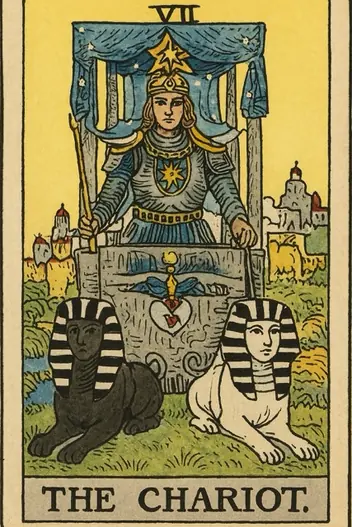

- Arcana
- The Chariot — Major Arcana; Judgement — Major Arcana
- Elements
- The Chariot — Water; Judgement — Fire
- Elemental interaction
- Opposing elements — energies create tension
- Numerology
- 7 + 20 = 27 → 9
When The Chariot and Judgement appear together, you are looking at a psychological crossroads where raw determination meets a moment of existential accounting. The Chariot represents the disciplined ego, the will to conquer obstacles through sheer focus and control. Judgement, conversely, is the call of the deeper Self—an invitation to evaluate, transform, and rise from the ashes of old patterns. In practical terms, this combination often appears when you have been driving hard toward a goal, and now the universe—or your own psyche—is demanding a pause for honest reflection. The question is not whether you can move forward, but whether you should—and what you must leave behind to do so authentically.
This is a potent pairing for anyone who has been suppressing doubts or ignoring red flags in pursuit of victory. The Chariot’s momentum can easily become a runaway train without Judgement’s sobering call for accountability. Psychologically, this mirrors the tension between the heroic ego (driven by external validation) and the individuating Self (driven by inner truth). The key insight is that true success here requires not just willpower, but a willingness to undergo a psychological reckoning—to confront what you have avoided, and to align your actions with a higher standard of integrity.
The Chariot and Judgement Combination Meaning
The core dynamic of The Chariot and Judgement is a strategic confrontation with consequence. The Chariot provides the raw horsepower—focus, ambition, and the ability to overcome external resistance. Judgement provides the radar—discernment, evaluation, and the capacity to see the bigger picture of cause and effect. When these cards merge, you are not simply moving forward; you are moving forward after a decisive evaluation of your past actions. This often manifests as a pivotal moment in a project, relationship, or personal journey where you must decide what to salvage and what to discard.
In practice, this combination suggests a mindset of calculated renewal. You are being asked to harness your willpower not for blind conquest, but for a targeted transformation. For example, a leader might need to fire a underperforming team member (Judgement’s hard truth) to steer the company back on course (The Chariot’s drive). On a personal level, it can indicate a period where you are auditing your own behavior—acknowledging past mistakes without shame, and using that clarity to fuel a more disciplined future. The psychological state is one of resolute accountability: you are no longer a victim of circumstance, but an active agent of your own correction.
The real-world implication is that this pair rarely signals easy or comfortable progress. Instead, it points to a necessary, often difficult, realignment. The Chariot’s victory is hollow if it is built on a foundation of denial. Judgement ensures that your wins are earned through integrity. Therefore, the primary action here is to stop and take stock before accelerating. Identify the one area where you have been avoiding a hard truth—whether it’s a broken promise, a flawed strategy, or a toxic relationship—and commit to facing it head-on. Only then can The Chariot’s power be used for sustainable, meaningful achievement.
Career and Finances
Strategic Opportunities:
This is an ideal time to launch a major initiative after a thorough review of past mistakes. Use Judgement’s clarity to refine your strategy before The Chariot’s full power is applied. A career pivot or a business restructuring is highly favored.
Strategic Opportunities:
You may be called to take a leadership role in a turnaround situation. Your ability to combine decisive action with honest assessment of what went wrong will be your greatest asset.
Calculated Risks:
Avoid making a major financial move based on pride or a desire for revenge. The Chariot’s ego can lead to overconfidence. Ensure your decisions are grounded in data and a realistic appraisal of risks, not a need to prove someone wrong.
In the professional sphere, The Chariot and Judgement signal a pivotal moment for decision-making and resource management. This is not a time for passive waiting or impulsive gambles. Instead, it is a period for strategic auditing—reviewing your career path, your company’s financial health, or a project’s viability with brutal honesty. The Chariot gives you the energy to execute, but Judgement ensures you are executing the right plan. A critical financial warning here is to resist the temptation to double down on a failing strategy out of sheer willpower. The Chariot’s “never give up” attitude can be a liability if it prevents you from cutting losses. Instead, use Judgement’s perspective to determine if a course correction—or a complete pivot—is necessary. For negotiations, this pair favors a direct, no-nonsense approach. You are in a position of strength if you lead with facts and a clear-eyed assessment of the situation. Avoid emotional appeals or passive-aggressive tactics; the most powerful move is to state your terms and your reasoning clearly, then let the other party respond.
Your pair is already on the table. Ask your question and draw the clarifying card
or simply focus on it
What Do The Chariot and Judgement Say About Love?
If you are single:
This combination suggests you may be called to re-evaluate your standards for a potential partner. Do not ignore red flags just because someone seems ambitious or exciting. Use Judgement’s clarity to discern if a new connection aligns with your long-term values, not just your immediate desires.
If you are in a relationship:
Expect a period of serious accountability between you and your partner. This is not the time for sweeping issues under the rug. The Chariot’s drive must be channeled into constructive conflict resolution—facing uncomfortable truths together to strengthen the bond.
In a relationship context, The Chariot and Judgement often appear when a couple is at a critical juncture—perhaps after a betrayal, a major life change, or a period of drifting apart. The Chariot represents the will to fight for the relationship, but Judgement demands that the fight be based on honesty, not ego. The key relationship advice here is to prioritize transparency over winning. If one partner is trying to “win” an argument (The Chariot’s competitive side), Judgement reminds them that the real victory is mutual understanding and growth. This pair also highlights the importance of boundaries: one partner may need to assert a hard limit (e.g., “I cannot stay if this behavior continues”), while the other must decide if they are willing to change. Emotional intelligence is paramount—this is not about blame, but about using the crisis as a catalyst for a deeper, more authentic connection. For singles, the message is equally clear: a new romance will not thrive on momentum alone. You must be willing to judge the character of the person you are dating, not just their charisma or drive.
What Are the Risks of The Chariot and Judgement?
The shadow side of The Chariot and Judgement manifests as a dangerous blend of hubris and self-righteousness. When the ego (The Chariot) co-opts the moral authority of Judgement, the seeker may become rigidly convinced of their own rightness, refusing to consider alternative perspectives. This can lead to authoritarian behavior—forcing decisions through without consulting others, or cutting off relationships with a sanctimonious “I know what’s best” attitude. The cognitive bias at play is the confirmation bias: you only seek evidence that supports your predetermined course of action, ignoring warning signs that Judgement would normally highlight.
Another pitfall is paralysis from over-analysis. The Chariot wants to move, but Judgement can get stuck in an endless loop of self-evaluation, leading to indecision and missed opportunities. The seeker might become their own harshest critic, judging every past action so harshly that they lose the confidence to act at all. This is a form of self-sabotage driven by perfectionism. Finally, there is the risk of performative transformation—going through the motions of a “reckoning” (e.g., making a dramatic apology or a public statement of change) without any real internal shift. The shadow here is using the language of growth to maintain the status quo. To avoid these pitfalls, the key is to balance accountability with self-compassion, and to remember that Judgement’s ultimate purpose is liberation, not condemnation.
Deepen your understanding
Find out exactly what this reading means for your current life situation with our oracle.
What If The Chariot or Judgement Appears Reversed?
When cards appear in a reversed position, the dynamic becomes distorted, turning into a trap.
If The Chariot is reversed:
You lose control over your destiny. Instead of purposeful movement — chaotic flailing. Judgment in the upright position intensifies the feeling of guilt over missed opportunities. Advice: stop blaming circumstances and start small — take control of one area of your life.
If Judgment is reversed:
Internal resistance to change and a refusal of self-analysis. You are ignoring obvious signals that it is time to change. The upright Chariot in this case becomes a meaningless race — you are moving, but in the wrong direction. Advice: stop. Your main task is not to win, but to understand why you are fighting.
If BOTH are reversed:
Complete imbalance. Anarchy in actions and denial of reality. You do not control the situation and do not want to hear the truth. This is a path to ruin. The only way to fix the situation is to admit your powerlessness and seek help from an external expert (coach, psychologist).
What Is the Overall Message of The Chariot and Judgement?
How to constructively use the Chariot's energy to balance Judgment? The answer is simple: transform judgment from an external authority into an internal audit. The Chariot's energy is your will and discipline. Direct it not toward suppressing opponents, but toward systematizing your life. Make "auditing" your goals, relationships, and finances a routine practice, not a one-time act.
Strategic advice: imagine Judgment is a map, and the Chariot is your navigator. You cannot simply drive by the map without consulting it. Your task is to consult the map (Judgment) every time you make an important decision (the Chariot). This will give you clarity and protect you from fatal mistakes. Instead of fearing "judgment" as punishment, perceive it as feedback from reality. If you honestly conduct the audit, the Chariot will deliver you to your destination with minimal losses. Do not try to outwit fate—better to forge an alliance with it.
Where to Go From Here
The Chariot and Judgement together deliver a powerful message about the necessity of honest self-assessment before decisive action. They ask you to stop, evaluate your past with clarity, and then move forward with purpose—not from ego, but from a place of earned integrity. The victory they promise is not about crushing opponents, but about aligning your will with your higher truth.
While this article provides a deep understanding of the archetypes, the true power of Tarot lies in its application to your unique situation. Your specific question, your current life context, and the other cards in your spread all add layers of nuance that a general interpretation cannot capture. To get a personalized reading of this exact combination for your love life, career, or personal dilemma, use the Fortune Cards app. Whether on the web or via download, you can input your question and receive a deep, tailored interpretation that cuts through the noise and gives you actionable clarity right now.
Interpretation by the Fortune Cards editorial team, based on the Rider–Waite tradition and Jungian archetypes. About our methodology · Updated: 2026-08-26
Other Combinations with The Chariot
Other Combinations with Judgement
Explore Individual Card Meanings
Table of Contents
Ready to find answers to your questions?
Start your first reading now and look at your situation with fresh clarity. The cards are ready to reveal deeper meaning.