Judgement and Five of Swords Meaning in Tarot


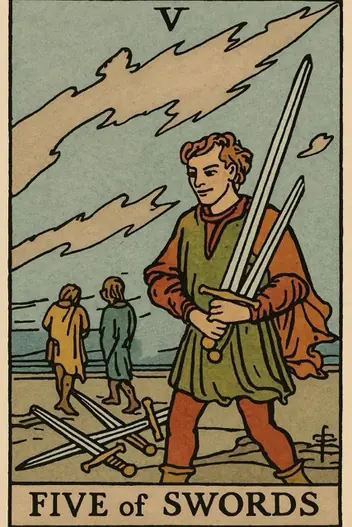
- Arcana
- Judgement — Major Arcana; Five of Swords — Minor Arcana, Swords
- Elements
- Judgement — Fire; Five of Swords — Air
- Elemental interaction
- Friendly elements — energies support each other
- Numerology
- 20 + 5 = 25 → 7
When the clarion call of Judgement meets the cold, calculating energy of the Five of Swords, the result is a stark psychological confrontation. Judgement represents a moment of absolute truth—a reckoning with the past where you must face the consequences of your choices. It is the archetype of the "inner tribunal," demanding radical honesty and a rebirth of identity. The Five of Swords, however, introduces a tactical, often bitter, conflict. It speaks of winning the battle but potentially losing the war, of cutting ties to preserve the ego at the expense of deeper connection.
This combination creates a powerful tension: you are being called to a higher purpose (Judgement) while simultaneously being tempted by a low-stakes victory that may leave you isolated (Five of Swords). The key question here is not if you will act, but how you will justify your actions to yourself afterward. This is a card pair about ethical integrity under pressure and the psychological cost of winning through defeat.
Judgement and Five of Swords Together: Meaning
The core dynamic of Judgement and Five of Swords is a crisis of conscience masked as a strategic necessity. You are likely facing a situation where you feel compelled to "win" a dispute or prove a point, but the victory feels hollow. Psychologically, this represents a clash between the Superego (Judgement’s call to a higher moral standard) and the Ego’s survival instincts (Five of Swords’ need to dominate or escape shame).
In practice, this often manifests as a person who has been wronged or betrayed, and now feels justified in using ruthless tactics to get even. The Judgement card insists on accountability, but the Five of Swords warns that the method of achieving it may damage your reputation or your own self-respect. The real work here is to distinguish between a necessary boundary and a destructive vendetta. You are being asked to evaluate whether the "truth" you are fighting for is genuinely liberating, or simply a weapon to hurt someone else.
The psychological state this creates is one of hyper-vigilance and moral fatigue. You may feel like you are the only one seeing clearly, while everyone else is deluded. This is a dangerous cognitive bias. The wise path is to use Judgement’s clarity to see the entire battlefield, not just the enemy. Your greatest risk is winning the argument but losing your soul.
Your pair is already on the table. Ask your question and draw the clarifying card
or simply focus on it
Judgement and Five of Swords in Love and Relationships
If you are single:
Be wary of a connection that feels like a "legal case" rather than a romance. You may be judging a potential partner too harshly based on past wounds, or you might be drawn to someone who enjoys "winning" arguments more than building intimacy. The goal is not to be right, but to be understood.
If you are in a relationship:
This pairing signals a toxic cycle of blame and score-keeping. One or both partners may be using past grievances as ammunition in current conflicts. The relationship is at a crisis point where a fundamental decision must be made: will you fight to "win" the argument, or fight to save the relationship?
In a relationship context, this combination often appears when a couple is facing a major reckoning—infidelity, a broken promise, or a long-ignored power imbalance. The Judgement card demands that both partners look at the truth of their dynamic, while the Five of Swords warns that one person may be preparing to "walk away victorious" but emotionally bankrupt. The healthiest approach is to acknowledge the hurt without using it as a weapon. If you are the one holding the sword, ask yourself: Is this victory worth the loneliness it will bring? Bold action here means setting a firm boundary, not launching a counter-attack. The relationship can only survive if both parties are willing to be judged by the same standard of honesty.
Deepen your understanding
Find out exactly what this reading means for your current life situation with our oracle.
Judgement and Five of Swords for Career and Money
Strategic Opportunities:
Use this energy to audit your professional reputation and cut out toxic alliances or clients that drain your resources. A clean break, even if costly, is better than a slow bleed.
Strategic Opportunities:
This is a powerful time for renegotiating contracts or roles where you have been undervalued. The Five of Swords gives you the tactical edge to secure better terms, but only if you lead with facts, not fury.
Calculated Risks:
Avoid public conflicts or office politics that could damage your long-term credibility. Winning a petty argument with a colleague may label you as difficult, not brilliant. Do not burn bridges you may need to cross again.
Professionally, this combination is a high-stakes warning against Pyrrhic victories. You may be tempted to expose a competitor’s flaw, sue a former employer, or force a colleague out. While you may technically "win," the cost—in legal fees, reputation, or emotional energy—may far outweigh the gain. Financially, this is not a time for speculative gambles. Instead, focus on restructuring your assets or debts with a clear, sober eye. The Judgement card suggests a tax audit, a legal settlement, or a major career pivot is imminent. Your best strategy is to prepare your case meticulously, but be willing to walk away from a fight that serves only your pride. Remember: in the long game of career, integrity is your most undervalued asset.
Judgement and Five of Swords Reversed Meaning
When cards are reversed, the dynamic shifts from external action to internal conflict or a complete blockage of the process.
If Judgment is Reversed:
The potential for transformation is blocked. You are postponing the inevitable, avoiding decisions and responsibility. Instead of clear judgment, you get chaos and uncertainty. The Five of Swords upright, alongside a reversed Judgment, points to a pointless struggle — you are fighting, but you don't understand what for. Advice: stop and acknowledge your unwillingness to change. This is more honest than feigning activity.
If the Five of Swords is Reversed:
This indicates an internal resistance to conflict. You fear the consequences of the truth, preferring a false peace. Judgment upright demands truth, but you are not ready to voice it. This is the state of a victim who tolerates injustice to avoid the pain of a breakup. Key advice: your silence is also a choice, and it has consequences. Weakness here is not a virtue.
If BOTH are Reversed:
Complete imbalance. You are in a trap of denial. There is neither a calling for change (Judgment reversed) nor the strength for conflict (Five of Swords reversed). This is apathy and stagnation, where problems are hushed up and energy is spent on self-deception. Remedy: an external catalyst is required — consultation with a psychologist, a coach, or a drastic change of scenery to shake you out of this quagmire.
When Judgement and Five of Swords Signal Trouble
The shadow of this pairing is self-righteousness disguised as moral clarity. The primary pitfall is the confirmation bias—you will only see evidence that supports your narrative of being wronged, while ignoring your own contributions to the conflict. This can lead to a state of paranoid isolation, where you believe everyone is against you, and only your "awakening" is valid.
Another dangerous manifestation is the "martyr complex" : you may feel called to sacrifice a relationship or job to prove a point, mistaking self-destruction for spiritual growth. The Five of Swords here can also represent gaslighting—either you are being manipulated into doubting your own judgment, or you are using your "awakened" status to manipulate others. Cognitive dissonance is high. You may know you are acting badly, but you rationalize it as "necessary truth-telling." The ultimate pitfall is winning a hollow victory that leaves you utterly alone, wondering why your "awakening" feels so empty. If you feel a rush of righteous anger, pause. That is often the shadow speaking.
Overall Meaning of Judgement and Five of Swords
How can the energy of Judgment be constructively used to balance the Five of Swords? The answer lies in redefining the concept of "victory". In this combination, you will never win in the eyes of others. Your victory is preserving your own integrity. Judgment grants you permission for truth, and the Five of Swords provides the tool for extracting it. Your task is not to brandish this tool, but to use it with surgical precision.
Strategic advice:
Before entering a conflict, ask yourself three questions. First: "What do I want to achieve?" — the answer must be specific. Second: "What is the minimum price I am willing to pay?" — define the boundaries of your losses. Third: "What will I learn about myself in the process?" — this is the most important question, transforming conflict into a lesson.
This card is not about avoiding pain. It is about passing through the fire of judgment without being consumed by the flames of others' opinions. In this context, the Five of Swords is not a loss, but the price for the right to be yourself. If you are willing to pay it, you will emerge from the situation not with trophies, but with a deep knowledge of your true priorities. Use the energy of Judgment to separate the important from the trivial, and the resolve of the Five of Swords to cut away what no longer serves your growth.
Your Next Step: Personal Context Matters
The Judgement and Five of Swords combination is a powerful call to own your choices and their consequences. It asks you to stop fighting battles that only serve your ego, and instead, use your clarity to rebuild on a foundation of authentic truth. The core message is: you can be right, or you can be free. Choose wisely.
While this article provides a deep, archetypal analysis of these two cards, the real power of Tarot lies in how they apply to your unique situation. The specifics of your question—who is involved, what is at stake, and your personal history—radically change the interpretation. To get a truly personalized reading of the Judgement and Five of Swords combination for your exact life circumstances, use the Fortune Cards app. You can access it on the web or download it now to receive a deep, tailored interpretation that addresses your specific question with the nuance and accuracy you deserve. Your story is unique. Let the cards tell it.
Interpretation by the Fortune Cards editorial team, based on the Rider–Waite tradition and Jungian archetypes. About our methodology · Updated: 2026-08-26
Other Combinations with Judgement
Other Combinations with Five of Swords
Explore Individual Card Meanings
Table of Contents
- Judgement and Five of Swords Together: Meaning
- Judgement and Five of Swords in Love and Relationships
- Judgement and Five of Swords for Career and Money
- Judgement and Five of Swords Reversed Meaning
- When Judgement and Five of Swords Signal Trouble
- Overall Meaning of Judgement and Five of Swords
- Your Next Step: Personal Context Matters
Ready to find answers to your questions?
Start your first reading now and look at your situation with fresh clarity. The cards are ready to reveal deeper meaning.