Judgement and Ten of Swords Together in Tarot
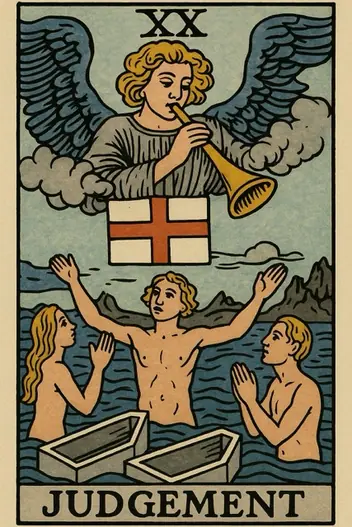
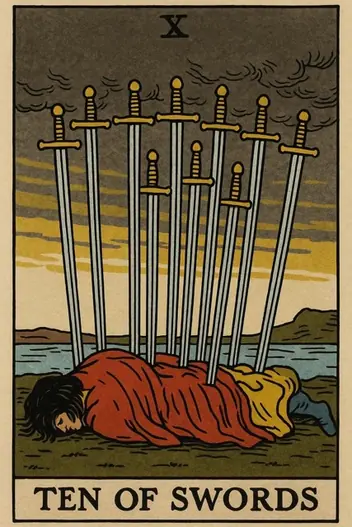
- Arcana
- Judgement — Major Arcana; Ten of Swords — Minor Arcana, Swords
- Elements
- Judgement — Fire; Ten of Swords — Air
- Elemental interaction
- Friendly elements — energies support each other
- Numerology
- 20 + 10 = 30 → 3
When the card of ultimate awakening meets the card of final defeat, we confront a psychological paradox: the call to rise from a situation that appears completely destroyed. Judgement demands radical self-evaluation and rebirth, while the Ten of Swords signals an ending so conclusive it feels like a death. Together, they create a tension between the need to move forward and the reality of being pinned down by consequences. This pairing rarely indicates a gentle transition; instead, it forces a ruthless audit of what went wrong and a decision about whether resurrection is possible—or wise.
From a Jungian perspective, this combination activates the archetypes of the Wounded Healer and the Shadow Self. The Ten of Swords represents the shadow material that has been suppressed until it manifests as a crisis—often self-inflicted. Judgement, however, is the inner judge that demands accountability, not punishment. The key insight here is that the seeker must differentiate between guilt (a useful signal) and shame (a paralyzing identity). The cards suggest that the only way out is through a painful but necessary confrontation with one's own patterns of denial.
Core Dynamics & Interpretation
The Judgement and Ten of Swords pairing creates a psychological crucible where the seeker's old identity must be sacrificed. The Ten of Swords shows a situation that has hit rock bottom—a betrayal, a failure, or a complete breakdown of trust. Judgement, however, introduces a non-negotiable call to rise. This is not about ignoring the pain but about using the catastrophe as a diagnostic tool. The core dynamic is: you cannot change what you refuse to see. The Ten of Swords provides brutal clarity; Judgement demands you act on it.
In practice, this combination often appears when a person is stuck in rumination—replaying the "death" over and over. The psychological state here is one of cognitive dissonance: knowing the ending is final, yet feeling a pull toward transformation. The most strategic response is to stop asking "why me?" and start asking "what did I ignore?" . The Ten of Swords is rarely random; it is the result of accumulated small decisions. Judgement forces the seeker to own their role in the collapse, not as self-blame, but as a prerequisite for rebuilding on solid ground.
The real-world implication is decisive action after analysis paralysis. This is not a time for more therapy or more talking; it is a time for execution of insight. The cards warn against spiritual bypassing—using the "rebirth" promise of Judgement to avoid the messy work of grief and repair. True transformation here requires a funeral before a resurrection. The seeker must let the old version of themselves, the relationship, or the career die completely before Judgement can offer a new direction.
Career Meaning of Judgement and Ten of Swords
Strategic Opportunities:
Use the crisis to fire a toxic client, partner, or employee that you have been avoiding. The Ten of Swords gives you permission to end it decisively.
Strategic Opportunities:
Rebrand or pivot your business model based on the hard data of what failed. Judgement supports a complete overhaul, not a patch.
Calculated Risks:
Avoid making any major financial decisions for 30 days after the "crash." The emotional weight of the Ten of Swords can cloud objective judgment.
In career and financial readings, this combination is a call for a strategic retreat and a forensic audit. The Ten of Swords might represent a project that failed spectacularly, a job loss, or a partnership that collapsed. Judgement says: do not waste the crisis. This is the moment to analyze the root cause of the failure—was it poor planning, bad timing, or a fundamental flaw in the business model? The psychological trap is over-identifying with the failure ("I am a failure") instead of treating it as data ("This approach failed").
Financially, this is a high-risk, high-reward moment. The cards warn against gambling on a "Hail Mary" recovery to avoid admitting loss. Instead, take a calculated loss to preserve capital for the next move. For example, if a business is failing, Judgement advises closing it with dignity rather than draining resources trying to save it. Bold strategic tip: the most profitable decision now might be the one that cuts your losses fastest. In career terms, this pairing often signals a forced career change that, while painful, aligns you with your authentic skills. The "death" is often the end of a role you outgrew years ago.
Your pair is already on the table. Ask your question and draw the clarifying card
or simply focus on it
Love and Relationships
If you are single:
This pairing suggests you are attracted to unavailable or emotionally destructive partners, or you are emerging from a painful ending that requires a complete identity reset before dating. Do not rush into a new connection; instead, audit your past choice patterns to avoid repeating the cycle.
If you are in a relationship:
You are at a make-or-break moment where a major betrayal or lie has been exposed. The relationship may appear dead, but Judgement offers a choice for radical honesty and renegotiation of terms—if both partners are willing to face the truth.
In a relationship context, this combination signals a crisis of integrity. The Ten of Swords often represents a "final straw" event—an affair, a financial deception, or a fundamental breach of trust. Judgement does not promise reconciliation; it promises clarity. The psychological work here is for both partners to separate the person from the behavior while still holding the person accountable. The key advice is: do not use "forgiveness" as a shortcut to avoid the hard work of rebuilding trust. True Judgement requires a public admission of fault and a concrete plan for change, not just apologies.
If the relationship can survive, it will be fundamentally different—more transparent, more grounded, and less tolerant of denial. If it cannot, Judgement ensures the ending is clean, not messy. The worst outcome is a half-death: staying together but never truly addressing the wound. Boldly, the cards advise: either commit to complete transformation or walk away with no guilt. The relationship's future hinges on whether both people can look at the "corpse" of what was and decide if a new form is possible.
Reversed Positions: What Changes?
If Judgment is Reversed (and the Ten of Swords is Upright):
This indicates blocked potential or self-deception. You see the end, you feel the pain (Ten of Swords), but you refuse to draw conclusions. You may blame circumstances, other people, or fate. Warning: you risk getting stuck in the victim role for a long time. Until you activate your inner "judgment" and conduct an honest self-analysis, you will repeat this scenario again. Advice: start small—acknowledge at least one of your own mistakes in this situation.
If the Ten of Swords is Reversed (and Judgment is Upright):
This is internal resistance to the inevitable or a delay of the finale. You know you need to act (Judgment), but you fear the blow. You put off making a decision, hoping everything will "blow over." Advice: don't wait for the blow to become stronger. The energy of Judgment here suggests you have a chance to exit the situation with minimal losses if you take the initiative and complete the process yourself, rather than waiting for it to be done for you.
If BOTH are Reversed:
Complete imbalance—chaos and denial. You accept neither the reality of the end nor the necessity of re-evaluation. This is a state of psychological paralysis, where a person freezes in the face of catastrophe. The most dangerous scenario, leading to prolonged depression. The way to correct this: forcibly reduce your stress level. You don't need analysis, but basic action: clean the house, go for a walk, do one simple task. Only by restoring basic functionality can you turn your mind back on and begin the process of awareness.
Uncover hidden insights
Let our advanced Tarot system interpret these archetypes specifically for your personal path.
What Are the Risks of Judgement and Ten of Swords?
The shadow of this combination is spiritual arrogance or toxic positivity. The seeker may use Judgement's "rebirth" narrative to skip the grieving process, telling themselves "everything happens for a reason" while avoiding the real pain. This leads to repressed emotions that will resurface later as physical illness or relationship dysfunction. Another shadow manifestation is self-flagellation: using the Ten of Swords as proof of one's worthlessness, and Judgement as a harsh inner critic that demands impossible perfection.
Cognitive biases to watch for include hindsight bias ("I should have seen this coming") and catastrophizing ("This failure defines my entire future"). The shadow also includes martyrdom—using the "death" of the situation to gain sympathy or avoid responsibility. The biggest pitfall is using this combination as an excuse for passivity. Judgement is an active call; the shadow version is waiting for a "sign" to move instead of taking decisive action. Bold warning: if you feel "stuck" between these cards, you are likely avoiding a painful truth that only you can face.
Judgement and Ten of Swords Combined Message
How to constructively use the energy of Judgment to balance the Ten of Swords? The key lies in shifting focus from the past to the future. The Ten of Swords is fixated on the moment of defeat, on the pain of the "here and now." Judgment proposes viewing this pain as data for analysis. Your task is to perform an "autopsy" of the situation without emotion, like a surgeon studying a pathology to prevent its recurrence in the future.
Strategic advice: use the "Reverse Gear" principle. Ask yourself: "What decision, made 3, 6, or 12 months ago, led me to this point?" The answer to this question is the voice of Judgment. Once you find that decision, you will understand exactly which mindset needs to be changed. In this context, the Ten of Swords is not a punishment, but feedback. The stronger the pain, the more valuable the lesson.
Your next step is not to try to "fix" the situation, but to integrate the experience. This means you must allow the old structure (relationship, job, belief) to collapse, without clinging to its wreckage. The energy of Judgment will grant you the clarity to see a new path, but only after you have passed through the "gate" of the Ten of Swords. Accept the loss as the price of entry into a new, more conscious stage of your life.
Applying This to Your Situation
The Judgement and Ten of Swords combination is a catalyst for radical honesty, not a prediction of doom. It asks you to stop avoiding the reality of a situation that has ended and to use that ending as a foundation for something more authentic. The core message is: you cannot heal what you refuse to see, and you cannot rebuild on a lie. Whether in love, career, or self-growth, the path forward requires a ruthless audit of your choices and the courage to let go of what is already dead.
While this article provides the general archetype, the true power of Tarot lies in how these cards interact with your specific life context. The Fortune Cards app can give you a deep, personalized interpretation of this exact combination for your unique question. Download it on the web or from your app store to get a reading that accounts for your specific situation, timing, and other cards in your spread. Don't settle for generic advice—get the clarity you need to make your next move.
Interpretation by the Fortune Cards editorial team, based on the Rider–Waite tradition and Jungian archetypes. About our methodology · Updated: 2026-08-26
Other Combinations with Judgement
Other Combinations with Ten of Swords
Explore Individual Card Meanings
Ready to find answers to your questions?
Start your first reading now and look at your situation with fresh clarity. The cards are ready to reveal deeper meaning.