King of Cups and Ten of Swords Together in Tarot
- Arcana
- King of Cups — Minor Arcana, Cups; Ten of Swords — Minor Arcana, Swords
- Elements
- King of Cups — Water; Ten of Swords — Air
- Elemental interaction
- Neutral elements — energies coexist without conflict
- Numerology
- 14 + 10 = 24 → 6
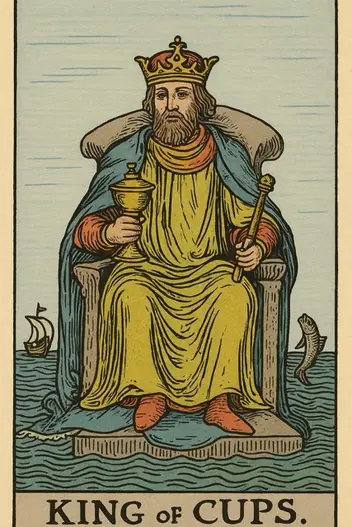
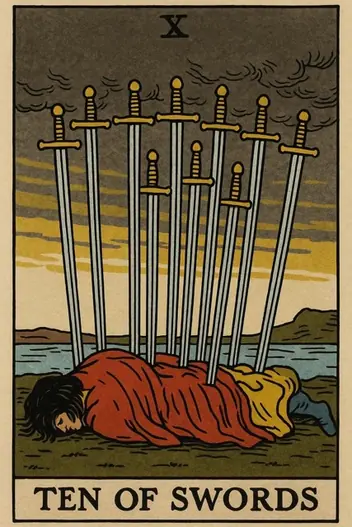
When the King of Cups, the archetype of emotional regulation and diplomatic control, meets the Ten of Swords, the card of rock-bottom endings and painful clarity, a complex psychological landscape emerges. You are not simply experiencing a crisis; you are being asked to manage one with sophisticated emotional intelligence. This combination suggests a scenario where a powerful, feeling-oriented person—or your own inner capacity for calm—must navigate a definitive, often brutal conclusion. The collision here is between the desire to maintain composure and the reality that something must die for growth to occur.
Practically, this pairing signals a moment of strategic surrender. The Ten of Swords demands you accept a defeat or an ending that is total and final, while the King of Cups provides the psychological toolkit to do so without self-destruction. The key insight is that emotional mastery does not mean avoiding pain, but processing it with dignity. This is not about pretending everything is fine; it is about choosing your response to a situation that is, objectively, over.
What Do King of Cups and Ten of Swords Mean Together?
The core dynamic of the King of Cups and Ten of Swords is a tension between containment and catastrophe. The King represents the ability to hold your emotional center, to observe feelings without being consumed by them. The Ten of Swords, however, represents the moment when the emotional body is overwhelmed—a betrayal, a sudden loss, or a painful truth that cannot be ignored. The psychological state created is one of "composed crisis." You may feel as if you are bleeding internally while maintaining a calm exterior, or you may be dealing with the aftermath of a shock that requires you to be the stable anchor for others.
In real-world terms, this combination often appears when a leader, caregiver, or emotionally mature individual must handle a situation that is fundamentally unfair or devastating. The risk is emotional suppression: using the King's control to numb the pain of the Ten of Swords, leading to long-term resentment or psychosomatic issues. The opportunity is transformative grief: allowing the Ten's finality to wash over you while the King's wisdom ensures you do not drown. The primary takeaway is that true power lies in accepting the ending without letting it define your self-worth. You are not the victim of the story; you are the narrator who is closing the chapter.
Love and Relationships
If you are single:
This combination warns against pursuing a connection that has already ended in your heart or mind. Do not use emotional intelligence to rationalize staying in a dead-end dynamic. Instead, apply the King's insight to understand why this pattern ended, and use the Ten's clarity to move on decisively.
If you are in a relationship:
Expect a powerful confrontation or a necessary ending that tests your emotional maturity. The partner embodying the King of Cups must avoid becoming a "therapist" to the one hit by the Ten of Swords. Mutual honesty, not one-sided emotional labor, is the only path forward.
In relationships, this pair often signals a breakthrough via breakdown. One partner may feel betrayed or stabbed in the back (Ten of Swords), while the other must remain calm and accountable (King of Cups). The critical advice is to avoid gaslighting or minimizing the pain. If you are the King, your role is not to fix the wound but to create a safe container for the truth to be spoken. If you are the Ten, your role is to express your pain without weaponizing it. Boldly state: The healthiest outcome is a respectful, conscious uncoupling or a deep, honest recalibration of the relationship's foundation. Emotional intelligence here means knowing when to fight and when to release.
Your pair is already on the table. Ask your question and draw the clarifying card
or simply focus on it
Career and Finances
Strategic Opportunities:
Leverage your emotional intelligence to mediate a toxic exit or project closure. Your ability to remain calm under fire will be remembered by higher-ups.
Strategic Opportunities:
Use the Ten of Swords' clarity to cut a failing investment or a draining partnership. The King's control ensures you do this with minimal legal or relational fallout.
Calculated Risks:
Beware of taking on "savior" projects. Do not let your empathy (King) convince you to revive a dead initiative (Ten) that should be buried. This is a time for strategic pruning, not resuscitation.
For your career, this combination is a call to manage the end of a cycle with professional grace. A contract may not be renewed, a project may be scrapped, or a colleague may be let go. The King of Cups energy is essential for handling the human element: delivering bad news, accepting a demotion, or protecting your team's morale during layoffs. Financially, this is a "stop-loss" moment. Do not pour more resources into a sinking ship. The Ten of Swords says the loss is already incurred; the King says you must account for it without panic. The strategic move is to protect your reputation and your cash reserves. A graceful exit now preserves the network and capital you will need for your next venture.
What If King of Cups or Ten of Swords Appears Reversed?
When cards appear in reversed positions, the dynamics become more complex and less predictable.
If the King of Cups is reversed:
Emotional control turns into manipulation and emotional tyranny. Instead of a mature conclusion, you get sabotage and passive aggression. The person uses their knowledge of others' feelings to strike (Ten of Swords) with maximum cruelty. Advice: distance yourself from those who use empathy as a weapon.
If the Ten of Swords is reversed:
The catastrophe is prolonged or fails to occur at all. This is a state of "death throes", where you know the end is inevitable but refuse to accept it. The King of Cups in this position loses his power, becoming an anxious observer. Warning: your delay in making a decision worsens the situation. The blow will still come, but you will lose control over its consequences.
If BOTH are reversed:
Complete imbalance: emotional immaturity (King of Cups) meets a protracted crisis (Ten of Swords). This is a toxic mix of self-sabotage and irrational fear. Solution: seek an external consultant or psychologist. Getting out of this loop on your own is nearly impossible due to a complete loss of objective perspective.
Deepen your understanding
Find out exactly what this reading means for your current life situation with our oracle.
King of Cups and Ten of Swords: Warning Signs
The shadow of this combination is emotional manipulation disguised as composure. The King of Cups can become a "cold fish" or a passive-aggressive tyrant, using his calmness to gaslight the person who is clearly wounded by the Ten of Swords. The cognitive bias here is the "I'm above this" fallacy—believing that not reacting emotionally means you are more mature, when in reality you may be avoiding accountability. Alternatively, the shadow of the Ten of Swords can lead to victim martyrdom, where the seeker uses their "backstabbing" narrative to justify a permanent state of helplessness, refusing the King's offer of emotional structure. Self-sabotage manifests as either staying too long in a toxic situation (King's complacency) or dramatically overreacting to a manageable setback (Ten's defeatism). The key pitfall is mistaking emotional numbness for emotional intelligence.
Synthesis: Strategic Conclusion
Constructive use of this combination requires a conscious separation of emotional competence from emotional suppression. Your task is not to avoid the blow of the Ten of Swords, but to meet it with maximum awareness. The strategic advice: use the energy of the King of Cups not to "save face," but to organize the process of recovery after the catastrophe.
The practical algorithm of action includes three steps. First: accept the fact that the situation is over and there is no return to the past. Second: use your emotional intelligence to create an "exit protocol" — a clear action plan for minimizing damage to all parties involved. Third: direct the liberated energy toward building a new structure, without trying to revive the old one.
The deep strategic conclusion is that true maturity is manifested not in the ability to avoid pain, but in the skill of integrating the experience of catastrophe into one's life. The King of Cups, having passed through the Ten of Swords, does not simply become emotionally mature — he becomes wise. This wisdom is not the knowledge of how to avoid fate's blows, but the understanding of how to rise from the ashes with dignity.
Where to Go From Here
The core message of the King of Cups and Ten of Swords is this: You can survive a fatal blow without becoming a monster. You have the emotional resources to handle this ending with dignity, but only if you allow yourself to feel the sword's sting without losing your throne. The finality is real—do not fight it. The mastery is also real—use it.
While this analysis provides the general archetype, the true power of Tarot lies in its application to your unique situation. The Fortune Cards app can give you a deep, personalized interpretation of this exact combination for your specific question about love, career, or personal growth. Whether you use the app on the web or download it, you will receive a custom reading that accounts for your context, helping you move from abstract insight to concrete action. Do not face this ending alone—let the cards guide your next strategic step.
Interpretation by the Fortune Cards editorial team, based on the Rider–Waite tradition and Jungian archetypes. About our methodology · Updated: 2026-08-26
Other Combinations with King of Cups
Other Combinations with Ten of Swords
Explore Individual Card Meanings
Ready to find answers to your questions?
Start your first reading now and look at your situation with fresh clarity. The cards are ready to reveal deeper meaning.