The Devil and Ten of Swords Meaning in Tarot

- Arcana
- The Devil — Major Arcana; Ten of Swords — Minor Arcana, Swords
- Elements
- The Devil — Earth; Ten of Swords — Air
- Elemental interaction
- Opposing elements — energies create tension
- Numerology
- 15 + 10 = 25 → 7
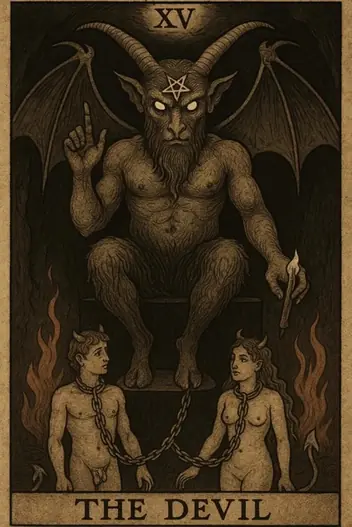
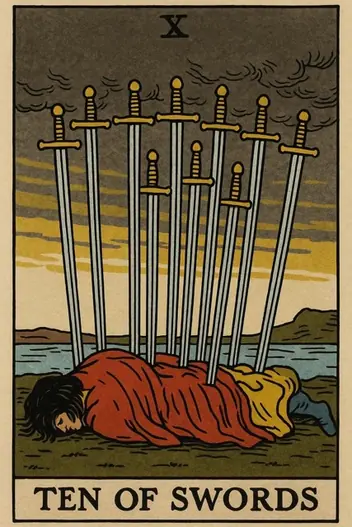
When The Devil and the Ten of Swords appear together, you are looking at the psychological endpoint of a toxic cycle. The Devil represents addiction, materialism, and the shadow of compulsive behavior—the chains we forge ourselves through fear and desire. The Ten of Swords signals a painful, abrupt ending—a crisis that feels like the ultimate betrayal or defeat. Together, they describe a collapse that is not random, but the inevitable consequence of ignoring red flags, overindulging in a destructive pattern, or clinging to a false sense of security.
This is not a card pair about bad luck. It is about cause and effect. The seeker may have been trapped in a situation—a relationship, a job, or a mindset—that promised comfort but delivered chronic anxiety. The Ten of Swords is the breaking point: the moment the bill comes due. Pragmatically, this combination demands a ruthless audit of your attachments. What are you unwilling to let go of, even as it destroys you? The path forward requires accepting the loss as a necessary amputation, not a tragedy.
The Devil and Ten of Swords Together: Meaning
The psychological state here is one of learned helplessness mixed with acute crisis. The Devil creates a loop of short-term gratification and long-term pain—think of a gambler chasing losses or a person staying in a demeaning job for the paycheck. The Ten of Swords is the moment the system crashes. The mind, having exhausted its coping mechanisms, experiences a cognitive collapse: the belief that you are powerless, that you deserve the pain, or that there is no way out.
This is where a Jungian lens is critical. The Devil is the Shadow archetype in full control—the parts of your psyche you deny (greed, envy, lust for control) that drive your behavior unconsciously. The Ten of Swords is the ego's death—the shattering of the persona you built around that shadow. For example, a person who identifies as a "fixer" in a toxic relationship may finally face the truth that they are an enabler. The collapse is brutal, but it is also the only path to individuation. The key insight: you cannot break a chain you refuse to see. This pair forces you to see the chain, even as it cuts into your neck.
The practical implication is clear: stop trying to salvage the unsalvageable. The Ten of Swords shows a figure pinned down by ten blades—any movement to "fix" the situation will only twist the blades deeper. Instead, the card asks you to lie still, assess the damage, and plan your crawl to safety. The Devil’s energy will tempt you to bargain ("If I just try harder, it will work"), but that is the addiction talking. The healthy response is to accept the loss as tuition for a painful lesson.
The Devil and Ten of Swords: Career and Money
Strategic Opportunities:
The crisis clears out dead weight. Use this moment to cut ties with a toxic client, a draining project, or a boss who exploits you. The ending is a clean slate.
Strategic Opportunities:
A major financial loss (e.g., a failed investment, a layoff) can force you to re-evaluate your relationship with money. Are you chasing status or security? This is a chance to build from values, not greed.
Calculated Risks:
Do not immediately jump into a new venture or job out of panic. The Devil’s energy can make you grab at another "golden handcuff" offer. Wait 30 days before signing anything.
Professionally, this pair often appears when a long-term unsustainable situation finally implodes. Think of a startup founder who ignored burnout until the company collapsed, or an employee who tolerated a hostile work environment until a nervous breakdown. The Ten of Swords is the public failure or sudden termination. Financially, it may represent a major loss due to impulsive spending, gambling, or over-leveraging. The Devil’s materialism—the belief that more money will solve your problems—is directly challenged.
Your strategic move is to adopt a survival mindset, not a growth mindset. Focus on liquidity, not leverage. Cut all discretionary expenses. Do not take on new debt to solve old problems. The Ten of Swords teaches that the worst is already here; the only way is up, but only if you stop digging. The financial warning is clear: this is a time for triage, not expansion. If you are in a negotiation, concede on small points to preserve your core assets. The goal is to emerge with enough to rebuild, not to win.
Your pair is already on the table. Ask your question and draw the clarifying card
or simply focus on it
The Devil and Ten of Swords as Feelings
If you are single:
This pair warns against pursuing a connection that feels intensely magnetic but also draining. You may be attracted to a partner who embodies your shadow—chaotic, controlling, or unavailable. Pause and ask yourself: is this passion or pathology?
If you are in a relationship:
You are likely in a cycle of conflict and reconciliation that has become destructive. One partner may feel "pinned down" by the other’s demands or betrayals. This is a signal that the relationship has crossed from challenging to toxic.
In relationships, The Devil and Ten of Swords describe a power imbalance masked as passion. One partner may be addicted to the drama, while the other feels victimized but stays out of fear—fear of loneliness, financial insecurity, or losing their identity. The Ten of Swords suggests a final betrayal or breakup that feels like a knife in the back. However, this ending is often a gift. The relationship was built on a shared shadow: mutual codependency, secret resentments, or unspoken agreements to ignore problems. The key relationship advice here is to stop blaming the other person. The Devil is your own attachment; the Ten of Swords is the consequence of ignoring it. To heal, you must take radical ownership of your choice to stay. Only then can you walk away without dragging the bitterness into your next relationship.
Negative Meaning of The Devil and Ten of Swords
The shadow of this combination is self-victimization and moral masochism. The seeker may unconsciously believe they deserve the pain, or worse, find a perverse comfort in the drama. The Devil’s shadow is addiction to intensity—you may feel "alive" only when things are falling apart. The Ten of Swords then becomes a self-fulfilling prophecy: you sabotage yourself to prove that you are a victim, avoiding the responsibility of freedom.
Cognitive biases to watch for: the sunk cost fallacy ("I’ve invested too much to leave now"), confirmation bias (seeking evidence that the situation will improve), and catastrophizing (believing this failure defines your entire future). The shadow path is to romanticize the suffering, turning it into a story of martyrdom. Pragmatically, this is the most dangerous trap. It keeps you in the Devil’s cage, just with a new label. The healthy alternative is to see the pain as data, not destiny.
Uncover hidden insights
Let our advanced Tarot system interpret these archetypes specifically for your personal path.
The Devil and Ten of Swords Reversed Meaning
When cards appear in a reversed position, the dynamic becomes more complex, but less fatal. If the Devil is reversed, it points to an internal struggle with addiction that has not yet been acknowledged. The person may deny their role in the crisis, shifting responsibility onto circumstances. Advice: stop looking for an external enemy. Your problem lies in the unwillingness to admit your own vulnerability. If the Ten of Swords is reversed, it speaks of resistance to an inevitable ending. You are clinging to a dying project or relationship, expending your last reserves on reviving it. Warning: this is a path to exhaustion. Refusing to let go now will result in a more painful crisis in the future. If BOTH cards are reversed, a situation of protracted deadlock arises, where a person is stuck between the fear of change and the fear of staying. Remedy: external intervention is necessary—consultation with a psychologist, coach, or mediator. Exiting this cycle on your own is virtually impossible, as both cards in their reversed form symbolize suppressed will and an inability to act.
The Devil and Ten of Swords: Tarot Advice
The combination of The Devil and the Ten of Swords is a tool for radical transformation, not a prophecy of doom. The main task is to harness the energy of The Devil (will, ambition, focus) in order to accept the lesson of the Ten of Swords (completion, release, acceptance of loss). The paradox is that only by acknowledging your powerlessness before circumstances (the surrender of the Ten of Swords) do you reclaim your real power (the true strength of The Devil). Strategic advice: start small. Identify one area of life where you feel the greatest pressure, and make a decision to cease one specific action that is draining you. This could be refusing to check your partner's phone, closing a credit card, or walking out of a futile meeting. Each such action is a blow to The Devil's illusion and a step out of the crisis. Remember: the Ten of Swords is not the end of the story, but the end of a chapter. It clears space for a new plot, but only if you are ready to let go of the old script. Your power now lies not in withstanding the blow, but in consciously not standing in its path.
Your Next Step: Personal Context Matters
The core message of The Devil and Ten of Swords is that freedom comes through surrender, not struggle. You cannot outrun your shadow; you must turn and face it. The ending you are experiencing is not the end of your story, but the end of a chapter built on a false premise. Let the old structure fall. What remains—your values, your resilience, your clarity—is what you will build from.
To apply this insight to your exact situation, you need more than a general meaning. Your specific question—about a relationship, a career move, or a personal habit—changes the nuance of these cards. That is why the Fortune Cards app exists. It gives you a deep, personalized interpretation of this exact combination for your unique question, right now. Download it on the web or from your app store, and let the cards speak directly to your life.
Interpretation by the Fortune Cards editorial team, based on the Rider–Waite tradition and Jungian archetypes. About our methodology · Updated: 2026-08-26
Other Combinations with The Devil
Other Combinations with Ten of Swords
Explore Individual Card Meanings
Table of Contents
- The Devil and Ten of Swords Together: Meaning
- The Devil and Ten of Swords: Career and Money
- The Devil and Ten of Swords as Feelings
- Negative Meaning of The Devil and Ten of Swords
- The Devil and Ten of Swords Reversed Meaning
- The Devil and Ten of Swords: Tarot Advice
- Your Next Step: Personal Context Matters
Ready to find answers to your questions?
Start your first reading now and look at your situation with fresh clarity. The cards are ready to reveal deeper meaning.