The Devil
- Arcana
- Major Arcana · XV
- Element
- Earth
- Planet / Sign
- Capricorn
- Numerology
- 15 → 6
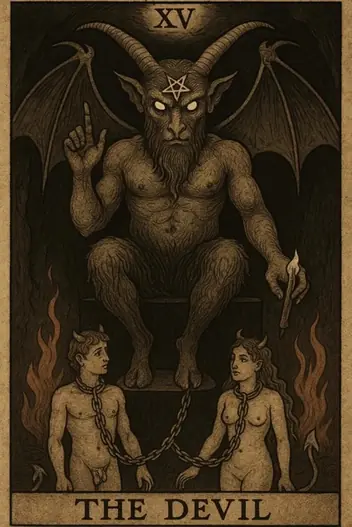
The Devil card represents the Jungian Shadow archetype in its most concrete form: the parts of ourselves we deny, repress, or project onto others. It is not a card of evil, but of addiction, fixation, and voluntary bondage—the moment when a person mistakes a compulsion for a necessity. Psychologically, this card signals a life stage where you are attached to a pattern, person, or belief that provides short-term comfort at the cost of long-term freedom.
The main challenge of The Devil is recognizing that the chains are self-imposed. The card’s imagery shows a captive who could simply walk away, but chooses not to. In readings, it forces you to confront the question: What am I tolerating or clinging to that I actually have the power to release?
Main Dynamics and Interpretation
When The Devil appears upright, it describes a state of psychological fixation that narrows your perception. You are likely overvaluing a single domain—pleasure, control, status, or a person—and allowing it to dictate your decisions. The core dynamic is substitution: you trade long-term integrity for immediate gratification. In business, this may appear as an obsession with revenue at the cost of ethics; in relationships, as staying with a partner who provides excitement but erodes your self-respect.
The resource of this card is raw, concentrated drive. It gives you the stamina to persist through discomfort and the clarity to see where you are lying to yourself. However, this energy is neutral—it can fuel a breakthrough or deepen a trap. The key decision is to use your awareness to break the pattern, not to justify it. The card demands that you stop treating your habits as fate and start treating them as choices. When you do, the same intensity that held you prisoner becomes the power that propels your liberation.
Ask your question and flip the cards
or simply focus on it
The Devil: Yes or No?
Leaning yes. But only if you are willing to confront your own shadow. The Devil represents bondage by material desires, compulsive patterns, or unhealthy attachments; the answer is "yes" to outcomes that stem from a conscious acknowledgment of your chains, not from ignoring them. Reversed, the card shifts to leaning no — it signals breaking free, but the "no" arises because the current dynamic is being dismantled, not fulfilled. The critical condition: the outcome depends entirely on whether you are acting from fear-based addiction or from a deliberate choice to reclaim your power. If you seek a yes without doing the inner work to unbind yourself, the Devil will deliver the yes — but it will cost you your freedom.
Get a personalized interpretation
Unlock the combined meaning of your cards in the context of your unique question — for free.
What Does The Devil Mean for Your Day?
Today, the Devil energy grips your attention like a magnet pulling you toward obsession — whether with a person, a habit, a goal, or a material outcome. Focus on identifying one compulsive pattern you have been rationalizing; write it down and name the fear beneath it. Take action by interrupting that pattern even once — delay a purchase, skip a habitual interaction, or sit with the discomfort of not reaching for your usual escape. Avoid chasing pleasure as a distraction from deeper emptiness; the trap today is mistaking intensity for intimacy or productivity for purpose. Do not judge yourself harshly, but do not indulge your shadow without eyes wide open.
Love and Relationships
If you are not in a relationship:
This card warns that you may be attracted to partners who represent forbidden or high-risk dynamics—someone unavailable, controlling, or emotionally volatile. Ask yourself: Am I drawn to the intensity or the person? The pattern is seductive because it feels alive, but it often masks a fear of genuine intimacy.
If you are in a relationship:
The Devil signals power imbalances and codependency. One partner may feel trapped, or both may be locked in a cycle of conflict and reconciliation. The healthiest move is to name the pattern aloud and set a boundary—e.g., “I will no longer engage in arguments that follow the same script.”
The core relationship advice here is to distinguish between passion and possession. Passion enhances freedom; possession restricts it. If you feel you cannot leave, examine whether that is a fact or a fear. Bold the main practical relationship advice: Stop rescuing, stop controlling, and start observing your own reactions. The Devil’s energy is best used to break a toxic bond, not to deepen it. Healthy conflict resolution requires you to suspend the drama and ask: What am I getting from staying stuck?
The Devil as Feelings: What They Think of You
They see you as an intoxicating presence — someone who stirs both desire and unease, as if you hold a key to a part of themselves they keep locked away. You evoke a mix of fascination and guilt; they may feel drawn to you in a way that feels secretly forbidden, as if your connection activates a hidden shadow they are not ready to examine. Their hidden intention is to use you as a mirror for their own repressed urges or as a conduit to escape their own constraints, but they fear losing control if they get too close. There is a latent hope that you will either save them from their own binds or fully join them in them — both are projections. An internal conflict brews: they want to possess what you represent, yet they sense that true intimacy would require them to face the very chains they are avoiding.
What Does The Devil Mean for Work and Money?
Strategic Opportunities:
Identify your single greatest source of leverage. The Devil’s focus can be redirected into mastering a skill or dominating a niche. Ask: Where am I willing to be obsessive in a productive way?
Resource Management:
Renegotiate terms of commitment. If you are overworked or underpaid, this card gives you the audacity to demand what you are worth—but only if you first stop accepting less.
Calculated Risks:
Avoid deals that require you to compromise your ethics or autonomy. The Devil often appears when a partnership or contract feels too good to be true. Bold financial warnings or strategic advice: Do not sign anything that creates a hidden dependency—on a person, a client, or a revenue stream.
In a professional context, The Devil represents high-stakes focus. You can achieve significant results if you channel your intensity into measurable goals. However, this card also warns against burnout through over-attachment. The most pragmatic framework is: Work hard, but never let your identity depend on the outcome. Financial planning should prioritize diversification and exit strategies, not doubling down on a single bet. The danger is not failure—it is success that chains you to a role you cannot escape.
Reversed Positions: What Changes?
When The Devil appears reversed, the meaning shifts from active bondage to internal resistance or blocked release. You may be aware of a toxic pattern but feel powerless to change it—or you may be denying the pattern exists altogether. This is a state of psychological inertia: you know the door is open, but you refuse to walk through it. The reversed Devil often appears when someone has already left a bad situation but still feels the pull of old habits, or when they are in denial about the depth of their own complicity.
The warning here is that avoidance is not liberation. Reversing the card does not automatically free you; it simply moves the conflict inside. You may rationalize staying in a dead-end job or an unhealthy relationship by saying “it’s not that bad.” Bold the correction: The only way out is to fully acknowledge the cost of staying. To correct this imbalance, you must stop minimizing the problem and start taking small, concrete steps toward independence—even if they feel uncomfortable. The reversed Devil is a call to stop waiting for a dramatic escape and start making quiet, deliberate exits.
The Shadow Side of The Devil
The shadow of The Devil manifests as cognitive biases that protect your attachments. The most common is sunk cost fallacy: you stay because you have already invested so much, even when the return is negative. Another is confirmation bias: you only notice evidence that supports your decision to remain, ignoring clear red flags. Self-sabotage also appears here—you unconsciously create crises to justify your dependency, or you push away people who offer genuine support because they threaten your narrative.
Irrational behavior under this card includes overprotection of a flawed system (e.g., defending an abusive partner or a corrupt workplace) and avoiding responsibility by blaming external forces. The Devil’s shadow is expert at reframing a choice as a necessity: I have to stay; I have no other option. The cognitive error is mistaking a preference for a constraint. To counter this, you must rigorously test your assumptions. Ask: If I had full freedom, what would I do? If the answer differs from your current path, you are in shadow. The correction is to own your agency, even when it is uncomfortable.
Synthesis: What It All Adds Up To
The Devil is one of the most misunderstood cards in the Tarot. It does not predict doom; it reveals the structure of your self-imposed limitations. The energy it provides is raw, focused, and powerful—but it is also neutral. You can use it to build a prison or to break one. The strategic conclusion is this: stop negotiating with your attachments. Do not try to moderate a toxic pattern; cut it. Do not try to “balance” a dysfunctional relationship; leave. The Devil’s lesson is that half-measures are the enemy of freedom.
Constructively, this card asks you to identify one area where you are settling for less than you deserve and make a concrete plan to change it within 30 days. The intensity of The Devil is a gift—it means you care deeply. The trap is caring about the wrong thing. Your strategic task is to redirect that intensity toward a goal that expands your autonomy, not one that shrinks it. Whether in love, career, or personal growth, the path forward is to stop asking “Why can’t I change?” and start asking “What am I choosing, right now, that keeps me here?”
The Devil is not your enemy. It is your teacher. Listen to what it reveals about your values, your fears, and your hidden strength. Then act.
Your Next Step: Personal Context Matters
This psychological and strategic breakdown provides a deep understanding of archetypes. However, Tarot is never universal for everyone. To understand exactly how this dynamic applies to your specific situation, a reading tailored exclusively to you is necessary.
Download the Fortune Cards app or visit our platform to get a deep AI interpretation of your unique spread. Don't just read about the cards—use Fortune Cards to find out exactly what step you need to take next.
Try Tarot Spreads with The Devil
Interpretation by the Fortune Cards editorial team, based on the Rider–Waite tradition and Jungian archetypes. About our methodology · Updated: 2026-08-26
Top Combinations with The Devil
Discover how The Devil interacts with other major cards in the deck to form powerful messages.
All 77 Combinations with The Devil
Discover how this card interacts with every other card in the Tarot deck and reveal hidden meanings.
Table of Contents
- Main Dynamics and Interpretation
- The Devil: Yes or No?
- What Does The Devil Mean for Your Day?
- Love and Relationships
- The Devil as Feelings: What They Think of You
- What Does The Devil Mean for Work and Money?
- Reversed Positions: What Changes?
- The Shadow Side of The Devil
- Synthesis: What It All Adds Up To
- Your Next Step: Personal Context Matters
Explore Tarot Universe
Ready to find answers to your questions?
Start your first reading now and look at your situation with fresh clarity. The cards are ready to reveal deeper meaning.