The Hierophant and Ten of Swords Tarot Combination

- Arcana
- The Hierophant — Major Arcana; Ten of Swords — Minor Arcana, Swords
- Elements
- The Hierophant — Earth; Ten of Swords — Air
- Elemental interaction
- Opposing elements — energies create tension
- Numerology
- 5 + 10 = 15 → 6
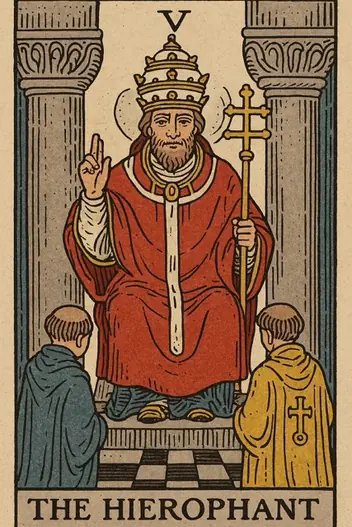
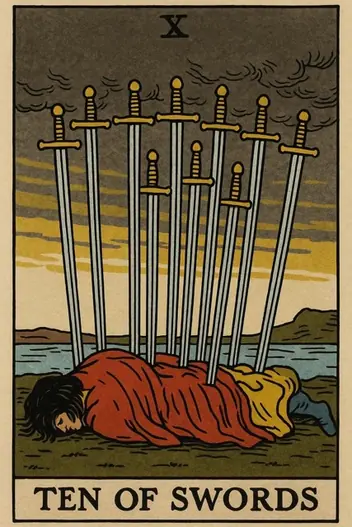
When The Hierophant—the archetype of tradition, mentorship, and shared belief systems—meets the Ten of Swords—the card of sudden endings, betrayal, and rock-bottom defeat—the result is a psychological collision between rigid structure and catastrophic collapse. This pairing suggests that a system, relationship, or belief you once relied upon as an absolute truth has failed you, or is about to. The challenge is not the pain itself, but whether you will cling to the wreckage of the old doctrine or use the crisis to redefine your values.
The core dynamic here is disillusionment. The Hierophant represents a trusted authority—a partner, a boss, a spiritual guide, or even your own internalized "shoulds." The Ten of Swords represents the moment when that authority is exposed as broken, hypocritical, or simply no longer viable. This is not a gentle transition; it is a forced ending. Psychologically, you are being asked to mourn the loss of certainty and then reclaim your personal authority from the ashes of the institution that failed you.
The Hierophant and Ten of Swords: How These Energies Interact
This combination signals a psychological tipping point where external structure meets internal devastation. The Hierophant’s energy is about conforming to a group, a code, or a tradition for safety and meaning. The Ten of Swords is the brutal realization that this safety was an illusion. The mind, once comforted by rules and roles, now experiences acute cognitive dissonance: "How could the system I trusted betray me so completely?"
The key insight here is that the ending is not random—it is the logical conclusion of a system that had become too rigid. The Ten of Swords often reveals a "last straw" moment—a betrayal, a public failure, or a sudden loss that forces you to admit the old way is dead. Your task is to resist the urge to immediately find a new Hierophant (a new guru, job, or ideology) and instead sit with the discomfort of having no map. This is a strategic retreat, not a defeat. The mind is being cleared of outdated programming.
In practical terms, this pairing warns against double binds: situations where you feel forced to choose between loyalty to a failing system and your own wellbeing. The healthiest response is radical acceptance—acknowledge the loss, learn the lesson the betrayal taught you about your own boundaries, and then walk away without looking back. The Hierophant’s wisdom is now yours to internalize, not to obey externally.
Your pair is already on the table. Ask your question and draw the clarifying card
or simply focus on it
The Hierophant and Ten of Swords: Career and Money
Strategic Opportunities:
The chance to exit a toxic organization or mentor relationship that has been draining you. This is your permission slip to leave.
Strategic Opportunities:
A forced reset that allows you to build a career based on your own values, not inherited ones. You can now define success on your terms.
Calculated Risks:
Do not sue, retaliate, or seek public vindication. The Ten of Swords warns that fighting the system while still inside it will only multiply your losses. Cut your losses and walk away.
In a professional context, this pairing is a career death card for a specific role, project, or company culture. You may be facing a scapegoating event (being blamed for a failure that was systemic), a layoff, or the collapse of a deal you bet everything on. The Hierophant here represents the corporate hierarchy, the "old boys' club," or a rigid industry standard that has just proven itself incompetent or unethical. Financial warning: Do not pour more money or time into saving a sinking ship. The Ten of Swords is the final nail. Your best strategic move is to take the severance, close the business, or resign with dignity. The psychological trap is "sunk cost fallacy"—believing that because you invested years, you must stay. Break that cognitive bias now. Use this moment to redefine your professional identity outside of the institutions that just failed you. The next role you take should be one where your values are aligned with the mission, not just the paycheck.
The Hierophant and Ten of Swords as Feelings
If you are single:
This combination warns against seeking a partner who will "save" you or provide a ready-made script for love. Avoid anyone who demands you conform to their rigid expectations—this is a setup for a painful ending.
If you are in a relationship:
A crisis of trust is likely. A long-held belief about your partner (e.g., "they would never lie to me," "our values are perfectly aligned") has been shattered by a specific event. Do not try to force the relationship back into its old shape.
The relationship dynamics here are about power and disillusionment. One partner may have acted as the "authority" (the Hierophant), defining the rules of the relationship—how to argue, how to show love, what is "acceptable." The Ten of Swords signals that this unbalanced dynamic has reached a breaking point, often through a betrayal or a cruel truth that cannot be unheard. The psychological work is to separate the person from the pattern. Your partner may not be evil, but the dynamic is dead. Bold advice: Do not beg for the relationship to return to its former state. Instead, ask yourself: What part of my own belief system about love was actually self-destructive? This is a time for radical honesty about what you need, not for repairing a broken contract. If you stay, it must be on completely new, mutually respectful terms—otherwise, the ending will repeat.
Your unique Tarot reading
See how these cards interact with your destiny. Start a free personal reading now.
The Hierophant and Ten of Swords Reversed: What Changes?
If The Hierophant is Reversed:
You are in a state of active rebellion against all authorities. This is not a crisis, but a conscious rejection of the system. The Ten of Swords here may mean this rebellion has gone too far, leaving you isolated. Advice — seek new, non-dogmatic communities, rather than simply negating the old ones.
If the Ten of Swords is Reversed:
The crisis is prolonged. You are clinging to what has been destroyed, refusing to acknowledge the end. This is a state of paralysis and internal resistance to the inevitable. Warning — delaying the moment of "death" of the old will only exacerbate future suffering.
If BOTH are Reversed:
Complete imbalance: you are simultaneously a rebel and a victim. You have destroyed the old system but created nothing new, and now suffer from the resulting chaos. Method for correction — realize that liberation from dogma does not equal permissiveness. You need to take responsibility for creating a new, flexible, yet stable structure in your life.
Negative Meaning of The Hierophant and Ten of Swords
The shadow of this combination is martyrdom and passive victimhood. The seeker may become addicted to the narrative of being "betrayed by the system," using the pain as an identity. This is a cognitive bias called "catastrophizing" —turning a painful ending into a permanent state of being. Another shadow is rigid cynicism: after being burned by one institution, you may swear off all structure, mentorship, or tradition, throwing the baby out with the bathwater. This leads to isolation and poor judgment. The most dangerous pitfall is revenge or public shaming—trying to destroy the Hierophant figure (a boss, ex-partner, or organization) out of a sense of righteous anger. The Ten of Swords warns that this will only "kill" you again in the court of public opinion. The shadow demands you feel the pain without becoming the pain.
Overall Meaning of The Hierophant and Ten of Swords
Constructive use of this dynamic requires paradoxical thinking. You need to embrace the energy of the Hierophant not as a set of rigid rules, but as the archetype of seeking higher meaning. Your crisis is not a punishment, but an initiation. The Ten of Swords clears the ground for building a new temple of your beliefs. To balance these cards, you need to become a "Hierophant in reverse"—one who creates new traditions rather than blindly following old ones.
The strategic advice lies in a ritual of closure. Perform a symbolic act of farewell to the old: write a letter to a departed job, partner, or belief, and then destroy it. This is not magic, but a psychological technique that anchors the fact of an ending in your mind. Then, using the discipline of the Hierophant, begin consciously shaping a new value system, grounded not in dogma but in tested experience. Your new faith must be proven through practice. Only in this way can you transform defeat into wisdom.
Your Next Step: Personal Context Matters
The core message of The Hierophant and Ten of Swords is that a belief system has died, and you must not resurrect it. The pain is real, but it is also a door to a more authentic life. Your next step is to interrogate your own assumptions: What did you blindly trust? What part of you knew the truth but ignored it? This combination asks you to become your own authority, wiser and more discerning than before.
While this article provides the general archetype, the true magic happens when Tarot is applied to your unique situation. The specific people, dates, and decisions in your life change the meaning dramatically. To get a deep, personalized interpretation of this exact combination for your specific question right now, use the Fortune Cards app. You can access it on the web or download it for a reading that speaks directly to your story. Don't just read about the archetypes—apply them to your life today.
Interpretation by the Fortune Cards editorial team, based on the Rider–Waite tradition and Jungian archetypes. About our methodology · Updated: 2026-08-26
Other Combinations with The Hierophant
Other Combinations with Ten of Swords
Explore Individual Card Meanings
Table of Contents
- The Hierophant and Ten of Swords: How These Energies Interact
- The Hierophant and Ten of Swords: Career and Money
- The Hierophant and Ten of Swords as Feelings
- The Hierophant and Ten of Swords Reversed: What Changes?
- Negative Meaning of The Hierophant and Ten of Swords
- Overall Meaning of The Hierophant and Ten of Swords
- Your Next Step: Personal Context Matters
Ready to find answers to your questions?
Start your first reading now and look at your situation with fresh clarity. The cards are ready to reveal deeper meaning.