Ten of Swords
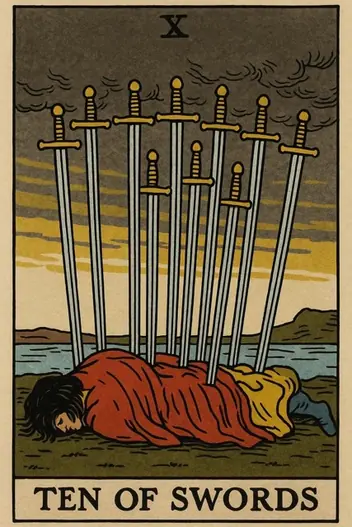
- Arcana
- Minor Arcana, Suit of Swords
- Element
- Air
- Decan
- the Sun in Gemini
- Numerology
- 10 → 1
The Ten of Swords represents an archetypal moment of psychological termination—the point where a painful, often self-inflicted cycle of thought reaches its absolute limit. In Jungian terms, this card embodies the Shadow of the Intellect, where over-analysis, rumination, and a fixation on worst-case scenarios have drained your resources. The imagery is stark: a figure pinned down by ten blades, yet the sky is clearing. This is not death; it is cognitive surrender.
The core challenge of this card is accepting that some problems cannot be solved by more thinking. The swords are ideas, judgments, and internal critiques that have turned against the self. To move forward, you must stop trying to "fix" the situation and instead allow the collapse to complete itself. This card demands a pragmatic, almost surgical detachment from the narrative you have built around your pain.
Ten of Swords: Core Meaning and Interpretation
Psychologically, the Ten of Swords signals the end of a mental loop—a pattern of catastrophizing, self-blame, or obsessive problem-solving that has produced diminishing returns. Your mindset is one of exhaustion and clarity, a paradoxical state where the worst has happened, and the only path left is forward. The resource this card provides is the gift of finality. When you stop fighting the ending, you stop wasting energy on what cannot be changed.
The key insight for decision-making is that this is a card of release, not recovery. Trying to salvage the situation will only prolong the suffering. Instead, focus on extracting the lesson and then discarding the rest of the baggage. The Ten of Swords asks you to recognize a fundamental truth: you cannot rebuild on a foundation that is already shattered. Your next move must be to a new territory, not a repair of the old one.
Ask your question and flip the cards
or simply focus on it
Is Ten of Swords a Yes or a No?
No.. The Ten of Swords embodies finality, betrayal, and an ending that has already reached its peak — a symbolic death of a situation, relationship, or mindset. Psychologically, this card signals that the unconscious has already processed the loss and is now in the stage of rigor mortis, where further action is futile and only acceptance remains. In a yes/no reading, the card refuses the question because the outcome has already been decided by prior events; you are asking about a future that has already collapsed. Reversed, the answer shifts to Leaning No — the worst may be past, but the wound is still fresh and requires mourning before any new possibility can emerge. The critical condition: the outcome depends entirely on whether you can cease resistance to the ending and let the old narrative die completely, rather than grasping for a resurrection that hasn't yet been earned.
Deepen your understanding
Find out exactly what this reading means for your current life situation with our oracle.
Card of the Day
The Ten of Swords as a Card of the Day signals a day of brutal clarity — you will be forced to see a truth you have been avoiding, often through a sharp disappointment or a sudden, definitive break. Focus on practicing radical acceptance: acknowledge what has ended without trying to soften the blow or rewrite the story. The action to take is to physically remove yourself from the source of pain — leave the conversation, close the tab, delete the message, walk away. Avoid the trap of victimhood, where you spiral into self-pity or blame others for a situation you co-created. Also avoid any urge to "fix" or "save" what is already dead — today, the only healthy energy is surrender, not salvage.
Ten of Swords in Love and Relationships
If you are not in a relationship:
This card indicates that you are attracted to patterns of emotional drama or intellectual conflict. You may be subconsciously choosing unavailable partners or situations where you can "prove" your worth through suffering. The strategic move is to break the pattern of repetitive heartbreak by first recognizing that your mind is creating the narrative of victimhood. Stop analyzing your ex; start observing your own choices.
If you are in a relationship:
This card signals a critical inflection point where a long-standing conflict or unspoken resentment has reached its peak. The relationship may feel "dead" or terminally exhausting. The core advice is to stop trying to win the argument. The Ten of Swords in a relationship context demands a radical honesty about whether the relationship serves your growth. If it does, you must let go of the need to be right. If it doesn't, you must let go of the relationship itself.
The main practical relationship advice is to prioritize emotional closure over emotional justice. You will not get an apology that satisfies you. You will not get the other person to see your pain. The Ten of Swords insists that your peace is more important than your story. Set a boundary, not as a punishment, but as a surgical cut to stop the bleeding.
What Does Ten of Swords Say About Their Feelings?
Through the lens of the Ten of Swords, this person perceives you as the embodiment of a painful ending — you may represent a truth they could not face, a boundary that finally held, or a loss they are still processing. They likely associate you with a moment of defeat or humiliation, not because of anything you did, but because your presence triggers the final collapse of their own illusions about the relationship or themselves. Psychologically, they feel both resentment and relief: resentment that you became the "executioner" of their hope, and relief that the cycle of pain is over. Their hidden fear is that you will return and force them to relive the wound; their hidden hope is that you have already moved on, so they can bury the memory without guilt. There is a deep internal conflict — part of them still tries to villainize you to justify the end, while another part knows that the sword was in their own hand, not yours. They are not thinking of you with warmth or desire; they are thinking of you as a scar that is only now beginning to close.
Career and Finance
Strategic Opportunities:
Complete a failed project or exit a toxic role. This card signals that your current professional path has reached a logical dead end. The opportunity is in the clean break—resigning, pivoting, or dissolving a partnership that no longer works. This frees up mental and emotional bandwidth for a fresh start.
Resource Management:
Use the crisis to audit your financial habits. The Ten of Swords often follows a period of financial overreach or poor planning. The opportunity is to reset your budget with extreme discipline. Write off the losses, close the accounts, and create a zero-based plan that accounts for your actual needs, not your idealized goals.
Calculated Risks:
Do not invest further resources into a sinking venture. The biggest mistake under this card is the sunk cost fallacy—throwing good money or time after bad. Objectively, if a business strategy, job, or investment has shown no positive indicators for three months, it is not a turnaround; it is a slow death. Walk away.
The strategic advice here is that your career is a portfolio, not a marriage. The Ten of Swords asks you to accept the loss of an asset (time, money, reputation) as a tax on a lesson learned. Pragmatically, update your resume, network with new contacts, and treat the exit as a necessary reorganization of your professional life. Financial warning: do not take on debt to "save" a failing situation.
Ten of Swords Reversed: What Changes
When the Ten of Swords appears reversed, the energy of finality is blocked by internal resistance. You are refusing to accept the ending. This manifests as prolonged rumination, denial, or a desperate attempt to resurrect a dead situation. The card reversed warns you that you are staying in a state of suffering longer than necessary because you are afraid of the unknown that follows the end. The danger is that you are wasting your own time.
To correct this imbalance, you must confront the fear of the void. The reversed Ten of Swords often accompanies a belief that "if I just hold on a little longer, it will get better." This is a cognitive distortion. The logical correction is to set a hard deadline for a decision. Write down the worst-case scenario of letting go, and then write down the cost of staying. The math will be clear. The blocked potential here is your own growth. The card reversed is a call to stop mourning the past and start acting in the present.
What Are the Pitfalls of Ten of Swords?
The shadow of the Ten of Swords is intellectual masochism—the tendency to replay painful memories or worst-case scenarios as a form of emotional self-harm. This is a cognitive bias known as rumination, where the mind believes that if it thinks about the problem enough, a solution will appear. In reality, it only deepens the neural pathways of despair. The pitfall is mistaking suffering for wisdom.
Other shadow manifestations include martyrdom (using your pain to gain sympathy or control) and paralysis through analysis (using "understanding" as an excuse for inaction). You may also fall into the trap of perfectionism, refusing to accept any ending that is not "clean" or "fair." The pragmatic truth is that most endings are messy and incomplete. The shadow asks you to choose: do you want to be right, or do you want to be free?
Synthesis: Strategic Conclusion
To constructively use the energy of the Ten of Swords, you must first separate the event from the story. The event is a fact: a relationship ended, a job was lost, a plan failed. The story is the meaning you attach to it: "I am a failure," "I will never be loved," "I should have seen it coming." Your task is to discard the story and keep only the fact. From the fact, you can extract a single, actionable lesson. Then, you burn the rest.
The strategic advice is to embrace the concept of "creative destruction." In economics, a failing business must be allowed to fail so that resources can be reallocated to more productive uses. Apply this to your life. The Ten of Swords is not a punishment; it is a reallocation of your energy. The pain you feel is the signal that your current structure is obsolete. Your next step is not to rebuild the same structure stronger, but to build a different structure elsewhere.
Finally, use the clarity of the bottom. When you have hit rock bottom, you have a unique advantage: you know exactly what does not work. This is invaluable data. The Ten of Swords gives you a zero-based starting point. From here, every decision you make is a net positive. Your only mistake would be to stay in the pit, trying to make it comfortable. Get up, leave the swords behind, and walk toward the horizon.
Applying This to Your Situation
This psychological and strategic breakdown provides a deep understanding of archetypes. However, Tarot is never universal for everyone. To understand exactly how this dynamic applies to your specific situation, a reading tailored exclusively to you is necessary.
Download the Fortune Cards app or visit our platform to get a deep AI interpretation of your unique spread. Don't just read about the cards—use Fortune Cards to find out exactly what step you need to take next.
Try Tarot Spreads with Ten of Swords
Interpretation by the Fortune Cards editorial team, based on the Rider–Waite tradition and Jungian archetypes. About our methodology · Updated: 2026-08-26
Top Combinations with Ten of Swords
Discover how Ten of Swords interacts with other major cards in the deck to form powerful messages.
All 77 Combinations with Ten of Swords
Discover how this card interacts with every other card in the Tarot deck and reveal hidden meanings.
Table of Contents
- Ten of Swords: Core Meaning and Interpretation
- Is Ten of Swords a Yes or a No?
- Card of the Day
- Ten of Swords in Love and Relationships
- What Does Ten of Swords Say About Their Feelings?
- Career and Finance
- Ten of Swords Reversed: What Changes
- What Are the Pitfalls of Ten of Swords?
- Synthesis: Strategic Conclusion
- Applying This to Your Situation
Explore Tarot Universe
Ready to find answers to your questions?
Start your first reading now and look at your situation with fresh clarity. The cards are ready to reveal deeper meaning.