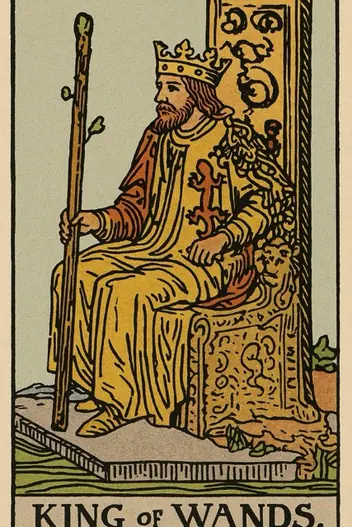
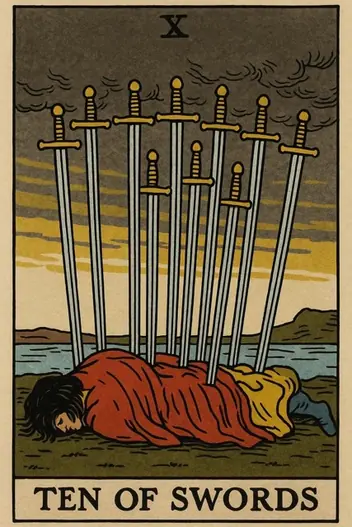
King of Wands and Ten of Swords Tarot as Feelings
- Arcana
- King of Wands — Minor Arcana, Wands; Ten of Swords — Minor Arcana, Swords
- Elements
- King of Wands — Fire; Ten of Swords — Air
- Elemental interaction
- Friendly elements — energies support each other
- Numerology
- 14 + 10 = 24 → 6
When the King of Wands—the archetype of bold leadership, visionary drive, and unshakable confidence—collides with the Ten of Swords—the card of painful endings, betrayal, and hitting rock bottom—the result is a psychological paradox. This pairing often signals that a period of intense, forward-moving energy has been abruptly halted by a harsh reality check. The King’s fire, which once fueled innovation, has now burned out of control, leaving a trail of consequences that demand immediate reckoning. In Jungian terms, this is the moment when the inflated ego (King of Wands) meets its shadow (Ten of Swords), forcing a painful but necessary confrontation with the limits of one’s power.
The core dynamic is about overextension meeting its inevitable consequence. The King of Wands represents a person—or a mindset—that is charismatic, decisive, and often impatient. They operate on instinct and a desire for rapid growth. The Ten of Swords, however, speaks to the cost of that speed: a sudden, catastrophic failure, often involving betrayal, public defeat, or the collapse of a previously successful venture. This is not a subtle warning; it is a loud, clear message that the current path is unsustainable. The key insight is that this ending is not random—it is the direct result of the King’s own actions, specifically a lack of foresight and a refusal to listen to dissenting voices.
What Do King of Wands and Ten of Swords Mean Together?
The psychological state created by this combination is one of post-traumatic clarity. The King of Wands’ initial reaction to the Ten of Swords’ blow is likely denial and rage—the ego cannot accept such a total defeat. However, the very nature of the Ten of Swords forces a surrender. It is the card of the “point of no return,” where the only way left is up, but only after fully acknowledging the depth of the fall. This is the critical pivot point: the seeker must move from reactive anger to reflective analysis.
In practical terms, this pairing suggests a complete system failure in an area of life the seeker once dominated. For an entrepreneur, it might mean a venture that was launched too aggressively without proper risk assessment collapses. For a leader, it could mean a team mutiny or a public scandal that destroys their reputation. The Jungian lesson here is the integration of the shadow: the King of Wands must learn that his power is not absolute, and that true leadership includes humility, patience, and the ability to listen to warnings. The Ten of Swords is not a punishment; it is a brutal teacher that forces the seeker to rebuild from a foundation of hard-won wisdom.
The long-term implication is strategic reinvention. Once the initial shock subsides, this combination offers a powerful opportunity to shed old, toxic patterns of overconfidence and impulsivity. The most important takeaway is that the King of Wands energy is not destroyed—it is purified. The seeker will emerge from this crisis with a more grounded, resilient version of their former ambition, provided they accept the lesson: vision without strategy leads to ruin.
King of Wands and Ten of Swords in Love Tarot
If you are single:
This pairing warns against pursuing a connection with someone who displays the King of Wands’ charm but also has a history of sudden, dramatic breakups. The Ten of Swords suggests that a new relationship could end in a painful, public betrayal. Pause and observe for red flags before investing emotionally.
If you are in a relationship:
The dynamic is one of a power struggle that has reached a breaking point. One partner (the King) may have been dominating decisions, leading to a catastrophic argument or discovery (the Ten of Swords) that shatters trust. Immediate, honest communication is non-negotiable.
In relationships, this combination often signals a toxic cycle of domination and collapse. The King of Wands partner may be charismatic and passionate, but they can also be controlling, dismissive, and prone to emotional outbursts. The Ten of Swords represents the moment the other partner finally ends the cycle—often in a dramatic, final way. This is not a card of reconciliation; it is a card of necessary endings. The key relationship advice is to recognize that the power dynamic is fundamentally unbalanced. The King of Wands must learn to yield control and listen, while the other partner must enforce firm boundaries. For couples willing to work through this, the path forward requires a complete renegotiation of roles, with a focus on mutual respect rather than dominance. If the King refuses to change, the Ten of Swords is a clear sign that the relationship has run its course.
Your pair is already on the table. Ask your question and draw the clarifying card
or simply focus on it
Career and Finances
Strategic Opportunities:
Use this crisis to audit your entire business model or career trajectory. The Ten of Swords reveals exactly what is broken. Rebuild from scratch with a focus on sustainable growth rather than rapid expansion.
Strategic Opportunities:
Leverage the King of Wands’ natural resilience to pivot into a new industry or role that values your vision but demands more careful execution. Your past failure is now a powerful story of learning.
Calculated Risks:
Avoid any new ventures that require large upfront capital or aggressive deadlines for at least 3-6 months. The shadow of the Ten of Swords is the temptation to “prove everyone wrong” by rushing back into action.
In the professional realm, this pairing is a red flag for over-leverage and ego-driven decisions. The King of Wands often excels in startup environments or leadership roles that reward risk-taking. However, the Ten of Swords indicates that a specific project, deal, or professional relationship has ended in a total loss—perhaps a lawsuit, a public failure, or a sudden termination. The financial warning is clear: do not double down on a losing strategy. The King’s instinct is to fight, but the Ten of Swords advises strategic retreat. This is the time to cut losses, settle debts, and restructure your financial portfolio with a focus on liquidity and safety. The strategic tip is to channel the King’s vision into long-term planning rather than immediate action. Use this setback to build a risk management framework that will prevent future collapses. For entrepreneurs, this is a classic “burn the ships” moment—but only after ensuring you have a lifeboat.
Reversed Positions: What Changes?
If the King of Wands is reversed, it indicates blocked potential or recklessness. The person either fears using their power (passive aggression, procrastination) or, conversely, acts impulsively and despotically, ignoring any signals from reality. In combination with the upright Ten of Swords, this is a warning: your unwillingness to take responsibility for leadership will lead to catastrophe. Advice: find the courage to admit that you are not in a resourceful state and delegate crisis management.
If the Ten of Swords is reversed, it speaks of internal resistance to completion or a weakness masquerading as drama. The person may be "playing the victim," unwilling to put in the effort to escape the crisis. The energy of the King of Wands is spent here on denying the obvious: "it's not that bad," "I can handle it." Advice: stop dramatizing and start acting. A reversed Ten of Swords often indicates that the final collapse hasn't happened yet, but it is inevitable if you don't change your approach.
If BOTH cards are reversed, a complete imbalance of dynamics arises. This is a state of a "leader without will" and a "victim without hope." The person is stuck in a cycle: sometimes trying to push hard, sometimes falling into apathy. The logical way to correct this: a complete halt and external consultation (mentor, psychologist, coach) are necessary. The energy is completely blocked, and attempts to "break through the dam" from within will lead to a breakdown. Warning: this is a high-risk state for the psyche. The only strategy is a total audit of values and goals.
Get a personalized interpretation
Unlock the combined meaning of your cards in the context of your unique question — for free.
King of Wands and Ten of Swords: Warning Signs
The shadow manifestation of this combination is toxic grandiosity followed by victimhood. The King of Wands, when acting from his shadow, becomes a tyrant—arrogant, dismissive of advice, and pathologically optimistic. He refuses to see the warning signs of the Ten of Swords until it is too late. When the fall comes, his ego cannot process the failure, so he externalizes blame. The cognitive bias at play is the “illusion of control” —the belief that one can manage all risks through sheer willpower. This leads to self-sabotage as the King repeats the same cycle of overreach and collapse.
Another pitfall is emotional numbness. The Ten of Swords is a deeply painful card, and the King of Wands’ default response is to suppress that pain and immediately “get back on the horse.” This avoidance prevents the necessary psychological integration. The poor judgment manifests as making impulsive decisions to regain a sense of power, such as starting a new project without a proper plan, or lashing out at perceived betrayers. The shadow lesson is that the seeker must sit with the discomfort of defeat, process the shame, and resist the urge to rebuild on a shaky foundation. True growth requires acknowledging that the King’s fire, without the tempering of wisdom, is simply destruction.
King of Wands and Ten of Swords Combined Message
Constructive use of this combination's energy requires paradoxical thinking. You must apply the will and strategic vision of the King of Wands not to "defeat" the Ten of Swords, but to orchestrate your own defeat for maximum gain. This is the art of "strategic surrender." Your task is to acknowledge that the battle is lost, but the war is not over. Use your charisma and leadership qualities to preserve the team, reputation, and key assets, sacrificing what is no longer viable.
Deep strategic advice:
Stop clinging to the old identity. The King of Wands who has passed through the Ten of Swords ceases to be a "conqueror" and becomes a "wise ruler." This experience is a brutal yet effective school of humility and strategic maturity. You will no longer act recklessly. You will learn to see risks and stop in time. Your strength will now lie not in forcefulness, but in the ability to accurately diagnose "dead zones" and cut them off without regret.
To balance this dynamic, activate the archetypes of the Hermit (inner reflection) and Temperance (balance and patience). Your task is to transmute the rage of defeat into cold analysis. Ask yourself: "What has this collapse taught me? What three key principles will I now integrate into my leadership?" The answers to these questions are the new thing that will be born from the ashes of the old. The energy of the King of Wands, purified by the fire of crisis, will become your most reliable asset.
Your Next Step: Personal Context Matters
The King of Wands and Ten of Swords combination is a powerful call to redefine your relationship with ambition and failure. It tells you that your current path, while once successful, has reached a definitive end. The core message is not despair, but strategic surrender and rebirth. You are being asked to let go of the need to control every outcome and instead focus on learning from the ashes. The true power of the King of Wands lies not in his initial victory, but in his ability to rise from defeat with humility and a better plan.
Ready to apply this insight to your specific situation? While this article provides the archetypal meaning of the King of Wands and Ten of Swords, the real value comes from seeing how these energies interact with your unique life circumstances. The Fortune Cards app offers a deep, personalized Tarot reading that analyzes this exact combination in the context of your specific question—whether about a relationship, career move, or personal dilemma. You can use the app on the web or download it now to get a tailored interpretation that reveals your next best step. Don’t just read about the cards; let them speak directly to you.
Interpretation by the Fortune Cards editorial team, based on the Rider–Waite tradition and Jungian archetypes. About our methodology · Updated: 2026-08-26
Other Combinations with King of Wands
Other Combinations with Ten of Swords
Explore Individual Card Meanings
Table of Contents
Ready to find answers to your questions?
Start your first reading now and look at your situation with fresh clarity. The cards are ready to reveal deeper meaning.