Temperance
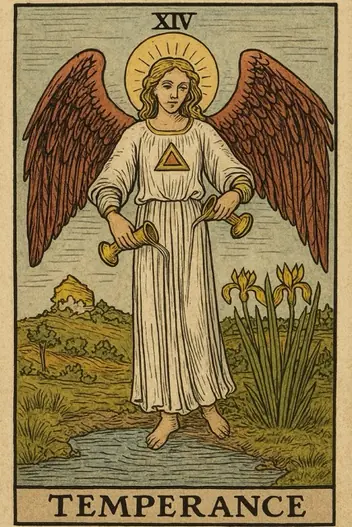
- Arcana
- Major Arcana · XIV
- Element
- Fire
- Planet / Sign
- Sagittarius
- Numerology
- 14 → 5
The Temperance card represents the Jungian archetype of the Integrator—the psychological capacity to synthesize opposing forces within the psyche. It signals a developmental stage where raw instinct (The Devil) and structured order (The Emperor) must be reconciled without destroying either. This is not about passive harmony; it is the active, disciplined work of holding tension between contradictions to produce a higher-order solution.
The core challenge of Temperance is resisting the urge to resolve conflict prematurely. In a culture that demands quick answers and binary choices, this card asks you to tolerate ambiguity, manage impulse control, and find the strategic middle path that optimizes long-term outcomes over short-term relief.
What Does Temperance Mean in Tarot?
Psychologically, Temperance activates the executive function of the ego—the part of your mind that modulates emotional reactivity and cognitive bias. It is the internal manager that prevents you from overcorrecting in one direction when another path fails. In practice, this manifests as measured risk-taking, patient negotiation, and emotional regulation under pressure. The person drawing this card is being asked to combine two seemingly incompatible strategies—logic and intuition, assertiveness and receptivity—into a coherent plan.
This card often appears when you are at a crossroads where neither extreme works. For example, in a conflict, you may need to be both firm on boundaries and empathetic to the other's perspective. In a project, you may need to blend creative experimentation with rigorous data analysis. Temperance rewards those who can delay gratification and refuse to settle for a simplistic answer. The practical consequence is that decisions made under this influence are more sustainable and less likely to require rework later.
Ask your question and flip the cards
or simply focus on it
Yes/No Answer
Leaning yes.. Temperance embodies synthesis, balance, and the alchemical middle path—it does not deliver a forceful yes, but rather a conditional alignment that requires patience. The card’s core archetype, the angel pouring water between cups, symbolizes the integration of opposites: conscious and unconscious, emotion and reason. In practice, this means the answer is yes only if you are willing to modulate extremes—no rushing, no forcing, no avoiding necessary compromise. In the reversed position, the energy shifts toward imbalance, haste, or blockage; the answer becomes leaning no, as the integration process is disrupted by internal conflict or addiction. The critical caveat: the outcome depends entirely on your ability to hold steady in uncertainty—impulsive action or rigid control will collapse the yes into a stalemate.
Get a personalized interpretation
Unlock the combined meaning of your cards in the context of your unique question — for free.
Temperance as the Card of the Day
The main vector of Temperance as a Card of the Day is harmonious flow—a day to blend, not to push. Focus on moderation in all things: temper your reactions, pace your work, and seek the middle ground in conversations that feel polarized. Take specific actions like revising a schedule to include breaks, or mediating a small dispute at home or work rather than taking a side. Avoid the trap of over-indulgence (in food, drink, or emotion) and the opposite trap of rigid self-denial—both are distortions of the card’s true energy. Beware of the impulse to fix everything at once; Temperance asks you to trust the slow process of mixing ingredients, not to demand immediate results.
What Does Temperance Mean in a Love Reading?
If you are not in a relationship:
This archetype attracts partners who are emotionally mature and non-reactive. You will find yourself drawn to individuals who can discuss differences without escalating into drama. The key is to avoid mistaking "boring" for "balanced"—look for someone who challenges you without destabilizing you.
If you are in a relationship:
Temperance calls for calibrating the power dynamic so that neither partner dominates or withdraws. It is a card of renegotiating roles—particularly around finances, household duties, or emotional labor—to create a system that feels fair to both.
In relationships, Temperance highlights the importance of conflict de-escalation. When you feel the urge to win an argument, this card asks you to pause and ask: "What is the long-term cost of winning this point?" The practical advice is to schedule difficult conversations rather than having them impulsively. Use a timer to ensure each partner speaks without interruption. Bold the main practical relationship advice: Temperance instructs you to treat your partner as an ally in solving a mutual problem, not an opponent to defeat. This prevents the accumulation of resentment that often destroys partnerships.
What does he/she think of me?
Through the lens of Temperance, this person perceives you as a calming, integrating presence—someone who brings balance to their emotional chaos or intellectual rigidity. They associate you with a feeling of healing and patience, as if you hold the ability to blend their scattered parts into a coherent whole. Their hidden intention is likely to seek from you a steadying influence, but this is tempered by a fear of over-reliance: they worry that leaning on your equanimity will expose their own instability. There is an internal conflict between seeing you as a source of peace and feeling that your composure renders you emotionally distant or “too measured.” Their deepest hope is that you will meet them halfway—not to rescue them, but to teach them how to hold their own extremes with the same grace you embody.
Temperance in Career and Finance
Strategic Opportunities:
Mid-range optimization. Temperance suggests you focus on improving existing processes rather than chasing radical innovation. Look for inefficiencies in your workflow or team communication that can be smoothed without major disruption.
Resource Management:
Resource blending. Combine two separate budgets or skill sets to create a new revenue stream. For example, merge your marketing budget with product development to launch a co-branded initiative.
Calculated Risks:
Avoid over-commitment to a single strategy. Temperance warns against putting all your resources into one bet, even if it looks promising. Diversify your time and capital across at least two parallel tracks.
Professionally, Temperance is the card of the effective middle manager—the person who bridges departments, mediates between executives and staff, and ensures projects stay on schedule without burning out the team. It is not a card for dramatic pivots or aggressive expansion. Bold financial warnings or strategic advice: Do not take on debt to fund a "balanced" portfolio; true balance comes from adjusting your existing assets, not adding leverage. In leadership, Temperance advises you to listen more than you speak in meetings and to make decisions based on data, not gut feelings, especially when emotions run high.
What Does Temperance Reversed Mean?
When Temperance appears reversed, the integrative function is blocked. This manifests as extreme oscillation between opposing behaviors—one day you are rigid and controlling, the next you are passive and avoidant. It signals an inability to hold tension, leading to impulsive decisions that create chaos. In relationships, you may swing between clinginess and detachment. In career, you may start projects with intense energy and abandon them at the first obstacle.
Bold warnings: Reversed Temperance is a red flag for burnout. You are likely overcorrecting for past mistakes by adopting the opposite extreme, rather than finding a middle ground. The logical correction is to set a single, non-negotiable daily practice that forces you to stay in the middle—such as a 10-minute meditation, a fixed bedtime, or a weekly review of your calendar. Do not try to fix everything at once. Pick one area of life where you are most reactive and apply the principle of moderation through consistency, not perfection.
Shadow Side and Pitfalls
The shadow of Temperance is false balance—the rationalization of inaction as wisdom. You may use the idea of "keeping the middle path" to avoid making hard decisions, such as firing a toxic employee or ending a stagnant relationship. This manifests as analysis paralysis, where you collect endless data to avoid committing to a course of action. The cognitive bias here is the sunk cost fallacy: you stay in a mediocre situation because you have invested time in "balancing" it, even when it is clearly failing.
Another pitfall is over-control. Temperance's shadow can turn into obsessive regulation of emotions, diet, work hours, or relationships. You may become so focused on maintaining equilibrium that you suppress legitimate anger, sadness, or ambition. This leads to emotional flatness and a loss of creative drive. The antidote is to recognize that true balance includes periodic imbalance. Allow yourself one day a week to be "unbalanced"—to work late, eat poorly, or express strong emotion—so that the rest of your life can remain stable without becoming sterile.
Temperance: The Combined Message
To constructively use the energy of Temperance, you must adopt a systems-thinking mindset. View your life as a set of interconnected variables—work, relationships, health, finances—where changing one affects the others. The goal is not to keep every variable at 50%, but to adjust them in relation to each other so that the entire system remains resilient. For example, if you take on a demanding project at work, deliberately reduce social obligations for two weeks to compensate. This is dynamic equilibrium, not static balance.
Strategically, Temperance rewards incremental progress over dramatic breakthroughs. Set a minimum viable standard for each area of your life—the lowest level of performance that prevents crisis—and focus your energy on the one area that is most out of alignment. Use the 80/20 rule: 80% of your stability comes from 20% of your habits. Identify those key habits (sleep, exercise, a single daily review) and protect them ruthlessly. Do not attempt to balance everything at once; prioritize the linchpin that holds the rest together.
The ultimate insight of Temperance is that sustainable success is boring. It requires daily discipline, patience with slow progress, and the courage to say "no" to exciting opportunities that would destabilize your foundation. If you can accept this, you will build a life that is not flashy, but unshakable.
Where to Go From Here
This psychological and strategic breakdown provides a deep understanding of archetypes. However, Tarot is never universal for everyone. To understand exactly how this dynamic applies to your specific situation, a reading tailored exclusively to you is necessary.
Download the Fortune Cards app or visit our platform to get a deep AI interpretation of your unique spread. Don't just read about the cards—use Fortune Cards to find out exactly what step you need to take next.
Try Tarot Spreads with Temperance
Interpretation by the Fortune Cards editorial team, based on the Rider–Waite tradition and Jungian archetypes. About our methodology · Updated: 2026-08-26
Top Combinations with Temperance
Discover how Temperance interacts with other major cards in the deck to form powerful messages.
All 77 Combinations with Temperance
Discover how this card interacts with every other card in the Tarot deck and reveal hidden meanings.
Table of Contents
- What Does Temperance Mean in Tarot?
- Yes/No Answer
- Temperance as the Card of the Day
- What Does Temperance Mean in a Love Reading?
- What does he/she think of me?
- Temperance in Career and Finance
- What Does Temperance Reversed Mean?
- Shadow Side and Pitfalls
- Temperance: The Combined Message
- Where to Go From Here
Explore Tarot Universe
Ready to find answers to your questions?
Start your first reading now and look at your situation with fresh clarity. The cards are ready to reveal deeper meaning.