Six of Wands and Ten of Swords Tarot Combination
- Arcana
- Six of Wands — Minor Arcana, Wands; Ten of Swords — Minor Arcana, Swords
- Elements
- Six of Wands — Fire; Ten of Swords — Air
- Elemental interaction
- Friendly elements — energies support each other
- Numerology
- 6 + 10 = 16 → 7
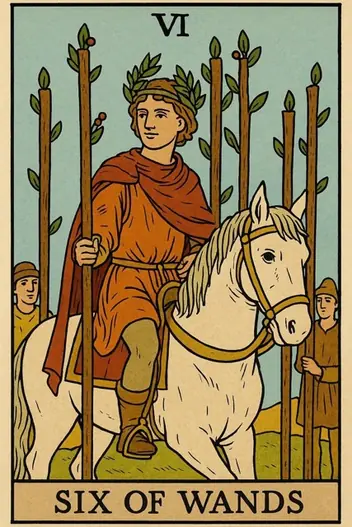
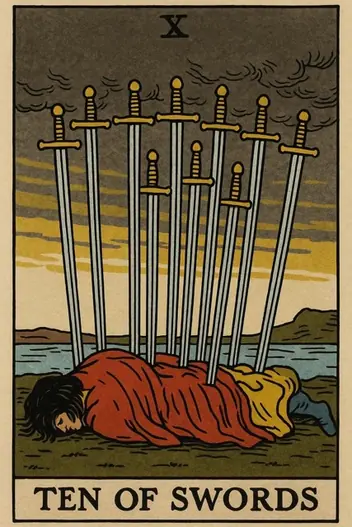
The Six of Wands represents victory, public recognition, and the ego’s moment of validation. The Ten of Swords depicts a painful ending, betrayal, or a rock-bottom moment—often sudden and total. When these two archetypes collide, they create a psychological paradox: the highest point of success can be immediately followed by a devastating fall, or, conversely, a complete breakdown can be the catalyst for genuine, earned triumph. This pairing forces us to examine the fragile line between confidence and hubris, and between surrender and strategic rebirth.
In real-world terms, this combination signals a turning point where external validation (Six of Wands) meets internal or external collapse (Ten of Swords). The key insight is that one often precipitates the other. A victory achieved through ego-driven ambition may attract hidden enemies or a reality check. Alternatively, a painful ending clears the path for a new, more authentic form of success that isn’t dependent on applause. The challenge is to discern whether you are riding high on unstable ground or using a low point to build a more resilient foundation.
Six of Wands and Ten of Swords: How These Energies Interact
The core dynamic of Six of Wands and Ten of Swords is a psychological oscillation between pride and defeat. The Six of Wands energy activates the Hero archetype—the part of us that craves recognition, leadership, and a clear win. The Ten of Swords, however, activates the Shadow of the Victim—the belief that we have been unfairly struck down, or the painful realization that our victory was built on sand. The mind often flips between these states, creating a cycle of grandiosity followed by shame.
This combination highlights a critical cognitive bias: the illusion of permanent success. When the Six of Wands is in play, we overestimate our control and underestimate external risks. The Ten of Swords then acts as a brutal corrective, forcing a confrontation with reality. The psychological maturity required here is radical humility. You must ask yourself: Is my current victory authentic and sustainable, or am I ignoring the sword waiting to fall? Conversely, if you are in the Ten of Swords position, this pairing suggests that your defeat is not final—it is a necessary death that will allow a new, more grounded form of victory to emerge. The strategic action is to accept the ending without self-pity, and to consciously choose the lessons over the wounds.
Your pair is already on the table. Ask your question and draw the clarifying card
or simply focus on it
Six of Wands and Ten of Swords in Love and Relationships
If you are single:
This combination warns against seeking validation through a new relationship. A flashy, "perfect" connection may quickly reveal hidden incompatibilities or end abruptly. Focus on emotional stability over public approval.
If you are in a relationship:
A public success (e.g., a promotion, a shared achievement) may mask a deep, unspoken wound between partners. Do not mistake external recognition for internal health. A painful conversation or ending may be necessary.
In relationships, the Six of Wands and Ten of Swords often points to a power imbalance or a hidden betrayal. One partner may be basking in the glow of external validation (social status, career wins) while the other feels stabbed in the back—neglected, deceived, or emotionally drained. The psychological dynamic is one of performative success versus authentic connection. The key relationship advice is to prioritize vulnerability over victory. If you are the "winner," check in with your partner’s true feelings. If you are the one feeling defeated, set a boundary: do not allow your partner’s success to invalidate your pain. This pairing can also signal the end of a relationship that was built on ego rather than intimacy—a necessary breakup that clears the way for healthier love.
Six of Wands and Ten of Swords in Career Readings
Strategic Opportunities:
Use a recent failure or setback as data for a more resilient strategy. The Ten of Swords ending reveals what isn’t working, allowing you to pivot.
Strategic Opportunities:
If you are currently winning, consolidate your gains quietly. Avoid public crowing. Use your platform to build alliances, not enemies.
Calculated Risks:
Do not accept a promotion or public role that is built on a fragile foundation (e.g., a toxic team, unstable finances). The victory may be a trap.
Professionally, this is a high-stakes risk management card. The Six of Wands suggests you may be in the spotlight, but the Ten of Swords warns that your reputation or position is vulnerable to a sudden collapse. This could mean a competitor’s attack, a project failure, or a financial loss that feels like a betrayal. The most important financial warning is to avoid over-leverage. Do not spend future earnings or make major commitments based on current success. Conversely, if you are in the Ten of Swords position—laid off, a business failed, a deal fell through—this combination signals that your next step must be grounded in reality, not ego. The strategic action is to cut your losses cleanly and rebuild from a position of genuine strength, not false hope. Bullet points for action: Audit your network for hidden risks, create a contingency plan for your biggest win, and refuse to let a defeat define your identity.
Get a personalized interpretation
Unlock the combined meaning of your cards in the context of your unique question — for free.
Six of Wands and Ten of Swords Reversed: What Changes?
When cards appear in a reversed position, the dynamics become more complex and less obvious.
If the Six of Wands is reversed:
This is a sign of a "stolen victory" or a fear of success. You either do not receive the recognition you deserve, or your achievements are attributed to others. In the context of the Ten of Swords, this indicates that you cannot complete the cycle of defeat because you are clinging to the illusion of a future triumph. Advice: give up seeking external approval. Your success right now is simply to survive and walk away.
If the Ten of Swords is reversed:
This is resistance to an inevitable end. The person is "playing dead," but in reality, they are afraid to take that final breath. This is a prolonged agony. In combination with an upright Six of Wands, it looks like an attempt to appear successful while everything is crumbling inside. Warning: you are avoiding necessary surgery. Procrastination will only intensify the pain.
If BOTH are reversed:
Complete paralysis of the will. You can neither win nor lose with dignity. This is a state of being "neither fish nor fowl," where a person is stuck between the desire to be recognized and the fear of being destroyed. Corrective measure: forced stoppage. You need an external manager, coach, or psychologist who will literally forbid you from taking any action for the next 2-3 weeks. Any active action now is an action born from trauma, which will exacerbate the imbalance.
The Shadow Side of Six of Wands and Ten of Swords
The shadow of this pairing is the martyr complex disguised as the hero. You may believe you are triumphing, but you are actually setting yourself up for a fall by ignoring feedback, overestimating your invulnerability, or surrounding yourself with sycophants. The cognitive bias at work is the Dunning-Kruger effect—a false confidence that blinds you to your own incompetence or the risks you face. Alternatively, you might embrace the Ten of Swords as a self-indulgent victim narrative, using a past defeat to avoid responsibility for your future. This leads to learned helplessness, where you refuse to act because you expect betrayal. Poor judgment here includes making public accusations (Six of Wands energy misused) or staying in a toxic situation because you fear the "final blow" (Ten of Swords energy paralyzed). The shadow asks: Are you using your victory to hide your wounds, or your wounds to avoid your victory?
Six of Wands and Ten of Swords: The Combined Message
Strategically, the Six of Wands and the Ten of Swords are cards of the "cycle of the Ego's death and rebirth." Their combined energy demands incredible psychological flexibility from you. You cannot harness the energy of the Victor (Six of Wands) until you have paid homage to the energy of the Victim (Ten of Swords). Attempting to skip the stage of mourning your losses will render your new "victory" fragile and unstable.
The constructive approach is as follows: first, accept the defeat as a fact. The Ten of Swords says: "This is the end. Do not try to resuscitate the corpse." Your task is to symbolically bury the old identity. Perform a closure ritual: write a list of what has died (a position, a relationship, a belief) and burn it. Only after this can you mount the horse of the Six of Wands.
The second step is to redefine the concept of "victory." In this context, the Six of Wands is not a triumph over others, but a triumph over your own past. Your new achievement should not be about status, but about wholeness. For example, not "get a promotion at any cost," but "build a business that won't collapse at the first storm." Use the experience of the Ten of Swords as an early warning system: as soon as you feel that your new victory is being built on the same old patterns (dependence on others' opinions, ignoring boundaries), stop immediately. The deepest strategic advice: your next victory must be a "quiet" one. Do not seek public recognition right away. Work in the shadows until you feel your new structure is resilient to any "swords" of fate.
Your Next Step: Personal Context Matters
The Six of Wands and Ten of Swords combination is a powerful reminder that every victory contains a seed of defeat, and every ending holds a new beginning. The psychological task is to balance ambition with humility, and grief with action. This is not a card of permanent triumph or permanent ruin—it is a call to integrate both experiences into a wiser, more grounded self. Your next step is to stop reading general meanings and apply this insight to your specific situation.
While this article gives you the archetypal framework, the true power of Tarot comes from personal context. Your exact question, your current emotional state, and the specific positions of these cards in a spread change everything. That’s why you need to get a deep, personalized interpretation tailored to your life. Use the Fortune Cards app to receive a custom reading for this exact combination, based on your unique question. You can access it on the web or download it now. Stop guessing—get the clarity you need to turn your victory or your defeat into your next strategic move.
Interpretation by the Fortune Cards editorial team, based on the Rider–Waite tradition and Jungian archetypes. About our methodology · Updated: 2026-09-17
Other Combinations with Six of Wands
Other Combinations with Ten of Swords
Explore Individual Card Meanings
Table of Contents
- Six of Wands and Ten of Swords: How These Energies Interact
- Six of Wands and Ten of Swords in Love and Relationships
- Six of Wands and Ten of Swords in Career Readings
- Six of Wands and Ten of Swords Reversed: What Changes?
- The Shadow Side of Six of Wands and Ten of Swords
- Six of Wands and Ten of Swords: The Combined Message
- Your Next Step: Personal Context Matters
Ready to find answers to your questions?
Start your first reading now and look at your situation with fresh clarity. The cards are ready to reveal deeper meaning.