Justice
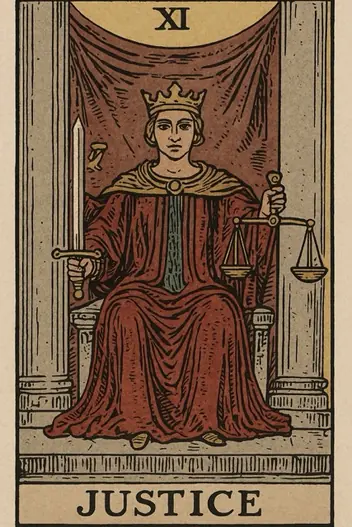
- Arcana
- Major Arcana · XI
- Element
- Air
- Planet / Sign
- Libra
- Numerology
- 11 → 2
The Justice card in Tarot represents the Jungian archetype of the Judge, a psychological function that evaluates, weighs evidence, and imposes structure on chaos. It is not a card of morality or punishment, but of cause-and-effect logic—the universal law that every action has a proportional consequence. This card appears when you are at a crossroads requiring a decision that aligns with your core values and objective reality, not emotional whims.
The fundamental challenge of Justice is the demand for radical honesty. It forces you to confront the gap between your self-perception and your actual behavior. It asks: Are you willing to accept the outcomes of your past choices, and are you prepared to make a choice that serves long-term integrity over short-term comfort? This is a card of accountability, not victimhood.
Main Dynamics and Interpretation
When Justice appears upright, it signals a period where logical analysis must override emotional reactivity. The psychological state is one of detached observation—you are called to step outside your own narrative and view your situation as a neutral third party. This is not coldness; it is the cognitive discipline required for fairness. The resource this card provides is clarity through reduction: stripping away excuses, rationalizations, and wishful thinking to expose the core truth of a situation.
In decision-making, Justice demands you create a decision matrix. Write down the pros and cons of each option, but weight them by objective importance, not emotional intensity. The key insight here is that Justice rewards process over outcome. If you follow a fair, transparent, and principled process, the result—even if painful—will be the correct one for your long-term growth. This mindset prevents the trap of hindsight bias, where you judge a decision by its result rather than the reasoning behind it. The real consequence of ignoring Justice is accumulating unresolved debts—broken promises, unaddressed conflicts, or ignored contracts—that will compound into larger crises later.
Ask your question and flip the cards
or simply focus on it
Justice: Yes or No?
Yes. But only after rigorous evaluation. The Justice card’s archetype is the impartial judge—it demands that the outcome be earned through truth and accountability. In the upright position, the scales tip in your favor only if you have acted with integrity and can present clear evidence of fairness. Reversed, the answer shifts to Leaning No, as the card warns of denial, hidden bias, or a refusal to accept consequences. The critical condition: the outcome depends entirely on whether you are willing to face uncomfortable facts and let go of self-deception. Without that, the scales remain stuck.
Ask your specific question
Don't rely on generic meanings. Get a customized reading tailored specifically to your energies.
What Does Justice Mean for Your Day?
The main vector of Justice today is accountability—you are being asked to review a past decision or relationship with cold clarity. Focus on gathering objective data: write down facts, consult a neutral third party, or revisit a contract or promise. Avoid the trap of rationalizing unfair behavior or playing the victim to avoid responsibility. Do not mistake emotional intensity for truth; your feelings are valid but not the final arbiter. Instead, take one concrete action to restore balance, such as apologizing or setting a boundary.
Love and Relationships
If you are not in a relationship:
This card indicates you must audit your own emotional patterns before seeking a partner. You are likely attracting people who mirror your own unresolved issues with fairness or reciprocity. The strategic move is to create a clear list of non-negotiable values (e.g., respect for boundaries, honesty about intentions) and refuse to compromise on them for the sake of connection.
If you are in a relationship:
Justice signals a need for a structured conversation about balance. Power imbalances, unspoken grievances, or unequal emotional labor must be addressed directly. The relationship will not survive avoidance of these issues.
The behavioral pattern Justice exposes is the tendency to keep a mental "scorecard" of grievances. This is a cognitive bias that poisons intimacy. The practical advice is to schedule a regular "relationship audit" —a calm, scheduled time (e.g., monthly) to discuss what is and isn't working. Use "I-statements" about your own experience, not accusations. Bold the main practical relationship advice: Fairness is not about equal outcomes; it is about equal opportunity to voice needs and be heard. If one partner consistently sacrifices for the other, resentment will build. Justice demands that both parties take equal responsibility for the health of the dynamic.
Justice as Feelings: What They Think of You
Through the lens of Justice, this person sees you as a figure of moral weight—someone who embodies fairness, but also judgment. You evoke a mix of respect and guardedness; they may feel you are measuring them against an invisible standard. Their hidden intention is to test your consistency: they want to know if you truly live by the principles you project. The fear is that you will expose their own imbalance or hypocrisy, so they approach you with cautious precision. There is an internal conflict: they admire your clarity yet feel uneasy about being held accountable by it. Ultimately, they are deciding whether you are an ally for truth or a threat to their self-image.
What Does Justice Mean for Work and Money?
Strategic Opportunities:
Negotiate a contract, partnership agreement, or formal review. This is the ideal time to clarify roles, compensation, and expectations in writing. Bold this: Legal or formal documentation now prevents future disputes.
Resource Management:
Audit your financial systems. Check for recurring expenses, debts, or investments that are not aligned with your long-term goals. Justice rewards methodical resource management.
Calculated Risks:
Avoid making decisions based on promises without proof. Do not accept verbal agreements or "handshake deals." Objectively avoid any situation where you feel pressured to skip due diligence.
In professional activity, Justice is the card of the fair leader—someone who applies rules consistently to everyone, including themselves. The strategic framework is to use a "pre-mortem" analysis: Imagine your decision has failed in six months. What went wrong? This reveals blind spots. For finances, bold the warning: Justice punishes "robbing Peter to pay Paul." Borrowing from one account to cover another, or using credit to fund a lifestyle you cannot afford, will lead to a reckoning. The card advises building a buffer of 3-6 months of expenses to handle consequences without panic.
Reversed Positions: What Changes?
When Justice appears reversed, the archetype of the Judge becomes the Injustice Collector. The blocked potential is self-deception and denial of responsibility. Instead of objective evaluation, the individual engages in blaming external factors—the economy, a partner, a boss—for their own choices. This is a defense mechanism that protects the ego but destroys growth. The manifestation in life is recurring patterns of unfairness: you feel cheated, overlooked, or victimized repeatedly. The warning here is clear: if you are constantly a victim, you are likely ignoring your own role in the story.
To correct this imbalance, you must reverse the question. Instead of "Why did this happen to me?" ask "What did I allow, ignore, or avoid that led to this outcome?" The logical way to correct this is to write a "responsibility map" : for a specific conflict or failure, list your own actions (not others') that contributed. Then, identify one action you can take today to make amends or change course. Reversed Justice is not a curse; it is a call to stop lying to yourself.
The Shadow Side of Justice
The shadow of Justice manifests as rigid perfectionism and moral superiority. The individual becomes a "judgmental critic" —applying harsh standards to others while making exceptions for themselves. This cognitive bias, known as fundamental attribution error, leads to seeing others' mistakes as character flaws and your own as situational accidents. The irrational behavior is obsessive "fairness" that actually masks a fear of vulnerability: you avoid intimacy by turning every interaction into a legal argument.
Another shadow pitfall is procrastination through analysis paralysis. You become so focused on making the "perfectly fair" decision that you make no decision at all. This is a form of self-sabotage that leads to missed opportunities. The fear underneath is that any choice will expose your inadequacy. The error is confusing fairness with certainty. Life does not offer guarantees; Justice only asks that you choose with integrity, not that you control the outcome. Avoid the trap of "I'll decide when I have all the facts"—you never will. Decide with the facts you have, and adjust later.
Synthesis: What It All Adds Up To
The Justice card is not a passive cosmic judge; it is an active psychological tool for building a life of integrity. To use its energy constructively, you must adopt a "trial and error" mindset with accountability. Every decision is a hypothesis. You test it, observe the result, and adjust. The key is to separate your identity from your decisions—a bad choice does not make you a bad person; it makes you a learner. This detachment allows you to accept consequences without shame and to correct course without ego.
Strategically, the most powerful action under Justice is to "clear the decks." List every unresolved debt—financial, emotional, or relational—that you are carrying. Prioritize the smallest ones first. Each resolution creates psychological momentum and frees cognitive load for bigger decisions. The ultimate advice is this: Treat fairness as a practice, not a principle. You will not always be perfectly fair, but you can always be transparent about your intentions and open to feedback. This builds trust with others and, more importantly, with yourself.
The final insight from Jungian psychology is that Justice represents the process of individuation through accountability. You become whole not by avoiding your shadow, but by owning every part of your story—the mistakes, the successes, and the ambiguous middle. This card is a call to stop waiting for external validation and start living by your own, consciously chosen code of ethics.
Your Next Step: Personal Context Matters
This psychological and strategic breakdown provides a deep understanding of archetypes. However, Tarot is never universal for everyone. To understand exactly how this dynamic applies to your specific situation—whether a career decision, a relationship crossroads, or a personal ethical dilemma—a reading tailored exclusively to you is necessary.
Download the Fortune Cards app or visit our platform to get a deep AI interpretation of your unique spread. Don't just read about the cards—use Fortune Cards to find out exactly what step you need to take next.
Try Tarot Spreads with Justice
Interpretation by the Fortune Cards editorial team, based on the Rider–Waite tradition and Jungian archetypes. About our methodology · Updated: 2026-08-26
Top Combinations with Justice
Discover how Justice interacts with other major cards in the deck to form powerful messages.
All 77 Combinations with Justice
Discover how this card interacts with every other card in the Tarot deck and reveal hidden meanings.
Table of Contents
- Main Dynamics and Interpretation
- Justice: Yes or No?
- What Does Justice Mean for Your Day?
- Love and Relationships
- Justice as Feelings: What They Think of You
- What Does Justice Mean for Work and Money?
- Reversed Positions: What Changes?
- The Shadow Side of Justice
- Synthesis: What It All Adds Up To
- Your Next Step: Personal Context Matters
Explore Tarot Universe

Ready to find answers to your questions?
Start your first reading now and look at your situation with fresh clarity. The cards are ready to reveal deeper meaning.