Love Tarot: Ten of Wands and Ten of Swords
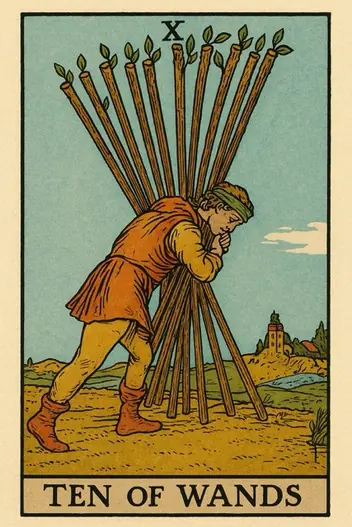

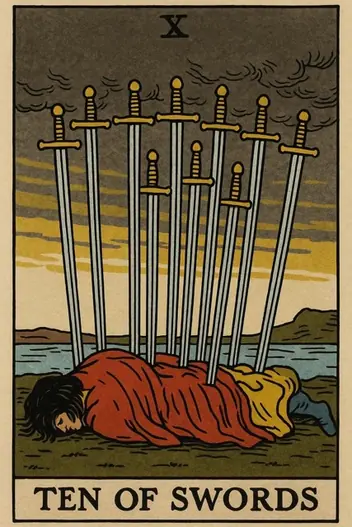
- Arcana
- Ten of Wands — Minor Arcana, Wands; Ten of Swords — Minor Arcana, Swords
- Elements
- Ten of Wands — Fire; Ten of Swords — Air
- Elemental interaction
- Friendly elements — energies support each other
- Numerology
- 10 + 10 = 20 → 2
When the Ten of Wands—the card of overburden, relentless effort, and burnout—meets the Ten of Swords—the card of painful endings, mental defeat, and rock bottom—you are facing a psychological crisis of accumulated exhaustion colliding with cognitive collapse. This is not a subtle combination. It signals a moment where the rational mind finally admits that the burdens it has been carrying are unsustainable. The intersection here is about the threshold of endurance: the point at which external pressures (Wands) have broken through internal defenses (Swords), forcing a reckoning.
Pragmatically, this pairing asks you to distinguish between necessary hardship (growth through discipline) and unnecessary suffering (self-imposed martyrdom). The Ten of Wands represents the physical and emotional weight of overcommitment; the Ten of Swords represents the mental narrative that this weight is inevitable or deserved. Together, they create a feedback loop of exhaustion and defeatism. The key insight? This is not a permanent state—it is a signal to stop, analyze, and release what no longer serves you.
Ten of Wands and Ten of Swords Combination Meaning
The psychological state created by this combination is one of learned helplessness mixed with stubborn pride. You have likely been saying "I can handle this" while ignoring clear signs of diminishing returns. The Ten of Wands represents the accumulated consequences of saying "yes" too many times—projects, obligations, emotional labor, or external expectations that have piled up until your capacity is exceeded. The Ten of Swords represents the mental crash that follows: the moment your unconscious mind forces you to stop by creating a crisis of meaning.
In real-world terms, this means you are at a decision point where the cost of continuing exceeds the benefit of quitting. The Swords card often appears after a betrayal, a sudden loss, or a painful realization that your efforts have been misdirected. When combined with the Wands, it suggests that the ending is not random—it is the logical conclusion of overextension. Your cognitive biases are likely working against you: the sunk cost fallacy (continuing because you've already invested so much) and the martyr complex (believing suffering is noble) are both active here. The pragmatic path is to conduct a ruthless audit of what you are carrying and ask: "Is this burden mine to bear, or am I holding it out of fear of change?"
Ten of Wands and Ten of Swords in Love Tarot
If you are single:
This combination warns against entering a new relationship while still emotionally drained from past obligations or unresolved issues. Your capacity for genuine connection is currently low—focus on stabilizing your own life before seeking partnership.
If you are in a relationship:
This pair signals a power imbalance where one partner is carrying the emotional or practical weight of the relationship while the other feels emotionally defeated or shut down. Honest, direct communication is non-negotiable.
In relationships, the Ten of Wands and Ten of Swords together often indicate a dynamic of exhaustion and withdrawal. One partner may feel they are doing all the work (Wands), while the other feels misunderstood or attacked (Swords). The result is a cycle of resentment and silence. The key relationship advice here is to stop trying to "fix" the other person and instead fix the system. Identify specific, concrete actions that can redistribute the load. If you are the one carrying the burden, set clear boundaries about what you will no longer do. If you are the one feeling defeated, ask for what you need without self-blame. This combination can lead to a breakthrough if both parties commit to radical honesty about their limits and desires. However, if the imbalance is too severe, it may signal that the relationship has reached its natural conclusion—and that ending it is the healthier choice.
Your pair is already on the table. Ask your question and draw the clarifying card
or simply focus on it
Career Meaning of Ten of Wands and Ten of Swords
Strategic Opportunities:
Evaluate your current workload for tasks that can be delegated, automated, or eliminated. This is a prime moment to restructure your workflow or renegotiate responsibilities.
Strategic Opportunities:
Use this crisis as leverage to ask for a promotion, raise, or better resources. The pain you are feeling is a testament to your value—make it visible to decision-makers.
Calculated Risks:
Avoid making major financial commitments or career changes while in a state of exhaustion. Your judgment is clouded by fatigue. Postpone any irreversible decisions until you have rested and gathered objective data.
In a professional context, this combination is a red flag for burnout and poor resource management. The Ten of Wands suggests you are taking on too much—possibly out of a sense of duty, fear of letting others down, or a misguided belief that working harder will solve systemic problems. The Ten of Swords warns that this approach will lead to a sharp, painful ending: a missed deadline, a resignation, a health crisis, or a public failure. The strategic move is to proactively cut your losses before the universe does it for you. Identify the one or two projects that truly matter and let the rest go. This is not a time for heroics; it is a time for triage. Financially, be cautious: the stress of this combination can lead to impulsive spending as a form of emotional release or, conversely, to hoarding resources out of fear of scarcity. Neither is productive. Aim for neutral, data-driven decisions based on your actual needs, not your emotional state.
Ten of Wands and Ten of Swords: Warning Signs
The shadow side of this combination is self-sabotage disguised as perseverance. You may be clinging to a failing project, relationship, or belief system because quitting feels like admitting defeat. This is cognitive dissonance at its most destructive: you know the situation is untenable, but you continue out of pride, guilt, or fear of the unknown. Another common pitfall is victimhood identity: adopting the narrative that you are a martyr who suffers nobly, which prevents you from taking responsibility for your own choices. This can manifest as passive-aggressive behavior in relationships or chronic complaining at work without taking corrective action. Additionally, the Ten of Swords can trigger catastrophic thinking—believing that one failure defines your entire future. Beware of the "all-or-nothing" mindset that says if you can't do it perfectly, you shouldn't do it at all. The shadow here is not the pain itself, but the refusal to learn from it.
Ask your specific question
Don't rely on generic meanings. Get a customized reading tailored specifically to your energies.
Reversed Positions: What Changes?
If the Ten of Wands is reversed:
This points to blocked potential and recklessness. You feel overloaded but refuse help, believing you can handle it alone. This is self-deception. Advice: publicly acknowledge your vulnerability. Ask for help before it's too late.
If the Ten of Swords is reversed:
This is internal resistance to the inevitable. You have already lost but refuse to admit it, prolonging the agony. This is a state of chronic anxiety and paralysis of will. Advice: stop resisting. Allow the situation to conclude. The death of the ego-project is the beginning of a new cycle.
If BOTH are reversed:
Complete imbalance. You are simultaneously overloaded and unable to complete the cycle. This is a state of "stuck" crisis, where neither activity nor passivity works. The remedy: radical external intervention. You need a coach, psychotherapist, or mentor who will forcibly halt your activity and help you navigate the process of completion.
Synthesis: Strategic Conclusion
How to constructively use the energy of this pair? Paradoxically, the Ten of Wands is your key to escape. Its energy of persistence and endurance, which led you to crisis, must be redirected. Instead of bearing an unbearable burden, use this same strength to endure emptiness and uncertainty.
Your task is to perform an act of courageous surrender. This is not weakness, but the highest form of strategic intelligence. You acknowledge that the current reality (Ten of Swords) is stronger than your will (Ten of Wands). You stop fighting not because you give up, but because you are regrouping for the next stage.
Strategic advice: apply the principle of "strategic retreat". A military commander who loses an army to save the banner is not a hero, but a fool. Your banner is your mental health and capacity for clear thinking. Retreat now to preserve them. Allow the "Ten of Swords" to complete what must be completed. In a week or a month, when the dust settles, you will see that this crisis has cleared the way for something fundamentally new. But to see this, you must first fully let go of the old.
Where to Go From Here
The core message of the Ten of Wands and Ten of Swords is clear: your current path is unsustainable, and the pain you are feeling is a signal to change direction. This is not a punishment—it is a psychological reset. The question is not whether you should stop, but what you are willing to release in order to move forward. The answer depends entirely on your unique circumstances, history, and goals.
Get a personalized, AI-powered Tarot reading for your specific question. While this article provides the general archetype, the true power of Tarot lies in applying these insights to your exact situation. The Fortune Cards app combines Jungian psychology with advanced AI to give you a deep, nuanced interpretation of the Ten of Wands and Ten of Swords based on your personal question and context. Use it on the web or download it now to discover what this combination means for your love life, career, or personal growth—right now.
Interpretation by the Fortune Cards editorial team, based on the Rider–Waite tradition and Jungian archetypes. About our methodology · Updated: 2026-09-24
Other Combinations with Ten of Wands
Other Combinations with Ten of Swords
Explore Individual Card Meanings
Table of Contents
Ready to find answers to your questions?
Start your first reading now and look at your situation with fresh clarity. The cards are ready to reveal deeper meaning.