Ten of Swords and Five of Pentacles Reversed in Tarot

- Arcana
- Ten of Swords — Minor Arcana, Swords; Five of Pentacles — Minor Arcana, Pentacles
- Elements
- Ten of Swords — Air; Five of Pentacles — Earth
- Elemental interaction
- Opposing elements — energies create tension
- Numerology
- 10 + 5 = 15 → 6
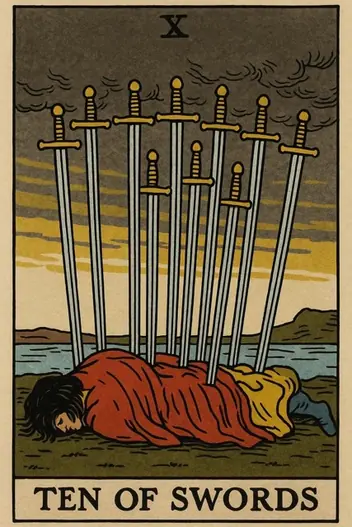
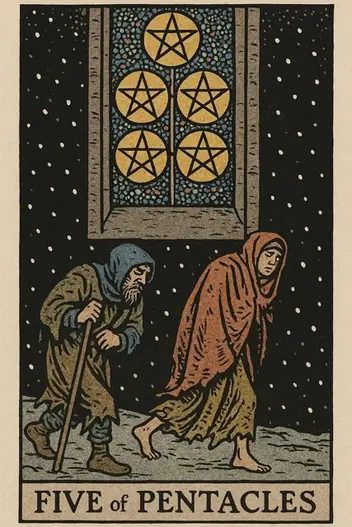
When the Ten of Swords—the card of painful endings, betrayal, and hitting rock bottom—intersects with the Five of Pentacles—the archetype of material lack, social exclusion, and spiritual poverty—the result is a psychological state of compounded crisis. This is not a simple setback; it is a convergence where an external loss (Ten of Swords) triggers an internal narrative of worthlessness (Five of Pentacles). The mind, already wounded, convinces itself that it has nothing left to offer and no resources to rebuild.
The collision of these two cards forces a confrontation with two primal fears: the fear of being destroyed by others (swords) and the fear of being abandoned or left out in the cold (pentacles). In practice, this combination often appears when a person has experienced a public failure, a betrayal, or a professional collapse, and then interprets that event as proof they are fundamentally "unworthy" or "unlovable." The strategic challenge is to separate the objective event from the subjective story of lack.
Ten of Swords and Five of Pentacles Together: Meaning
The core dynamic here is a psychological feedback loop of shame and scarcity. The Ten of Swords represents the crisis point—the moment when a situation, relationship, or career path has been decisively "killed" or terminated. This could be a firing, a breakup, or a public humiliation. The Five of Pentacles then adds the layer of existential poverty: the belief that one is now isolated, resource-less, and outside the circle of safety. Together, they create a mindset where the seeker feels both victimized by fate and unworthy of recovery.
This combination is a powerful wake-up call to recognize the difference between a temporary setback and a permanent identity. The Ten of Swords says, "This chapter is over." The Five of Pentacles whispers, "And you don't deserve a new one." The psychological trap is catastrophizing—turning a single loss into a global verdict on your value. A key insight is that the Five of Pentacles often represents a self-imposed exile. The "cold" you feel may be your own refusal to ask for help, rather than an actual lack of support. The real work is to acknowledge the pain of the ending without adopting the story of permanent lack.
Your pair is already on the table. Ask your question and draw the clarifying card
or simply focus on it
Ten of Swords and Five of Pentacles in Love and Relationships
If you are single:
This pair suggests you may be approaching new connections from a place of wounded pride and perceived inadequacy. You might be projecting a fear of rejection before any real interaction occurs, or you may be drawn to partners who mirror your own sense of lack.
If you are in a relationship:
The dynamic indicates a crisis of trust and shared resources. One or both partners may feel "left out in the cold" emotionally, or there may be a recent betrayal that has shattered the foundation of the relationship.
In relationships, this combination signals a high-stakes moment of emotional reckoning. The Ten of Swords often points to a specific wound—an affair, a harsh word, or a broken promise—that has cut deeply. The Five of Pentacles then amplifies the fear that this wound is irreparable and that the relationship is now "bankrupt." The critical advice is to resist the urge to isolate. When these cards appear, the worst thing you can do is to withdraw into silent suffering, believing your partner cannot or will not understand. Instead, focus on rebuilding a shared sense of safety through transparent communication. If you are single, challenge the belief that you must be "whole" before you can connect. The path forward is to acknowledge your hurt without letting it define your worth as a partner.
Uncover hidden insights
Let our advanced Tarot system interpret these archetypes specifically for your personal path.
Ten of Swords and Five of Pentacles: Career and Money
Strategic Opportunities:
Rebuild from a position of radical honesty. Use the "rock bottom" feeling to re-evaluate what you truly value in work, rather than clinging to a broken career path.
Strategic Opportunities:
Leverage your network unexpectedly. The Five of Pentacles warns against pride; reach out to former colleagues or mentors you have not spoken to in years. Help often comes from forgotten sources.
Calculated Risks:
Avoid making major financial decisions from a state of panic. The urge to "settle for anything" or to take on high-interest debt to feel secure is a dangerous trap. Wait until the emotional shock has subsided.
Professionally, this combination is a red flag for burnout and financial mismanagement. The Ten of Swords can indicate a project that has failed, a job loss, or a public mistake that feels career-ending. The Five of Pentacles warns of real material consequences—missed payments, depleted savings, or a loss of professional status. The strategic move is to treat this as a triage situation. First, stabilize your basic financial survival without making long-term commitments. Second, separate your professional identity from your personal worth. A failed venture does not make you a failure. The key warning here is against "poverty mentality"—the belief that there are no opportunities left. In reality, the Ten of Swords clears the deck for something new, but the Five of Pentacles can blind you to the openings that exist. Focus on micro-actions: update your resume, talk to one person in your field, or take a small consulting gig. Action breaks the cycle of shame.
Ten of Swords and Five of Pentacles Reversed: What Changes?
When cards appear reversed, the dynamic becomes less fatal but more insidious.
If the Ten of Swords is reversed:
This indicates resistance to an inevitable ending. The person clings to outdated projects or relationships, refusing to acknowledge their collapse. Advice: recognize that delaying departure only worsens the losses. This is not stubbornness, but a fear of the void.
If the Five of Pentacles is reversed:
The "outcast" or "pauper" situation may be psychologically advantageous. The person uses the victim status to gain attention or avoid responsibility. Warning: such a position destroys reputation and repels genuine support.
If BOTH are reversed:
Complete imbalance: denial of reality (reversed Ten of Swords) combines with refusal of help (reversed Five of Pentacles). The person is in isolation but does not acknowledge it. Corrective measure: turn to an objective "external observer" — a coach or consultant who can point out the blind spots.
Negative Meaning of Ten of Swords and Five of Pentacles
The shadow of this combination is a dangerous spiral of victimhood and self-neglect. When the energy is blocked, the seeker may romanticize their suffering, wearing their "rock bottom" as a badge of honor or using it as an excuse to stop trying. Cognitive biases such as confirmation bias (only seeing evidence that supports your worthlessness) and learned helplessness (believing that nothing you do will change the outcome) are rampant. The Five of Pentacles can manifest as actual self-sabotage—skipping job interviews, ignoring bills, or pushing away friends who try to help. The Ten of Swords can lead to paranoid thinking, where you see betrayal in every neutral interaction. The most dangerous pitfall is ignoring the practical, material reality in favor of a dramatic narrative of "destiny" or "fate." This combination demands grounded action, not spiritual bypassing. If you find yourself feeling "cursed" or "destined to fail," you are likely in the shadow of these cards.
Ten of Swords and Five of Pentacles: The Combined Message
Constructive use of this energy requires the courage to embrace the end. The Ten of Swords is not merely pain; it is liberation from an old, outworn structure. To balance the Five of Pentacles, you must stop seeking resources externally and begin generating them internally. The strategy is this: use the crisis as a catalyst to reassemble your value system.
Your primary asset right now is clarity. You know precisely what no longer works. Focus on the "minimum viable product" of your life: what do you need right now for basic comfort and security? Let go of everything that demands emotional or financial investment without immediate return. This period is not about growth, but about quality sanitation.
A deep strategic counsel: begin a "major overhaul" of your schedule and social circle. Remove all "background noise"—people, tasks, and habits that drain you. The healthy form of the Five of Pentacles is the ability to ask for help. The Ten of Swords is the capacity to draw a line. By combining them, you will learn to end toxic cycles and openly request support. This is the formula for emerging from crisis.
Your Next Step: Personal Context Matters
The core message of the Ten of Swords and Five of Pentacles is that endings and lack are not the final truth, but a starting point for radical honesty. You must first acknowledge the depth of the wound and the reality of the material loss, and then, consciously refuse to let that define your future. This is a time for ruthless pragmatism, not despair.
While this article provides the general archetype, the true magic happens when Tarot is applied to your unique situation. Your specific question, your personal history, and the other cards in your spread will shift the meaning dramatically. To get a deep, personalized interpretation of this exact combination for your specific question right now, use the Fortune Cards app. You can access it on the web or download it today to receive a tailored reading that cuts through the general advice and speaks directly to your life.
Interpretation by the Fortune Cards editorial team, based on the Rider–Waite tradition and Jungian archetypes. About our methodology · Updated: 2026-08-26
Other Combinations with Ten of Swords
Other Combinations with Five of Pentacles
Explore Individual Card Meanings
Table of Contents
- Ten of Swords and Five of Pentacles Together: Meaning
- Ten of Swords and Five of Pentacles in Love and Relationships
- Ten of Swords and Five of Pentacles: Career and Money
- Ten of Swords and Five of Pentacles Reversed: What Changes?
- Negative Meaning of Ten of Swords and Five of Pentacles
- Ten of Swords and Five of Pentacles: The Combined Message
- Your Next Step: Personal Context Matters
Ready to find answers to your questions?
Start your first reading now and look at your situation with fresh clarity. The cards are ready to reveal deeper meaning.