Knight of Wands and Ten of Swords Tarot as Feelings
- Arcana
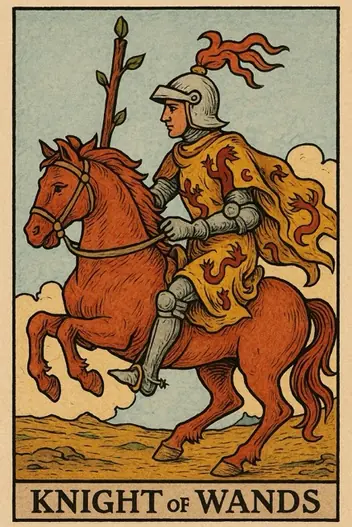
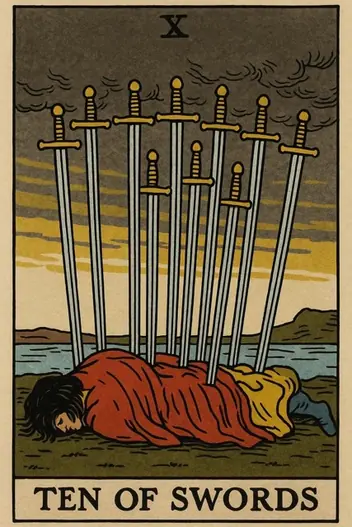
- Knight of Wands — Minor Arcana, Wands; Ten of Swords — Minor Arcana, Swords
- Elements
- Knight of Wands — Fire; Ten of Swords — Air
- Elemental interaction
- Friendly elements — energies support each other
- Numerology
- 12 + 10 = 22 → 4
The Knight of Wands embodies impulsive action, fiery passion, and the pursuit of novelty—a drive to charge forward without hesitation. The Ten of Swords represents a painful ending, mental defeat, and the collapse of a belief system. When these two collide, the result is a psychological crossroads: a moment where the consequences of unchecked momentum force a stark reckoning. This is not a gentle warning; it is a wake-up call that demands strategic pause and honest self-assessment.
In Jungian terms, this pairing reflects the clash between the Puer Aeternus (eternal youth) archetype—which seeks constant excitement—and the Shadow of defeat that arises when that energy is misdirected. The Knight’s fire burns bright, but without direction, it can ignite a crisis. The Ten of Swords offers a brutal but necessary lesson: some battles are lost so that a wiser warrior can emerge.
What Do Knight of Wands and Ten of Swords Mean Together?
At its core, this combination highlights the psychological tension between action and aftermath. The Knight of Wands pushes for immediate movement, often based on enthusiasm rather than strategy. The Ten of Swords reveals the cost: a mental breakdown, a failed project, or a relationship that has run its course. The key insight here is that the Knight’s energy is not inherently negative—it simply requires a framework of risk assessment. Without it, the seeker may repeat a cycle of burning out, crashing, and starting over.
This is a pivot point for cognitive restructuring. The mind is flooded with catastrophic thoughts (“I’ve ruined everything”), but the Knight’s resilience offers a lifeline: the ability to rise again, but with new data. The practical implication is to stop, assess the damage, and extract the lesson before charging forward again. The Ten of Swords is not the end of the story—it is the death of an old pattern, not the death of the self. Use this moment to rebuild your internal compass with clearer boundaries and a more realistic timeline.
Your pair is already on the table. Ask your question and draw the clarifying card
or simply focus on it
What Do Knight of Wands and Ten of Swords Say About Love?
If you are single:
This pair warns against rushing into a new connection to escape past pain. The Knight’s impulsiveness could lead you to ignore red flags, only to face a similar ending. Focus on healing before pursuing the next spark.
If you are in a relationship:
The dynamic may involve one partner feeling emotionally “stabbed” by the other’s reckless behavior. Conflict is likely rooted in unmet needs for stability versus freedom.
In romantic contexts, the Knight of Wands and Ten of Swords often signals a relationship that has hit a critical breaking point due to impulsive decisions or emotional burnout. One partner may have acted without considering the other’s feelings, leading to a severe breakdown in trust. The most pragmatic approach is to treat this as a crisis intervention moment. Rather than assigning blame, focus on identifying the specific action that caused the wound and negotiate a new boundary. For couples willing to do the work, this can be a catalyst for deeper honesty. However, if the Knight’s energy is chronic and the Ten of Swords represents repeated betrayal, the wisest choice may be a clean, respectful exit to avoid further psychological damage.
Career and Finances
Strategic Opportunities:
Leverage a failed project as a case study for process improvement. The Knight’s energy can be redirected into innovation—if you first analyze what went wrong.
Strategic Opportunities:
Use the Ten of Swords’ clarity to cut ties with a toxic client, partnership, or role. The ending is a gift if it frees you from a dead-end situation.
Calculated Risks:
Avoid any new investment or job offer for at least 30 days. The Knight’s impulsiveness could lead to repeating the same mistake. Wait for the adrenaline of the “ending” to subside before making major financial moves.
Professionally, this combination is a red flag for burnout and poor strategic planning. The Knight of Wands might represent a hasty launch, an overambitious proposal, or a conflict with a superior that escalated unnecessarily. The Ten of Swords confirms the fallout: a termination, a significant financial loss, or a public failure. The practical takeaway is to shift from “acting” mode to “auditing” mode. Review your recent decisions with brutal honesty. Did you skip due diligence? Overpromise? Ignore feedback? The path forward requires recalibrating your risk tolerance and building a support system (mentors, financial advisors) to temper your natural drive. Do not double down on a failing strategy—cut losses and pivot.
Uncover hidden insights
Let our advanced Tarot system interpret these archetypes specifically for your personal path.
Reversed Knight of Wands and Ten of Swords Explained
Knight of Wands Reversed:
This indicates blocked initiative. You want to act, but fear or external circumstances paralyze you. Instead of an impulsive rush, you fall into apathy. Advice: analyze what exactly is holding you back — is it a real obstacle or your own insecurity? Take one small but concrete step to break the cycle of inaction.
Ten of Swords Reversed:
This is resistance to the inevitable end. You cling to a dying relationship, project, or idea, refusing to acknowledge its demise. This causes chronic stress and exhaustion. Warning: prolonging the agony will only worsen the consequences. Acknowledge the end of a phase — this will provide energy for a new beginning.
BOTH Reversed:
Complete imbalance, where impulse is suppressed and crisis is denied. This is a state of "frozen conflict": you neither act nor bring the situation to a close. Logical way to correct this: artificially create a "bottom." Make a default decision — for example, to quit or separate if the situation doesn't change within a month. This will bring clarity and relieve tension.
Shadow Side & Pitfalls
The shadow side of this pairing manifests as self-destructive impulsivity and victim mentality. The Knight’s unchecked energy can lead to repetitive patterns of starting projects or relationships with grand visions, only to abandon them when obstacles arise. The Ten of Swords then becomes a self-fulfilling prophecy of defeat, where the seeker unconsciously engineers a “tragic ending” to avoid accountability. Psychologically, this mirrors cognitive distortions like “all-or-nothing thinking” (“If I fail once, I’m a total failure”) and “emotional reasoning” (“I feel hopeless, so I must be hopeless”). The pitfall is to romanticize the crash—to wear the Ten of Swords as a badge of martyrdom rather than a lesson. To avoid this, practice metacognition: ask yourself, “What role did my own choices play in this outcome?” The shadow also includes using the Knight’s energy to escape grief—jumping into a new venture or relationship before processing the pain of the last one. True growth requires sitting with the discomfort of the Ten of Swords, not running from it.
Knight of Wands and Ten of Swords Combined Message
Constructive use of this pair requires a paradoxical approach: channel the Knight's energy toward completion, not new beginnings. Instead of wasting momentum storming new heights, direct it toward conscious and active closure of the old. Resign dramatically, but with dignity. End relationships clearly and cleanly, without scandals. Close a project by delivering a final presentation of its failures. This transforms defeat into a strategic maneuver.
The Ten of Swords in this combination is not a verdict, but a tool for "surgically removing" what no longer works. Your task is not to avoid pain, but to use it as a signal for precise action. A deep strategic counsel: ask yourself — "What exactly must die so I can move forward without the burden of the past?" The answer to this question will grant you clarity and transform the impulsive Knight into a strategist who knows when to attack and when to retreat, conserving strength for the battle ahead.
Applying This to Your Situation
The Knight of Wands and Ten of Swords is a powerful call to pause, reflect, and redirect your fire. The core message is clear: unexamined action leads to avoidable endings, but every ending contains the seeds of a more mature beginning. Your next step is to apply this wisdom to your specific situation—where exactly did the momentum go wrong, and what boundaries need to be set for the future?
While this analysis provides a universal framework, the true power of Tarot lies in its personalization to your unique life. The Fortune Cards app offers a deep, AI-driven interpretation of this exact combination tailored to your specific question—whether it’s about a relationship, career decision, or personal challenge. You can use the app on the web or download it now to get a customized reading that accounts for your context, timing, and emotional state. Don’t just read the archetype—live the insight.
Interpretation by the Fortune Cards editorial team, based on the Rider–Waite tradition and Jungian archetypes. About our methodology · Updated: 2026-10-08
Other Combinations with Knight of Wands
Other Combinations with Ten of Swords
Explore Individual Card Meanings
Table of Contents
Ready to find answers to your questions?
Start your first reading now and look at your situation with fresh clarity. The cards are ready to reveal deeper meaning.