Ten of Swords and Ten of Pentacles Together in Tarot

- Arcana
- Ten of Swords — Minor Arcana, Swords; Ten of Pentacles — Minor Arcana, Pentacles
- Elements
- Ten of Swords — Air; Ten of Pentacles — Earth
- Elemental interaction
- Opposing elements — energies create tension
- Numerology
- 10 + 10 = 20 → 2
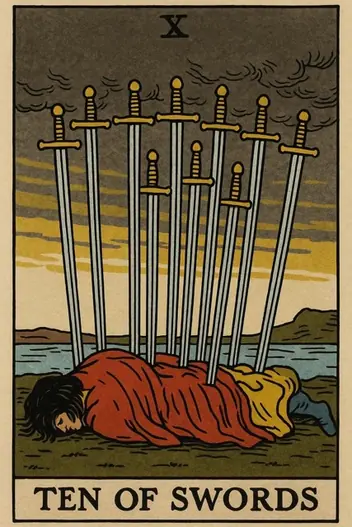
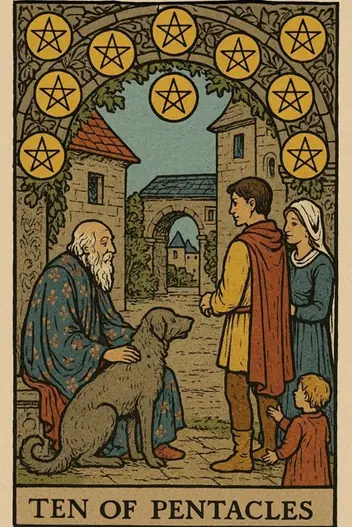
When the Ten of Swords—the card of painful endings, betrayal, and rock-bottom—collides with the Ten of Pentacles—the card of generational wealth, family legacy, and long-term security—you are looking at a profound psychological paradox. This combination suggests that a devastating loss or a sudden collapse is not just an end, but a necessary clearing of the ground for something more stable and authentic to emerge.
From a Jungian perspective, this pairing represents the death of a false persona (the ego-identity tied to status, inheritance, or external validation) in order to resurrect a more integrated, values-driven life. The Ten of Swords forces you to confront the shadow of your own naivety or misplaced trust, while the Ten of Pentacles demands you ask: What legacy am I truly building, and for whom? This is not a card of easy comfort; it is a strategic call to accept the loss, extract the lesson, and rebuild with ruthless integrity.
What Do Ten of Swords and Ten of Pentacles Mean Together?
At its core, this combination reveals a psychological state where security and crisis are locked in a dialectic. The Ten of Pentacles represents the archetype of the "Eternal Family" or "Institution"—the structures we rely on for stability: a job, a marriage, a trust fund, a reputation. The Ten of Swords is the archetype of the "Wounded King"—the moment when that structure fails you completely, often through a betrayal, a legal dispute, or a catastrophic mistake.
The key insight here is that the Ten of Swords does not destroy the Ten of Pentacles; it exposes its hidden fault lines. If you have been clinging to a legacy that was built on a lie (e.g., a family business that exploits others, a relationship based on obligation rather than love, a career that drains your soul), this card pair forces the reckoning. The psychological task is to distinguish between the form of security (the house, the title, the bank account) and the function of security (safety, belonging, purpose). The cards suggest that the form must die so the function can survive.
In practical terms, this means you are likely facing a "reset" that feels like a funeral. You may lose a job, a partner, or a long-held dream. But the Ten of Pentacles assures you that what remains after the collapse is more real and more sustainable than what was lost. The mindset required is one of stoic acceptance combined with strategic humility: acknowledge the loss fully, but do not mistake it for a verdict on your worth. This is a cognitive reframe from "I am a failure" to "I am shedding a false inheritance."
What Do Ten of Swords and Ten of Pentacles Say About Love?
If you are single:
This combination warns against rushing into a relationship based on financial stability or family approval. The "perfect on paper" partner may carry hidden debts—emotional or literal. Focus on healing your own sense of worth before seeking a legacy with someone else.
If you are in a relationship:
Expect a crisis of loyalty or inheritance. This could involve a partner's family meddling, a betrayal of trust around money, or a painful realization that your shared "future plans" were built on a fragile foundation. Honest, uncomfortable conversations are non-negotiable.
In relationships, the Ten of Swords and Ten of Pentacles together often signal the end of a cycle of obligation. You or your partner may have been playing the role of the "good son/daughter" or the "provider" out of duty, not desire. The Ten of Swords exposes the emotional bankruptcy of that role—perhaps through an affair, a financial secret, or a sudden illness that reveals who truly shows up. The key relationship advice is bold: Do not try to "fix" the past. Instead, negotiate a new contract based on current reality, not family history.
This pairing also highlights power dynamics around money and control. If one partner holds the financial reins, the other may feel stabbed in the back when that power is abused. The psychological work is to redefine what "security" means in the relationship—moving from external assets (houses, trusts) to internal assets (trust, communication, shared values). If you can survive this rupture, the bond can become stronger than any inheritance.
Your pair is already on the table. Ask your question and draw the clarifying card
or simply focus on it
What Do Ten of Swords and Ten of Pentacles Indicate for Your Career?
Strategic Opportunities:
Complete a painful but necessary restructuring. If a project, partnership, or business line is failing, let it die. The Ten of Swords gives you permission to cut losses and redirect resources to what is truly viable.
Strategic Opportunities:
Claim your intellectual property or rightful inheritance. This combination often appears in legal disputes, wills, or patents. It suggests that fighting for what is yours is not greed—it is integrity. Hire a lawyer, document everything, and don't back down.
Calculated Risks:
Avoid "sunk cost" thinking. Do not throw good money after bad just because you have invested years in a failing strategy. The Ten of Pentacles rewards long-term vision, but the Ten of Swords says that vision must be updated after a failure.
In professional and financial contexts, this card pair is a hard reset on your career architecture. You may be facing a layoff, a bankruptcy, or a public failure. The pragmatic advice is to treat this as a due diligence audit of your entire financial life. Where are your assets truly vulnerable? Which relationships (clients, partners, mentors) are reliable, and which are just part of the "family myth"?
The most important financial warning here is: Do not take on debt to maintain appearances. The Ten of Pentacles can tempt you to borrow against future expectations to preserve a lifestyle or a status. The Ten of Swords warns that this will only delay the inevitable and deepen the wound. Instead, downsize deliberately. Sell the house, dissolve the partnership, file for the restructure. The goal is to emerge with a lean, honest foundation—not a gilded prison.
Shadow Side & Pitfalls
The shadow of this combination is the refusal to let go. The Ten of Swords can manifest as a victim mentality—blaming the family, the economy, or the ex-partner for your collapse. The Ten of Pentacles can then become a fantasy of revenge or a desperate attempt to "win back" what was lost through manipulation or control. This is the cognitive bias of "just-world fallacy" : believing that if you suffer enough, the universe will restore your legacy. It won't. The shadow path is bitter loyalty to a dead system.
Another pitfall is financial martyrdom: sacrificing your own health, time, or ethics to preserve a family name or a company that no longer serves anyone. This often shows up as "golden handcuffs" —a high-paying job or inheritance that requires you to tolerate abuse, fraud, or moral compromise. The Ten of Swords screams "wake up," but the shadow clings to the comfort of the known.
Finally, there is the risk of spiritual bypassing: using the Ten of Pentacles' "everything happens for a reason" to avoid processing the real grief of the Ten of Swords. You must feel the betrayal, the loss, the shame fully before you can rebuild. Skipping this step leads to repeating the same pattern with a new family, new business, or new partner. The shadow is premature optimism without accountability.
Uncover hidden insights
Let our advanced Tarot system interpret these archetypes specifically for your personal path.
What If Ten of Swords or Ten of Pentacles Appears Reversed?
When the Ten of Swords appears reversed, the intensity of the crisis diminishes, but does not disappear. You are granted a reprieve, not a solution. Psychologically, this means you are avoiding confrontation, hoping the problem will resolve itself. Advice: do not confuse a breather with recovery. Use this time for preparation, not denial. If the Ten of Pentacles is reversed, the support structure is unreliable. The family, company, or financial foundation you relied upon has developed a crack. Warning: do not rely on promises or past merits. Verify the actual state of your resources—bank accounts, legal documents, partnership agreements.
If both cards are reversed, the dynamic becomes chaotic. You are simultaneously denying both the crisis and the available resources. This is a state of cognitive dissonance: you know the problem exists but are not ready to act. Advice: start small. Choose one aspect of your life—financial or emotional—and conduct a full audit. Do not try to solve everything at once. Break the problem into manageable parts and address them sequentially. Irrational behavior here manifests as paralysis of will or, conversely, as impulsive actions without a plan.
Ten of Swords and Ten of Pentacles Combined Message
Constructive use of this dynamic requires a paradigm shift: stop perceiving the crisis as an enemy and begin seeing it as a tool for cleansing. The Ten of Swords is not a punishment, but a surgical removal of what is already dead. Your task is not to save everything indiscriminately, but to separate the viable from the toxic.
Strategically, you can harness the energy of the Ten of Swords to accelerate the inevitable. If you know that a breakup or restructuring is necessary, do it quickly and cleanly. Protraction only increases emotional and material costs. The "one-strike principle": one decisive action that completes a cycle is less painful than a series of small cuts.
The Ten of Pentacles in this combination offers you support in the form of real resources, not illusions. Family, capital, professional reputation — these are tools, not ends. A deep strategic piece of advice: redistribute resources from dying structures into new ones. Close a failing business, but use your connections and experience to start in a new niche. Break off toxic relationships, but preserve your financial independence.
The key decision you must make:
what exactly are you willing to lose in order to keep what matters most? The answer to this question provides clarity. Do not try to hold onto everything — that is the path to total loss. Choose one or two core values (family, health, professional identity) and sacrifice everything else to preserve them. This is not surrender — it is a strategic regrouping.
Your Next Step: Personal Context Matters
The core message of Ten of Swords and Ten of Pentacles is this: Your greatest loss is also your most honest inheritance. The structures you thought were permanent were actually prisons. The betrayal you suffered was a permission slip to build a life aligned with your true values, not someone else's blueprint. To move forward, you must mourn the past, audit your present, and commit to a legacy that is earned, not inherited.
But this is a general archetype. Your specific situation—whether it's a divorce, a business failure, or a family feud—has unique variables that no article can capture. That is where the Fortune Cards app becomes your strategic ally. Instead of guessing how these cards apply to your exact question, you can input your personal context and receive a deep, tailored interpretation that accounts for your cards' positions, your query, and your current life stage.
Use the Fortune Cards app now on the web or download it to get a personalized, actionable reading for this exact combination. Don't let a generic meaning leave you stuck. Let the cards speak directly to your legacy.
Interpretation by the Fortune Cards editorial team, based on the Rider–Waite tradition and Jungian archetypes. About our methodology · Updated: 2026-08-26
Other Combinations with Ten of Swords
Other Combinations with Ten of Pentacles
Explore Individual Card Meanings
Table of Contents
- What Do Ten of Swords and Ten of Pentacles Mean Together?
- What Do Ten of Swords and Ten of Pentacles Say About Love?
- What Do Ten of Swords and Ten of Pentacles Indicate for Your Career?
- Shadow Side & Pitfalls
- What If Ten of Swords or Ten of Pentacles Appears Reversed?
- Ten of Swords and Ten of Pentacles Combined Message
- Your Next Step: Personal Context Matters
Ready to find answers to your questions?
Start your first reading now and look at your situation with fresh clarity. The cards are ready to reveal deeper meaning.