Knight of Cups and Ten of Swords Together in Tarot
- Arcana
- Knight of Cups — Minor Arcana, Cups; Ten of Swords — Minor Arcana, Swords
- Elements
- Knight of Cups — Water; Ten of Swords — Air
- Elemental interaction
- Neutral elements — energies coexist without conflict
- Numerology
- 12 + 10 = 22 → 4
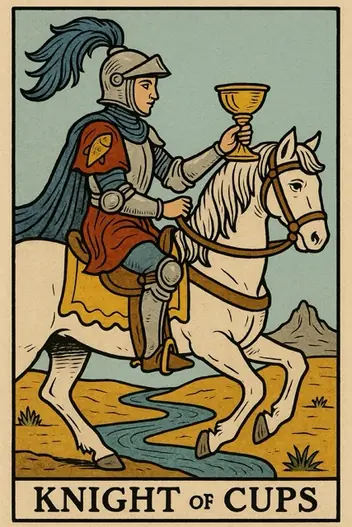
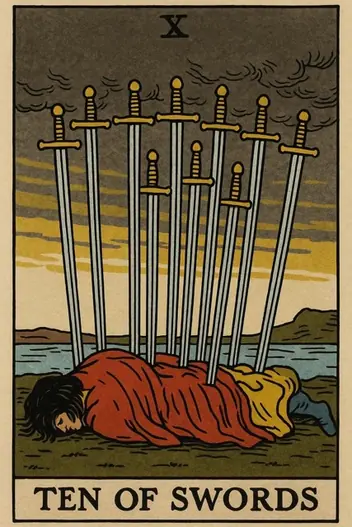
The Knight of Cups represents the archetype of the romantic seeker—driven by emotion, idealism, and a desire for meaningful connection. The Ten of Swords, in stark contrast, depicts the moment of finality, betrayal, or a painful ending that leaves no room for denial. When these two cards appear together, they signal a collision between emotional aspiration and harsh reality. This combination often emerges when a person’s idealistic hopes are met with a definitive, sometimes brutal, conclusion—forcing a necessary psychological reckoning.
In practical terms, this pairing asks you to examine the gap between what you feel is possible and what the evidence suggests is actually happening. The Knight of Cups wants to rescue, heal, or pursue a dream; the Ten of Swords insists that the battle is over. The key psychological insight here is that clinging to an idealized narrative after the facts have spoken is a form of self-deception. The path forward requires integrating the emotional wound (Ten of Swords) with the capacity for renewal (Knight of Cups), but only after accepting the loss.
Knight of Cups and Ten of Swords Combination Meaning
The core dynamic of this combination is a psychological rupture between hope and reality. The Knight of Cups represents a state of emotional openness, often accompanied by a desire to pursue a vision or a person with unwavering faith. The Ten of Swords, however, is the archetype of the martyr—the moment when the seeker is "pinned down" by circumstances, criticism, or a definitive end. When these energies merge, the result is a painful but potentially transformative crisis: the idealist must confront the fact that their dream has died.
This is not a time for emotional rescue missions. The most critical insight is that the Knight of Cups’ energy must be redirected from chasing to processing. The seeker may feel a strong urge to "fix" the situation or to re-engage with a person or project that has clearly ended. This is a cognitive bias known as the sunk cost fallacy—the mistaken belief that more emotional investment will reverse a loss. The Ten of Swords demands that you lie still and let the wound bleed out. Accepting the finality is the first step toward genuine healing.
In real-world terms, this combination often appears during a breakup, a career failure, or a shattered personal belief. The psychological task is not to resurrect the past but to use the Knight’s emotional intelligence to grieve effectively. The Knight of Cups can become a powerful ally here—not as a pursuer, but as a compassionate observer who honors the pain without trying to escape it. The dynamic is one of necessary surrender: you stop fighting the inevitable and begin the work of emotional integration.
Your pair is already on the table. Ask your question and draw the clarifying card
or simply focus on it
What Do Knight of Cups and Ten of Swords Say About Love?
If you are single:
This pairing warns against pursuing someone who has clearly rejected you or is emotionally unavailable. The Knight of Cups’ romantic idealism can blind you to red flags. Focus on understanding why you are drawn to unavailable partners rather than trying to win them over.
If you are in a relationship:
This combination signals a critical turning point. A betrayal, a painful truth, or a fundamental incompatibility has come to light. The relationship may be ending, or it requires a radical renegotiation of terms. Avoid the temptation to "smooth things over" with grand gestures.
In relationships, the Knight of Cups and Ten of Swords together create a powerful but painful dynamic. The Knight’s desire for emotional depth and connection clashes with the Ten’s message of finality. This often manifests as one partner clinging to a romanticized version of the relationship while the other has already emotionally checked out. The psychological danger here is emotional triangulation: the seeker may try to involve a third party (a friend, a therapist, or even a new love interest) to avoid facing the ending directly. The healthiest path is radical honesty. If the relationship is over, the Knight of Cups must learn to honor the love that was there without denying the death that has occurred. Key relationship advice: Do not mistake emotional intensity for emotional intimacy. The Ten of Swords is a clear signal that the current pattern is unsustainable.
Career Meaning of Knight of Cups and Ten of Swords
Strategic Opportunities:
Accept the loss and pivot. The Knight of Cups’ creativity can be redirected toward a new project that aligns with your values, not toward reviving a dead venture.
Strategic Opportunities:
Use your emotional intelligence to network authentically. People will remember how you handled a failure with grace; this builds long-term trust.
Calculated Risks:
Avoid making impulsive financial or career decisions driven by wounded pride. The Knight of Cups can be tempted to make a "heroic" gesture (e.g., quitting without a plan) to restore a sense of control, which the Ten of Swords warns against.
In a career context, this combination often appears after a major professional setback: a layoff, a failed project, a public criticism, or a partnership dissolution. The Knight of Cups may feel a strong urge to defend their reputation or to launch a counterattack. This is a strategic error. The Ten of Swords suggests that the situation is beyond salvage; any attempt to "win" will only prolong the pain. Instead, focus on damage control and strategic withdrawal. The Knight of Cups’ best asset here is their ability to read the emotional climate—use this to identify who your true allies are and to negotiate a graceful exit if needed. Important financial warning: Do not invest more money or time into a venture that has already shown clear signs of failure. The Ten of Swords is a definitive "no" from the universe; respect it.
Get a personalized interpretation
Unlock the combined meaning of your cards in the context of your unique question — for free.
Reversed Knight of Cups and Ten of Swords Explained
Reversed cards in this pair shift the emphasis from external drama to internal blockages.
If the Knight of Cups is reversed:
This indicates a blocked emotional potential. The person wants to show care but fears rejection or ridicule. Instead of active rescue, they watch the catastrophe from the sidelines, feeling guilty. Advice: stop waiting for the perfect moment; your inaction is also a form of participation in the collapse. Even a clumsy attempt at help is better than paralysis of the will.
If the Ten of Swords is reversed:
The classic meaning is "a postponement of the inevitable" or a superficial wound. The situation is not destroyed to its foundations but is in deep crisis. The person refuses to acknowledge the end. Warning: this is the most dangerous position. The Knight of Cups (even upright) may persuade you to "try again," but the reversed Ten of Swords indicates you are merely delaying the moment of reckoning. Do not succumb to false hopes.
If BOTH are reversed:
Complete imbalance. Emotional immaturity (reversed Knight) meets an inability to complete a cycle (reversed Ten). This is a stalemate where the person painfully clings to what no longer works but fears taking a decisive step. Remedy: a firm external intervention is necessary. Seek out a mentor or psychologist who will "lance the boil" and help you undergo the ritual of closure that you are unable to perform on your own.
Knight of Cups and Ten of Swords: Warning Signs
The shadow side of this combination is emotional martyrdom. The Knight of Cups can become a "wounded healer" who refuses to let go of a painful story because it provides a sense of identity or moral superiority. The seeker may unconsciously choose to stay in a state of victimhood (Ten of Swords) because it feels safer than the vulnerability of moving on. This is a form of cognitive distortion known as catastrophizing—blowing the ending out of proportion to justify a prolonged period of helplessness. Another pitfall is projection: the Knight of Cups may project their own unmet needs onto the person or situation that ended, believing that "if only they had done X, everything would be fine." This prevents the seeker from taking responsibility for their own role in the dynamic. The most dangerous trap is using the pain of the Ten of Swords as an excuse to avoid future emotional risks. This is a form of self-sabotage that the Knight of Cups must consciously resist.
What Is the Overall Message of Knight of Cups and Ten of Swords?
How to constructively use the energy of the Knight of Cups to survive the Ten of Swords? The key lies in shifting focus from "saving others" to "protecting yourself." The Knight of Cups archetype possesses a colossal resource of faith and emotional generosity. Instead of directing it toward resuscitating a corpse (the Ten of Swords), use it to create a safe space for your own recovery after the catastrophe.
The paradox is that the Knight of Cups is the only card in the deck capable of extracting a lesson from the Ten of Swords without cynicism. He can perceive the collapse not as the end of the world, but as a painful yet necessary experience that clears the space for something new. Strategic advice: after fate's blow, do not immediately try to "fix" what is destroyed. Allow yourself to be the Knight of Cups toward yourself. Show yourself the same tenderness and support you usually give to others. Engage in what nourishes your soul: art, nature, silence. This will reboot your emotional battery.
The second part of the strategy is intellectualizing the pain. The Ten of Swords is the point where emotions (the Knight) must yield to analysis. Ask yourself: "Which of my illusions exactly has collapsed?", "What boundaries did I violate while trying to help?", "What behavioral pattern led me to this point?" Transform the emotional blow into a cognitive insight. This is the only way to avoid repeating this scenario. The Knight of Cups who has passed through the Ten of Swords ceases to be a naive romantic and becomes a wise empath, who knows the value of their energy and does not squander it. They learn to see the difference between a cry for help and manipulation, between a project that can be saved and a hopeless cause.
Applying This to Your Situation
The Knight of Cups and Ten of Swords together deliver a clear, albeit painful, message: a cycle has ended, and the only healthy response is to grieve, learn, and redirect your emotional energy. The Knight’s idealism is not wrong—it simply needs a new object. The Ten of Swords’ finality is not a punishment—it is a release. By accepting the loss without clinging to the fantasy, you free yourself to pursue a future that is grounded in reality rather than wishful thinking.
But Tarot is not a one-size-fits-all oracle. Your specific relationship, career, or personal challenge adds layers of nuance that a general article cannot capture. To get a personalized, deep interpretation of this exact combination for your unique situation, use the Fortune Cards app. Whether you access it on the web or download it, the app will guide you through a tailored reading that considers your question, your context, and the full archetypal resonance of these cards. Stop guessing—get the clarity you need to take your next step with confidence.
Interpretation by the Fortune Cards editorial team, based on the Rider–Waite tradition and Jungian archetypes. About our methodology · Updated: 2026-08-26
Other Combinations with Knight of Cups
Other Combinations with Ten of Swords
Explore Individual Card Meanings
Table of Contents
- Knight of Cups and Ten of Swords Combination Meaning
- What Do Knight of Cups and Ten of Swords Say About Love?
- Career Meaning of Knight of Cups and Ten of Swords
- Reversed Knight of Cups and Ten of Swords Explained
- Knight of Cups and Ten of Swords: Warning Signs
- What Is the Overall Message of Knight of Cups and Ten of Swords?
- Applying This to Your Situation
Ready to find answers to your questions?
Start your first reading now and look at your situation with fresh clarity. The cards are ready to reveal deeper meaning.