Knight of Cups and Page of Swords Together in Tarot

- Arcana
- Knight of Cups — Minor Arcana, Cups; Page of Swords — Minor Arcana, Swords
- Elements
- Knight of Cups — Water; Page of Swords — Air
- Elemental interaction
- Neutral elements — energies coexist without conflict
- Numerology
- 12 + 11 = 23 → 5
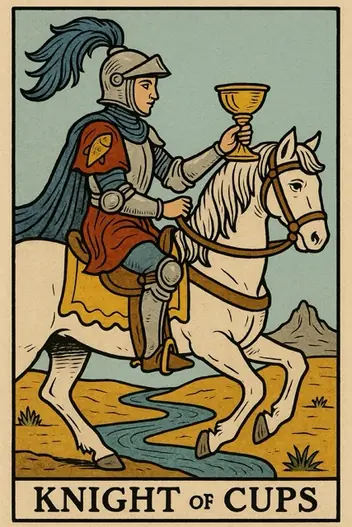
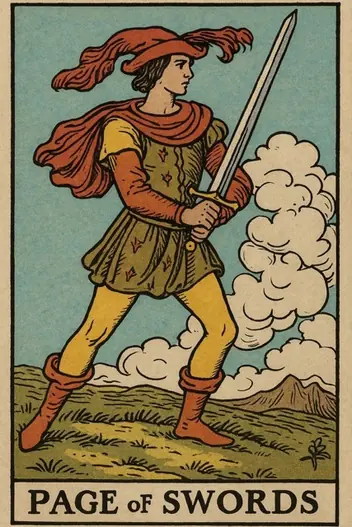
The collision of the Knight of Cups and Page of Swords creates a fascinating psychological tension between heart-driven idealism and analytical detachment. The Knight of Cups represents the archetype of the romantic pursuer—driven by emotion, vision, and a desire for meaningful connection. The Page of Swords, in contrast, embodies the curious intellectual—sharp, observant, and quick to question assumptions. When these two energies merge, you are likely experiencing a period where your emotional impulses are being filtered through a rational lens.
In practical terms, this combination suggests a decision-making process that oscillates between following your feelings and analyzing the data. You may feel a strong pull toward a person, project, or creative vision, yet simultaneously find yourself scrutinizing every detail for flaws or hidden risks. This is not inherently negative; rather, it signals a need to integrate emotional intuition with critical thinking rather than letting one dominate the other. The key question becomes: Can you trust your heart enough to act, while keeping your mind sharp enough to navigate obstacles?
Core Dynamics & Interpretation
The Knight of Cups and Page of Swords together create a dynamic of emotional pursuit tempered by intellectual caution. Psychologically, this mirrors the tension between the feeling function (Jungian introverted feeling) and the thinking function (extraverted thinking). You are likely in a state where your desires are clear, but your strategy is still forming. The Knight of Cups wants to charge ahead with passion, while the Page of Swords insists on gathering more information, testing boundaries, and assessing consequences.
In real-world terms, this combination often appears when you are courting a new opportunity—whether romantic, creative, or professional—but feel the need to verify its authenticity. You may be drawn to someone or something that seems ideal, yet you cannot ignore the red flags or practical limitations the Page of Swords highlights. The healthiest outcome arises when you let the Page’s curiosity inform the Knight’s direction rather than suppress it. For example, instead of blindly pursuing a romantic interest, you might ask probing questions to understand their values. Instead of committing to a creative project impulsively, you could research market trends or seek expert feedback.
A significant psychological risk here is cognitive dissonance: wanting something deeply while simultaneously doubting its viability. This can lead to paralysis or self-sabotage if not managed consciously. The pragmatic path forward involves treating your emotions as valuable data points, not commands. Use the Page of Swords’ analytical energy to map out the potential pitfalls, then let the Knight of Cups’ conviction carry you through them with purpose.
Knight of Cups and Page of Swords in Love Tarot
If you are single:
This combination suggests you are evaluating a potential partner with both hope and skepticism. Don’t dismiss your gut feelings, but verify them with objective observations. A new connection may feel magical, yet the Page of Swords warns you to watch for inconsistencies between words and actions.
If you are in a relationship:
You or your partner may be in a phase of intellectual critique of the emotional bond. This can be constructive if you frame it as curiosity rather than criticism. Use the Page’s questions to deepen intimacy, not create distance.
In relationships, the Knight of Cups and Page of Swords indicate a dynamic where emotional expression is being analyzed. One partner may feel the other is overthinking or being too detached, while the other feels the first is being too idealistic or naive. The mature approach is to bridge this gap through clear communication. The Knight of Cups can learn from the Page by articulating feelings with precision rather than vague poetry. The Page can learn from the Knight by acknowledging that not everything needs to be dissected—some experiences are meant to be felt.
Key relationship advice:
Avoid the trap of trying to “fix” your partner’s emotions with logic. Instead, validate their feelings first, then collaborate on solutions. If you are the Knight of Cups in this pairing, practice patience and ask your partner what they need to feel secure. If you are the Page of Swords, practice vulnerability and share your concerns without framing them as accusations.
Your pair is already on the table. Ask your question and draw the clarifying card
or simply focus on it
What Do Knight of Cups and Page of Swords Indicate for Your Career?
Strategic Opportunities:
Use the Page of Swords’ research skills to validate a creative or entrepreneurial idea before investing significant resources. This is an excellent time to prototype, gather feedback, or run a small-scale test.
Strategic Opportunities:
Leverage the Knight of Cups’ charisma to build rapport with key stakeholders—clients, investors, or collaborators. Combine emotional intelligence with data-driven pitches for maximum impact.
Calculated Risks:
Avoid over-committing to a project based on emotional excitement alone. The Page of Swords warns against ignoring warning signs in contracts, budgets, or timelines.
In a professional context, this combination suggests a phase of strategic exploration where you are balancing passion with pragmatism. You may be considering a new job, launching a business, or pitching a creative concept. The Knight of Cups provides the motivation and vision to move forward, while the Page of Swords ensures you don’t overlook critical details. This is a powerful pairing for roles that require both innovation and analysis, such as product development, marketing strategy, or client relations.
Financial warning:
Be cautious with speculative investments or ventures that rely heavily on emotional appeal. The Page of Swords advises you to read the fine print, ask hard questions, and never let a charming pitch override your due diligence. If something feels too good to be true, it probably is. Conversely, don’t let fear of analysis paralysis prevent you from seizing a genuinely good opportunity. Set a deadline for decision-making and stick to it.
What If Knight of Cups or Page of Swords Appears Reversed?
When cards appear in reversed positions, the constructive dialogue between archetypes is disrupted, and their shadow sides take over.
Reversed Knight of Cups + upright Page of Swords:
Emotional potential is blocked. You feel apathy, a creative crisis, or an inability to believe in yourself. The Page of Swords in this situation becomes a cruel critic. Instead of analyzing, you engage in self-flagellation and devalue any of your impulses. Advice: turn off the "inner censor" and start doing something with your hands to unblock the energy of feelings.
Upright Knight of Cups + reversed Page of Swords:
The intellectual function is weakened. This manifests as an inability to formulate your thoughts, an internal resistance to studying or planning. The Knight of Cups in this case becomes reckless and impulsive, as there is no one to stop him. You act without thinking and make foolish mistakes. Advice: find an external consultant or mentor who can take on the role of the "Page."
BOTH reversed:
Complete imbalance. This is a state of "emotional chaos" and "intellectual laziness" simultaneously. You don't know what you want and don't want to analyze why. This is a direct path to self-destruction through empty dreams and fruitless arguments. Correction: return to basics. Start with one simple action (Knight) and one simple question (Page). Don't try to solve everything at once.
Uncover hidden insights
Let our advanced Tarot system interpret these archetypes specifically for your personal path.
What Are the Risks of Knight of Cups and Page of Swords?
When the Knight of Cups and Page of Swords energies are blocked or unbalanced, several shadow manifestations can emerge. The most common is rationalization of emotional impulses: you convince yourself that a poor decision is logical simply because you want it badly. This cognitive bias—often called motivated reasoning—can lead to ignoring red flags or overestimating your control over outcomes.
Another pitfall is emotional manipulation disguised as intellectual debate. The Knight of Cups may use charm to deflect criticism, while the Page of Swords may use cutting questions to wound rather than understand. In relationships, this can create a toxic cycle of one partner idealizing and the other devaluing. Professionally, it may manifest as passive-aggressive behavior where you undermine a colleague’s ideas while pretending to be supportive.
Finally, this combination can produce decision paralysis when the Knight’s desire for perfection meets the Page’s endless curiosity. You may find yourself stuck in a loop of research, seeking the “perfect” answer that never arrives. The antidote is to recognize that no amount of analysis can eliminate all risk. Sometimes, you must act with incomplete information, trusting that your emotional compass will guide you through the uncertainty.
Knight of Cups and Page of Swords Combined Message
Constructive use of the Knight of Cups energy to balance the Page of Swords requires a conscious switching between modes. Imagine the process of creating an architectural project. First, you must allow yourself to be the Knight: feel the inspiration, sketch a bold, beautiful design, experience the joy of the idea. Then you are obliged to become the Page: pick up a calculator, check the load-bearing capacity of the structures, assess the budget, and find contractors. Attempting to do both simultaneously will lead to failure.
Key strategic advice: use the "storm and siege" principle. Allocate clear time blocks. The first block (20% of the time) is complete freedom for the Knight: brainstorming, dreaming, visualization, without any criticism. The second block (80% of the time) is the Page's work: analysis, critique, planning, error-checking. This approach allows you to use the heart's energy for generating ideas and the mind's energy for their implementation, preventing them from conflicting.
This synthesis transforms you from a dreamer or a critic into a creator. You don't just want to change the world—you know how to do it. You don't just criticize the existing order—you propose a concrete, beautiful alternative. The deep conclusion of this combination: true power lies not in choosing between head and heart, but in the ability to make them work towards a single goal. When the Knight of Cups inspires the Page of Swords, and the Page of Swords gives the Knight of Cups solid ground beneath his feet, you become invulnerable to illusions and the fear of failure.
Your Next Step: Personal Context Matters
The Knight of Cups and Page of Swords combination ultimately challenges you to unite your heart and mind in pursuit of a meaningful goal. Whether in love, career, or personal growth, the core message is clear: passion needs strategy, and strategy needs passion. By honoring both your emotional truth and your intellectual curiosity, you can navigate this dynamic with clarity and purpose.
However, the true power of Tarot lies in its application to your unique situation. This article provides the general archetype, but your specific question, life stage, and personal history will shape the exact meaning. To get a deep, personalized interpretation of this combination for your relationship, career, or personal dilemma, use the Fortune Cards app. Available on the web or as a download, it offers tailored readings that integrate your context with the wisdom of the cards. Don’t settle for generic advice—unlock the insights that are truly yours.
Interpretation by the Fortune Cards editorial team, based on the Rider–Waite tradition and Jungian archetypes. About our methodology · Updated: 2026-08-26
Other Combinations with Knight of Cups
Other Combinations with Page of Swords
Explore Individual Card Meanings
Table of Contents
- Core Dynamics & Interpretation
- Knight of Cups and Page of Swords in Love Tarot
- What Do Knight of Cups and Page of Swords Indicate for Your Career?
- What If Knight of Cups or Page of Swords Appears Reversed?
- What Are the Risks of Knight of Cups and Page of Swords?
- Knight of Cups and Page of Swords Combined Message
- Your Next Step: Personal Context Matters
Ready to find answers to your questions?
Start your first reading now and look at your situation with fresh clarity. The cards are ready to reveal deeper meaning.