Three of Cups
- Arcana
- Minor Arcana, Suit of Cups
- Element
- Water
- Decan
- Mercury in Cancer
- Numerology
- 3
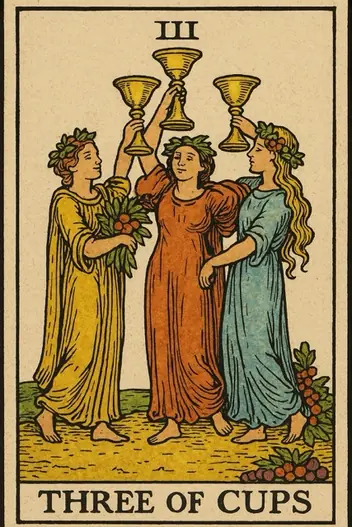
The Three of Cups represents the Jungian archetype of the "Festival" or "Community"—a psychological state where individual identity temporarily merges with a group to celebrate shared success, emotional bonds, and mutual support. This card signals a phase where social validation and collective harmony become primary drivers of well-being. The core challenge it presents is balancing the intoxicating pull of belonging with the need for personal authenticity and long-term responsibility.
In a reading, this card often appears when you are reaping the rewards of prior collaboration or navigating the emotional highs of a close-knit social circle. It is not a card of solitary achievement but of networked success. The main idea is that your current growth is catalyzed by the quality of your connections, but the risk lies in losing yourself within the group's emotional current.
Main Dynamics and Interpretation
The upright Three of Cups indicates a psychological state of emotional abundance and social synchronicity. Your decision-making is currently supported by a strong sense of belonging and trust. This card suggests that your emotional intelligence is operating at a high level, allowing you to read group dynamics accurately and contribute positively. The resource here is social capital—the accumulated goodwill and reciprocity that makes collaboration effortless. In practical terms, this is an excellent time for team-based projects, networking events, or any venture requiring consensus and morale.
However, the mindset this card provides carries a strategic warning: avoid over-optimism about group loyalty. The joy is real, but it can lead to cognitive biases like "groupthink" , where critical thinking is sacrificed for harmony. The real-world consequence is that you may overlook a flaw in a plan or a person because the emotional payoff of agreement is too high. Use this energy to celebrate wins, but schedule a separate, solitary review of the details. The key is to enjoy the collective high without abdicating your individual judgment.
Ask your question and flip the cards
or simply focus on it
Three of Cups: Yes or No?
Yes.. The Three of Cups represents emotional alignment, mutual support, and the completion of a shared cycle—this energy leans decisively toward affirmation when the question involves collaboration, friendship, or creative partnership. Its archetype is the communal feast, where individual cups are raised in synchronicity, signaling that your desire is already woven into a supportive network. In reversed position, the answer shifts to Leaning No, as the card signals overindulgence, jealousy, or a broken bond where trust has been diluted by gossip or unmet expectations. The critical condition is that this "yes" depends on your willingness to show up authentically and celebrate others’ wins—if your request isolates you from your social ecosystem, the outcome will feel hollow or delayed.
Deepen your understanding
Find out exactly what this reading means for your current life situation with our oracle.
What Does Three of Cups Mean for Your Day?
The Three of Cups charges today with a current of lighthearted connection and creative overflow—you are being called to prioritize pleasure, not productivity. Focus on reuniting with friends, co-creating something without a rigid agenda, or simply laughing in the company of those who know your unvarnished self. Avoid the trap of mistaking this energy for forced positivity or people-pleasing; the card warns against drinking from a cup that isn’t yours, meaning don’t suppress your own mood to match the group’s. Also, beware of jealousy—someone’s envy may surface as a backhanded compliment or a subtle withdrawal. Let your actions be generous without expectation, and let your conversations be real rather than performative.
Love and Relationships
If you are not in a relationship:
This card suggests you are most likely to attract a partner through shared social activities and mutual friends. Your best strategy is to position yourself as a connector and a source of positive energy, rather than focusing on a single target. The risk is mistaking group chemistry for romantic chemistry.
If you are in a relationship:
The Three of Cups signals a phase of social integration and mutual support. The dynamic is positive, but the challenge is ensuring that the couple's identity is not lost in the group's identity. Maintain private rituals to protect the core of the relationship.
The main behavioral pattern here is a strong preference for harmony over conflict. While this fosters a loving environment, it can suppress necessary, healthy disagreements. The practical relationship advice is to schedule "reality checks" with your partner where you both agree to voice one minor frustration in a safe, structured way. This prevents the buildup of resentment that often follows excessive social harmony. Bold the need for intentional, private vulnerability to counterbalance the public joy.
Three of Cups as Feelings: What They Think of You
Through the lens of the Three of Cups, this person perceives you as a source of emotional safety and shared joy—you are the one they invite to the table when they need to feel seen without pretense. They associate you with a lightness that feels rare and precious, possibly even nostalgic, as if you remind them of a time when life was simpler or more collaborative. Their hidden hope is that you will continue to initiate connection, because they fear that if they stop reciprocating, the warmth will dissolve into silence. Yet there is an internal conflict: they may unconsciously idealize you as the “keeper of the good times,” which can pressure you to perform happiness or avoid bringing heavy truths into the dynamic. Their deepest fear is not losing you, but losing the version of themselves that feels whole when they are with you—a dependency they may not fully admit.
What Does Three of Cups Mean for Work and Money?
Strategic Opportunities:
Leverage your professional network for a new partnership. This is an ideal time to co-author, co-found, or co-lead a project. Your social capital is at its peak.
Resource Management:
Use team celebrations to reinforce loyalty and reduce turnover. A small, genuine gesture of appreciation now will yield high returns in future productivity.
Calculated Risks:
Avoid making large financial commitments based on group enthusiasm alone. The "party" energy can inflate perceived value. Get a third-party, objective audit before signing.
In a professional context, the Three of Cups points to a leadership style based on democratic consensus and emotional safety. You will be effective as a facilitator or team cheerleader. For financial planning, this card warns against "social spending" —investments driven by the desire to keep up with peers or maintain a group's lifestyle. Bold the warning: separate your financial decisions from your social circle's approval. Your economic future should be based on data, not on the desire to continue the celebration.
Reversed Positions: What Changes?
When reversed, the Three of Cups signals a blocked flow of social joy. The psychological state shifts from abundance to isolation, jealousy, or superficiality. This is not a total loss of community, but a distortion of its positive aspects. You may feel like an outsider in a group that used to welcome you, or you may find that "celebrations" feel hollow and performative. The internal resistance manifests as fear of being excluded, leading to people-pleasing or, conversely, to cynical withdrawal.
The logical way to correct this imbalance is to audit the quality of your connections. Ask: Is this group based on genuine support or on shared avoidance of real issues? If the card appears reversed in a relationship reading, it often points to triangulation or hidden resentments within a friend group. The warning is clear: do not force the joy. Attempting to recreate the "party" when the underlying trust is broken will only deepen the dysfunction. Instead, focus on one-on-one repair with the key individuals involved, and let the group dynamic heal organically.
The Shadow Side of Three of Cups
The shadow of the Three of Cups is emotional dependency on group validation. The irrational behavior associated with this card is the sacrifice of personal boundaries for the sake of belonging. You may find yourself agreeing to things you don't want, spending money you don't have, or ignoring a friend's toxic behavior because "we're all having a good time." This is a classic manifestation of the "False Self" in Jungian terms—a persona constructed entirely to fit the social mold.
The cognitive bias at play is the "bandwagon effect" , where your judgment is skewed by the perceived consensus of the group. The pitfall is that you may avoid necessary solitude and introspection. The fear here is of being left out or judged as "not fun." To counter this shadow, you must practice strategic isolation. Schedule time alone immediately after a social high to recalibrate your own thoughts. Ask yourself: "What is my honest opinion, separate from everyone else's?" This is the only way to enjoy the Three of Cups without losing your true self.
Synthesis: What It All Adds Up To
To constructively use the energy of the Three of Cups, you must adopt a dual strategy: immersion and detachment. First, immerse yourself fully in the social and collaborative opportunities this card presents. Actively build your network, celebrate milestones, and strengthen emotional bonds. This is a time of high psychological payoff for social investment. Your creativity and morale will be boosted by the collective energy. Use this to complete group projects or to launch a community-based initiative.
Second, detach with a clear, analytical framework. Before every major decision made in a group context, apply the "24-Hour Rule" : wait a full day before committing to any plan formed in a celebratory atmosphere. This breaks the spell of emotional contagion and allows your rational mind to catch up. The deep strategic advice is to treat social joy as a resource to be managed, not a state to be maintained. Enjoy it, but do not try to sustain the high indefinitely. The Three of Cups is a phase of recharging and bonding, not a permanent lifestyle. Use it to build the trust and goodwill that will sustain you through the inevitable challenges represented by the Five or Seven of Cups.
Ultimately, the card teaches that belonging is a tool for growth, not a destination. Your goal is to emerge from this phase with stronger relationships and a clearer sense of your own identity within them.
Your Next Step: Personal Context Matters
This psychological and strategic breakdown provides a deep understanding of archetypes. However, Tarot is never universal for everyone. To understand exactly how this dynamic applies to your specific situation, a reading tailored exclusively to you is necessary.
Download the Fortune Cards app or visit our platform to get a deep AI interpretation of your unique spread. Don't just read about the cards—use Fortune Cards to find out exactly what step you need to take next.
Try Tarot Spreads with Three of Cups
Interpretation by the Fortune Cards editorial team, based on the Rider–Waite tradition and Jungian archetypes. About our methodology · Updated: 2026-08-26
Top Combinations with Three of Cups
Discover how Three of Cups interacts with other major cards in the deck to form powerful messages.
All 77 Combinations with Three of Cups
Discover how this card interacts with every other card in the Tarot deck and reveal hidden meanings.
Table of Contents
- Main Dynamics and Interpretation
- Three of Cups: Yes or No?
- What Does Three of Cups Mean for Your Day?
- Love and Relationships
- Three of Cups as Feelings: What They Think of You
- What Does Three of Cups Mean for Work and Money?
- Reversed Positions: What Changes?
- The Shadow Side of Three of Cups
- Synthesis: What It All Adds Up To
- Your Next Step: Personal Context Matters
Explore Tarot Universe

Ready to find answers to your questions?
Start your first reading now and look at your situation with fresh clarity. The cards are ready to reveal deeper meaning.