Three of Cups and Five of Swords Together in Tarot
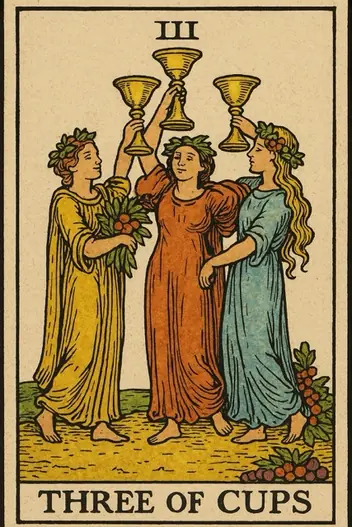

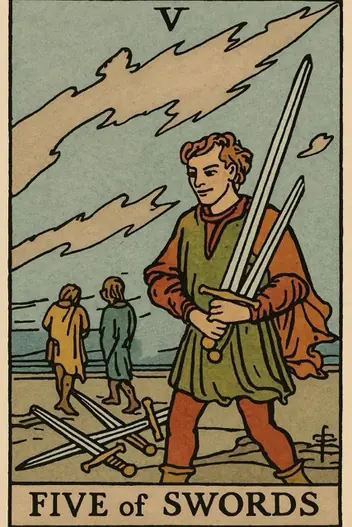
- Arcana
- Three of Cups — Minor Arcana, Cups; Five of Swords — Minor Arcana, Swords
- Elements
- Three of Cups — Water; Five of Swords — Air
- Elemental interaction
- Neutral elements — energies coexist without conflict
- Numerology
- 3 + 5 = 8
When the Three of Cups—a card of shared joy, friendship, and emotional fulfillment—meets the Five of Swords—a card of hollow victory, conflict, and cutting losses—you are looking at a psychological paradox. This pairing often emerges when a recent win feels empty, or when social harmony has been purchased at the cost of personal integrity. The core tension here is between the desire for belonging and the need to assert dominance or win an argument. In practical terms, this combination signals a moment to question: Is this celebration genuine, or am I covering up a deeper wound?
The collision of these archetypes creates a high-stakes dynamic: the Five of Swords brings a sharp, adversarial mindset, while the Three of Cups demands emotional connection and collective joy. This can manifest as a person who wins a professional battle but alienates their team, or someone who reconciles with a friend but only after a bitter fight. The key insight is that this combination rarely sustains pure happiness—it requires you to acknowledge the cost of your victory and decide whether the price was worth paying.
Three of Cups and Five of Swords Combination Meaning
The psychological state created by the Three of Cups and Five of Swords is one of cognitive dissonance—you feel triumphant but also uneasy. The Five of Swords represents a victory that leaves others defeated, often achieved through manipulation, cutting remarks, or strategic withdrawal. The Three of Cups then attempts to paper over the damage by celebrating with those who remain loyal. This is a defense mechanism where the seeker uses social approval to numb the guilt of having hurt others.
In real-world terms, this combination often appears when you have won an argument but lost a relationship. You may feel a temporary high from proving you were right, but the underlying conflict hasn’t been resolved—it’s been suppressed. The shadow of the Five of Swords is the belief that winning is more important than understanding, while the Three of Cups can become a performative mask to avoid accountability. To navigate this, you must ask: Am I celebrating with true allies, or am I using them to avoid my own guilt? The pragmatic takeaway is that this pairing demands a cost-benefit analysis of your social capital—sometimes, the price of winning is too high.
What Do Three of Cups and Five of Swords Indicate for Your Career?
Strategic Opportunities:
This combination can signal a successful negotiation or project completion where you emerge as the leader. Use the Three of Cups energy to celebrate your team’s contributions and reinforce loyalty, even if the process was tense.
Strategic Opportunities:
It may indicate a restructuring or layoff where you survive but others don’t. Leverage this position to rebuild relationships with remaining colleagues and create a more cohesive environment.
Calculated Risks:
Avoid gloating or isolating yourself after a win. The Five of Swords warns that visible triumph can create enemies. Also, be cautious of overspending on celebrations to mask professional guilt—this can lead to financial strain.
In a career context, this pairing often appears during office politics, competitive bids, or performance reviews. The Five of Swords suggests you have outmaneuvered a rival or secured a promotion at someone else’s expense. However, the Three of Cups warns that your social network may be damaged—colleagues may view you as ruthless or untrustworthy. The strategic move is to immediately pivot from “winner” to “bridge-builder.” Host a team lunch, acknowledge others’ contributions, and use your newfound authority to advocate for collaboration rather than further conflict. Financially, this combination warns against making large purchases or investments based on a recent win—the emotional high can cloud judgment. Bold financial advice: Wait 48 hours after any victory before making a significant financial decision. If you’re self-employed, this pairing may indicate a client dispute you’ve won but at the cost of future referrals—consider whether the win was worth the long-term loss.
Your pair is already on the table. Ask your question and draw the clarifying card
or simply focus on it
Three of Cups and Five of Swords in Love Tarot
If you are single:
This combination warns against jumping into a new connection immediately after a conflict with someone else. You may attract partners who seem fun and supportive, but the underlying dynamic could be based on avoiding unresolved issues rather than genuine compatibility.
If you are in a relationship:
This pairing signals a power struggle disguised as reconciliation. One partner may have “won” an argument, but the other feels resentful. The celebration is hollow unless both parties have processed the conflict honestly.
In relationships, the Three of Cups and Five of Swords create a toxic cycle of conflict and superficial repair. The Five of Swords energy pushes you to win at all costs—cutting remarks, silent treatment, or emotional blackmail—while the Three of Cups tempts you to sweep things under the rug with a night out or a romantic gesture. The critical relationship advice here is to stop confusing resolution with reconciliation. A victory in an argument is not the same as healing a rift. Bold action required: schedule a calm, structured conversation to address the root cause of the conflict, rather than relying on social distractions to mend the bond. If you are single, this combination suggests you may be attracted to someone who appears charming but has a hidden competitive streak—proceed with caution and set clear boundaries early.
What If Three of Cups or Five of Swords Appears Reversed?
When cards appear in reversed positions, the dynamics become more complex and less obvious.
If the Three of Cups is reversed:
This points to blocked potential for social support or recklessness in company. You may feel like an outcast or, conversely, rely excessively on alcohol and empty entertainment to drown out an inner conflict. Advice: stop trying to "buy" loyalty or solve the problem through parties — this merely masks the real conflict instead of resolving it.
If the Five of Swords is reversed:
This often speaks to internal resistance and weakness. You may be avoiding conflict even when necessary, or feeling like a victim of circumstances. Warning: your unwillingness to assert your interests within the group may lead to you being taken advantage of. This is not about peace, but about capitulation.
If BOTH are reversed:
This is a complete imbalance of dynamics. Social connections are broken, and the conflict has reached a dead end. The logical way to correct this: temporary isolation. You need to cease any attempts to "build bridges" or "prove you are right." Focus on inner work and restoring your own resources before engaging in any social interactions.
Uncover hidden insights
Let our advanced Tarot system interpret these archetypes specifically for your personal path.
Shadow Side & Pitfalls
The shadow manifestation of this combination is performative triumph masking deep insecurity. The cognitive bias at play is the sunk cost fallacy—you may cling to a victory that actually cost you more than it gained, simply because you invested so much energy into the conflict. This can lead to self-sabotage where you push away supportive people because you feel unworthy of their friendship after your aggressive behavior.
Another common pitfall is emotional suppression. The Five of Swords creates a winner/loser dynamic, and the Three of Cups encourages you to “move on” without processing the pain. This can result in passive-aggressive behavior or resentment that erupts later. Poor judgment manifests as choosing social validation over moral clarity—you may surround yourself with people who enable your victory narrative rather than challenge you. The shadow advice is to be brutally honest: Did I win because I was right, or because I was willing to hurt someone? If the answer is the latter, the celebration is a form of denial, and the real work is apology and repair, not party planning.
Three of Cups and Five of Swords Combined Message
How can the energy of the Three of Cups be used constructively to balance the Five of Swords? The key to synthesis lies in redefining the concept of "victory." Instead of striving for victory over others (Five of Swords), use social intelligence and support (Three of Cups) to achieve victory together with others.
Your strategic advice is to transform competition into collaboration. If you sense a brewing conflict within a group, do not try to suppress it by force. Instead, initiate an open discussion in an informal setting. Use the energy of the Three of Cups (trust, openness, joy) as a container for the sharp issues of the Five of Swords. Find out what each participant truly wants and identify the point where your interests align.
This combination demands from you a high level of emotional intelligence. You must be able to separate facts from emotions and not allow pride to destroy what you are building. Ask yourself: "What is more important to me—being right in this specific argument, or preserving long-term relationships and my reputation?" The answer to this question will be your strategy.
Where to Go From Here
The core message of the Three of Cups and Five of Swords is that victory without integrity creates a hollow celebration. You must evaluate whether your social circle supports genuine growth or merely validates your ego. This pairing asks you to balance ambition with empathy—to win without destroying connections. The most pragmatic path forward is to acknowledge the cost of your actions, apologize where needed, and ensure your future victories are built on collaboration, not conquest.
Want to know exactly how this dynamic applies to your unique situation? The Fortune Cards app provides a deep, personalized interpretation of this exact tarot combination based on your specific question—whether about a relationship, career move, or personal dilemma. Our algorithm integrates Jungian psychology and practical decision-making to give you actionable insights tailored to your life. Try the Fortune Cards app on the web or download it now to get your custom reading and turn this complex energy into a clear path forward.
Interpretation by the Fortune Cards editorial team, based on the Rider–Waite tradition and Jungian archetypes. About our methodology · Updated: 2026-08-26
Other Combinations with Three of Cups
Other Combinations with Five of Swords
Explore Individual Card Meanings
Table of Contents
- Three of Cups and Five of Swords Combination Meaning
- What Do Three of Cups and Five of Swords Indicate for Your Career?
- Three of Cups and Five of Swords in Love Tarot
- What If Three of Cups or Five of Swords Appears Reversed?
- Shadow Side & Pitfalls
- Three of Cups and Five of Swords Combined Message
- Where to Go From Here
Ready to find answers to your questions?
Start your first reading now and look at your situation with fresh clarity. The cards are ready to reveal deeper meaning.