Five of Swords and Ten of Pentacles Reversed in Tarot
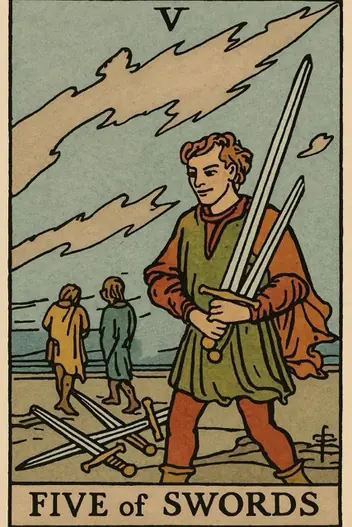

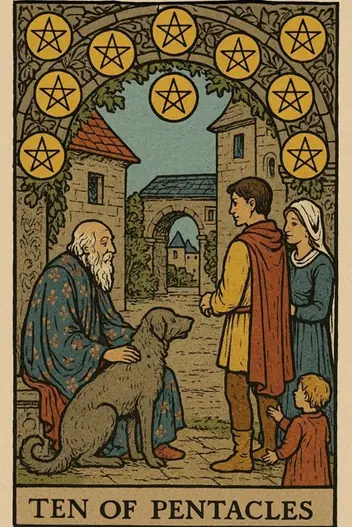
- Arcana
- Five of Swords — Minor Arcana, Swords; Ten of Pentacles — Minor Arcana, Pentacles
- Elements
- Five of Swords — Air; Ten of Pentacles — Earth
- Elemental interaction
- Opposing elements — energies create tension
- Numerology
- 5 + 10 = 15 → 6
This combination presents a powerful psychological tension: the short-term victory of the Five of Swords clashing with the long-term stability of the Ten of Pentacles. When these archetypes collide, you are likely facing a decision where achieving a win may damage a legacy, a relationship, or a financial foundation. The core question becomes not can you win, but what are you willing to sacrifice for the victory?
The Five of Swords represents a conflict resolved through dominance, often leaving one party isolated or morally compromised. The Ten of Pentacles represents the ultimate material and familial security—a dynasty built on trust, tradition, and shared resources. Together, they force a pragmatic evaluation: is the prize worth the collateral damage to your support system?
Five of Swords and Ten of Pentacles Card Meaning Explained
The psychological state created by the Five of Swords and Ten of Pentacles is one of calculated conflict within a structured environment. You are not fighting a stranger in a vacuum; you are navigating a power struggle within a family business, a long-term partnership, or an established community. The Ten of Pentacles provides the stage, while the Five of Swords writes the script of confrontation.
This pairing often manifests as a test of boundaries and inheritance. You may feel compelled to assert your position aggressively, believing that compromise will weaken your claim to resources or status. However, the Ten of Pentacles warns that every battle leaves a scar on the collective memory. Winning an argument today might create a rift that undermines the very structure you are trying to protect. The key insight is to distinguish between a necessary stand for your values and a wasteful fight for ego.
In practical terms, this combination demands a strategic retreat from petty conflicts. The Five of Swords energy is sharp but isolating. The Ten of Pentacles energy is enduring but requires cooperation. Your most effective mindset is to ask: “Will this victory strengthen my long-term position, or will it alienate the people whose support I need to sustain that position?” The answer determines whether you fight or fold.
Your pair is already on the table. Ask your question and draw the clarifying card
or simply focus on it
Five of Swords and Ten of Pentacles in Career Readings
Strategic Opportunities:
Use your sharp analytical skills to renegotiate contracts or roles in a family business or long-standing organization. Your clarity can be an asset if wielded diplomatically.
Strategic Opportunities:
Assert your value in a hierarchical environment where tradition has previously stifled innovation. The Five of Swords gives you the courage to challenge outdated norms.
Calculated Risks:
Avoid burning bridges with senior stakeholders or mentors. Winning a single project may cost you future sponsorship. Objectively assess if the conflict is about principle or pride.
In the professional realm, this combination signals a high-stakes negotiation or succession conflict. You may be competing for a promotion, a partnership share, or control over a project that has deep roots in the company’s culture. The Five of Swords energy tempts you to use aggressive tactics—spreading rumors, undermining rivals, or making ultimatums. Bold important financial warnings: Such moves may secure short-term gains but will erode the trust required for long-term leadership. The Ten of Pentacles represents the ultimate reward: a stable, prosperous legacy. If you achieve it through betrayal, you will inherit an empty throne.
Your strategic move is to channel the Five of Swords’ clarity into constructive confrontation. Present your case with evidence, not emotion. Frame your victory as a benefit to the collective, not just yourself. If you can show that your win strengthens the entire structure, you align the Five of Swords’ ambition with the Ten of Pentacles’ stability.
Ask your specific question
Don't rely on generic meanings. Get a customized reading tailored specifically to your energies.
Five of Swords and Ten of Pentacles as Feelings
If you are single:
This combination suggests you may be entering a situation where a potential partner comes from a tightly-knit family or established social circle. Expect resistance if your approach feels competitive or dismissive of their existing bonds.
If you are in a relationship:
The Five of Swords indicates an unresolved power struggle—likely over finances, household decisions, or family obligations. The Ten of Pentacles warns that winning this argument may cost you the partnership itself.
In relationship dynamics, the Five of Swords and Ten of Pentacles reveal a battle for control within a shared legacy. You or your partner may feel that one person is prioritizing personal victory over the health of the relationship. This is not a time for silent resentment; it is a time for structured, honest negotiation. Bold key relationship advice: Set a clear boundary between “winning the argument” and “solving the problem.” If you find yourself keeping score, you have already lost the spirit of partnership.
The shadow of this pairing in love is transactional thinking—treating love as a zero-sum game. To break this pattern, acknowledge the other person’s perspective without surrendering your own. The goal is not to dominate but to create a legacy of mutual respect, even when you disagree.
Five of Swords and Ten of Pentacles Reversed Meaning
If the Five of Swords is reversed:
Aggression becomes passive. You may avoid conflicts, even when it's necessary to defend your boundaries, leading to a buildup of tension. Alternatively, you might feel impotent rage and sabotage your own plans. Advice: stop fearing healthy competition and learn to say "no" without guilt.
If the Ten of Pentacles is reversed:
The foundation is cracking at the seams. This can signify a break with family, loss of inheritance, or business bankruptcy. Internal resistance to change prevents you from accepting the new reality. Warning: don't cling to the illusion of past stability—it's time to build a new value system from scratch.
If BOTH are reversed:
Complete imbalance, where conflict destroys everything but brings no victory. This is a state of chaos and self-destruction, where you simultaneously fear fighting and fear losing what is already crumbling. The logical way to correct this: immediately cease all active actions. Take a 1-2 week pause to reduce the emotional intensity. Then, begin by restoring basic trust—first towards yourself, then towards your immediate circle.
The Shadow Side of Five of Swords and Ten of Pentacles
The shadow of the Five of Swords and Ten of Pentacles is the tyranny of legacy. When this energy is blocked, you may experience cognitive bias toward scarcity thinking—believing that there is not enough recognition, money, or power to go around. This leads to self-sabotage through over-competitiveness, where you alienate allies in pursuit of a hollow victory.
Another common pitfall is moral compromise justified by tradition. You might rationalize unethical behavior by saying, “This is how it’s always been done,” or “I’m protecting the family name.” The Ten of Pentacles can become a shield for the Five of Swords’ aggression, allowing you to hurt others while feeling righteous. Recognize this as a defense mechanism. The true shadow is not the conflict itself, but the refusal to take responsibility for the emotional damage it causes.
Finally, this combination can trigger analysis paralysis. You may become so obsessed with the “right” strategy that you miss the human cost. Poor judgment emerges when you treat people as obstacles rather than partners. If you feel a cold, calculating energy taking over, pause and reconnect with the relational aspect of the Ten of Pentacles—the love and loyalty that built the structure in the first place.
Five of Swords and Ten of Pentacles: Tarot Advice
How can the energy of the Five of Swords be constructively used to activate the Ten of Pentacles? Redirect aggression from people to problems. Instead of attacking an opponent, attack the obstacle. Your determination and sharpness of mind (Swords) should be aimed at removing bureaucratic barriers, optimizing processes, or protecting your assets from external threats, not at destroying internal bonds (Pentacles).
Strategic advice: become an "advocate" for your system, not its executioner. Use the force of the Five of Swords to fiercely defend the interests of your "clan" (family, business, team) against the outside world. Within the system, however, show diplomacy and seek consensus. Your strength should serve to protect values, not to destroy them.
This combination demands from you a high level of awareness. Before acting, clearly define: "What do I want to preserve?" and "What am I willing to lose?". If the answer to the second question includes "the trust of loved ones" or "reputation," seek another path. True victory is not the annihilation of an opponent, but strengthening your position without causing irreparable damage to the foundation upon which you stand.
Your Next Step: Personal Context Matters
The Five of Swords and Ten of Pentacles together deliver a stark message: Victory without legacy is a loss. The core of this reading is a call to examine your motives in any current conflict. Are you fighting to build something lasting, or to prove a point? The answer determines whether you will walk away with a trophy or a throne. Your most powerful move is to choose battles that strengthen your foundations, not just your ego.
While this article provides the general archetype, the true magic happens when Tarot is applied to your unique situation. The Fortune Cards app offers a deep, personalized interpretation of this exact combination for your specific question right now. You can use the app on the web or download it to get a reading that considers your personal history, emotions, and goals. Stop guessing—get the insight you need to make a decision you can live with.
Interpretation by the Fortune Cards editorial team, based on the Rider–Waite tradition and Jungian archetypes. About our methodology · Updated: 2026-10-15
Other Combinations with Five of Swords
Other Combinations with Ten of Pentacles
Explore Individual Card Meanings
Table of Contents
- Five of Swords and Ten of Pentacles Card Meaning Explained
- Five of Swords and Ten of Pentacles in Career Readings
- Five of Swords and Ten of Pentacles as Feelings
- Five of Swords and Ten of Pentacles Reversed Meaning
- The Shadow Side of Five of Swords and Ten of Pentacles
- Five of Swords and Ten of Pentacles: Tarot Advice
- Your Next Step: Personal Context Matters
Ready to find answers to your questions?
Start your first reading now and look at your situation with fresh clarity. The cards are ready to reveal deeper meaning.