Love Tarot: Five of Swords and Four of Pentacles
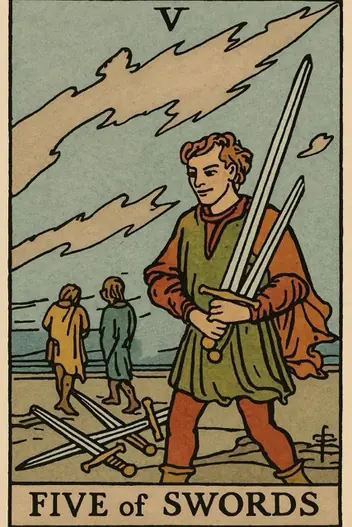

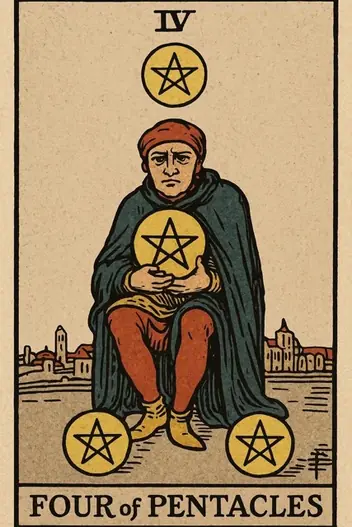
- Arcana
- Five of Swords — Minor Arcana, Swords; Four of Pentacles — Minor Arcana, Pentacles
- Elements
- Five of Swords — Air; Four of Pentacles — Earth
- Elemental interaction
- Opposing elements — energies create tension
- Numerology
- 5 + 4 = 9
When the Five of Swords—a card of conflict, Pyrrhic victories, and hollow triumph—collides with the Four of Pentacles—a symbol of rigid control, hoarding, and defensive scarcity—the result is a psychological fortress built on a battlefield. This pairing reveals a mindset where winning has come at a steep price, and the primary instinct is to protect what remains, often at the expense of connection and growth.
The core dynamic here is a defensive posture born from recent conflict. You may have "won" an argument, secured a resource, or defended your position, but the victory feels empty. The Four of Pentacles then amplifies this by locking down resources, emotions, or trust to prevent further loss. This is not a state of peace but a tense, watchful truce. The key psychological insight is that the need to be right or secure has overshadowed the need to be connected or adaptable. The question becomes: Is the fortress worth the isolation?
Core Dynamics & Interpretation
The fusion of these two cards creates a high-control, low-trust psychological environment. The Five of Swords brings a sharp, analytical mind that has learned to cut through opposition, but it also carries a residue of guilt, resentment, or loneliness. The Four of Pentacles then applies a rigid structure to this emotional state, leading to behaviors like withholding affection, micromanaging resources, or refusing to compromise. This is a classic defense mechanism: if you feel you've been burned in a recent battle, you over-correct by building walls.
In real-world terms, this combination often appears when someone has won a disagreement but lost a relationship, or secured a financial advantage but damaged a partnership. The mindset is transactional and cautious. Every interaction is evaluated for potential threat or loss. Psychologically, this activates the scarcity mindset—the belief that there isn't enough trust, money, or respect to go around, so you must clutch tightly to what you have. The danger is that this self-protection becomes a self-fulfilling prophecy: your defensiveness pushes others away, confirming your belief that you can't rely on anyone.
The strategic implication is clear: you must distinguish between genuine protection and self-sabotaging hoarding. Are you securing your boundaries, or are you trapping yourself in a cage of your own making? The Five of Swords asks you to examine the cost of your victory, while the Four of Pentacles asks if that cost is worth the security you now cling to.
Five of Swords and Four of Pentacles in Love Tarot
If you are single:
This combination suggests you are approaching new connections with a defensive, evaluative mindset. You may be hyper-focused on not being taken advantage of, which can make you appear cold or untrusting. The challenge is to distinguish between healthy skepticism and preemptive rejection.
If you are in a relationship:
You or your partner may be holding onto a past argument or resentment, using it as a reason to withhold emotional or physical intimacy. The dynamic is one of score-keeping and power struggles rather than collaboration.
In relationships, this pairing is a red flag for emotional hoarding. One partner may have "won" an argument (Five of Swords) and now uses that victory to control the terms of engagement (Four of Pentacles). This creates a toxic cycle of resentment and withdrawal. The winner feels empty because their victory didn't bring connection; the loser feels defeated and distrustful. The core advice is to stop keeping score. Bold: The only way to break this cycle is to consciously choose vulnerability over control. This means admitting when a "win" was actually a loss for the relationship, and being willing to release the need to be right in favor of being close. If you're single, Bold: your defensive posture is likely screening out the very people who could offer genuine connection. You must risk showing your hand to find a partner who values collaboration over conquest.
Your pair is already on the table. Ask your question and draw the clarifying card
or simply focus on it
Career Meaning of Five of Swords and Four of Pentacles
Strategic Opportunities:
Leverage your recent hard-won knowledge to negotiate clearer contracts or boundaries with colleagues or clients. Use the analytical sharpness of the Five of Swords to audit your financial systems and identify leaks.
Strategic Opportunities:
Consolidate your resources into stable, low-risk investments. The Four of Pentacles is excellent for building a safety net if you can do so without becoming paralyzed by fear.
Calculated Risks:
Do not engage in petty office politics or zero-sum negotiations. The victory you achieve may damage your reputation or alliances. Avoid hoarding information or credit from your team—this will breed resentment.
In your career, this combination warns against winning the battle but losing the war. You may be tempted to fight for a promotion, a budget, or a project, but the method you use could alienate allies. Bold: A Pyrrhic victory in the workplace can stall your long-term growth. Financially, the Four of Pentacles urges caution but not paralysis. Bold: The key is to save and protect without becoming miserly or risk-averse. Ask yourself: Is my financial strategy based on genuine security, or on a fear of future loss that isn't justified? The best move is to use the strategic mind of the Five of Swords to plan, but the steady hand of the Four of Pentacles to execute—without the emotional baggage of past defeats.
Deepen your understanding
Find out exactly what this reading means for your current life situation with our oracle.
Five of Swords and Four of Pentacles: Warning Signs
The shadow of this combination is paranoia and isolation. When blocked, the Five of Swords' conflict energy turns inward, leading to self-criticism and rumination about past losses. The Four of Pentacles then amplifies this into hoarding behaviors—not just of money, but of time, energy, and affection. You may find yourself refusing to delegate, share credit, or accept help, convinced that others will take advantage. This is a classic cognitive bias known as "loss aversion" : the pain of losing is psychologically twice as powerful as the pleasure of gaining. In this state, you overvalue what you have and undervalue what you could gain through openness.
Self-sabotage manifests as creating conflicts to justify your defensiveness. For example, you might pick a fight with a partner to have a reason to withdraw, or you might reject a collaborative project because you fear being exploited. The shadow here is the belief that safety is found in control, not in connection. This is a poor judgment call because it ignores the human need for interdependence. The path out of this shadow is to consciously practice small acts of generosity and trust, even when it feels risky. This recalibrates your risk assessment and reminds you that not every interaction is a battle.
Reversed Positions: What Changes?
When cards appear reversed, the tension is released, but new risks emerge.
If the Five of Swords is reversed:
Aggression turns into passivity. You neither fight nor defend yourself. Warning: This is a state of "capitulation." You may surrender your resources (Four of Pentacles) without a fight, purely out of fear of conflict. Advice: Do not confuse peacefulness with cowardice. Knowing when to fight back is as much a skill as knowing how to negotiate.
If the Four of Pentacles is reversed:
The fear of loss gives way to impulsive squandering. Advice: You risk throwing away what you worked so hard to obtain. The victory (Five of Swords) may be devalued by meaningless spending or carelessness.
If BOTH are reversed:
Complete imbalance. You failed to seize the resource, and you also failed to hold onto it. This is a "lost everything" scenario. Logical way to correct it: Acknowledge defeat and start from scratch, but with a focus on building, not on war. You need to reconsider the very model of your behavior: abandoning struggle and control in favor of cooperation and openness.
Five of Swords and Four of Pentacles Combined Message
How can this powerful yet dangerous energy be used constructively? The answer is paradoxical: you must "let go" in order to "hold on." The Five of Swords gives you clarity of mind and the capacity for decisive action. The Four of Pentacles provides discipline and the ability to manage resources. The problem is that they work against each other.
Your strategic task is to separate them in time. First, use the Five of Swords for analysis: honestly assess what exactly you are protecting and why. Then, apply the Four of Pentacles to create a system—not for locking things away, but for structuring them.
A deep strategic insight:
Imagine your "victory" not as a fortress, but as a garden. The Five of Swords is needed to clear the plot and uproot the weeds. The Four of Pentacles is needed to build a fence—not a solid, impenetrable one, but one with a gate. Your task is not to sit inside trembling, but to learn how to let the right people in and release the excess. Only in a mode of "controlled openness" can you transform an empty trophy into a working asset. Stop being the guard of your own happiness—become its gardener.
Your Next Step: Personal Context Matters
The core message of the Five of Swords and Four of Pentacles is that defensive victories often lead to empty fortresses. You have the tools to protect yourself and analyze situations, but the cost may be isolation and stagnation. The key is to ask: Am I protecting a genuine resource, or am I hoarding out of fear? The answer depends entirely on your unique life context—your past conflicts, your current resources, and your long-term goals.
While this article provides a powerful archetypal map, the true insight comes from applying it to your specific situation. That's where the Fortune Cards app excels. It doesn't just give you generic meanings; it interprets this exact combination in the context of your personal question, your relationship history, or your career dilemma. Whether you use it on the web or download it, you'll get a deep, personalized reading that cuts through the noise and gives you the pragmatic next step you need. Click here to get your personalized interpretation now.
Interpretation by the Fortune Cards editorial team, based on the Rider–Waite tradition and Jungian archetypes. About our methodology · Updated: 2026-08-26
Other Combinations with Five of Swords
Other Combinations with Four of Pentacles
Explore Individual Card Meanings
Table of Contents
- Core Dynamics & Interpretation
- Five of Swords and Four of Pentacles in Love Tarot
- Career Meaning of Five of Swords and Four of Pentacles
- Five of Swords and Four of Pentacles: Warning Signs
- Reversed Positions: What Changes?
- Five of Swords and Four of Pentacles Combined Message
- Your Next Step: Personal Context Matters
Ready to find answers to your questions?
Start your first reading now and look at your situation with fresh clarity. The cards are ready to reveal deeper meaning.