Four of Pentacles
- Arcana
- Minor Arcana, Suit of Pentacles
- Element
- Earth
- Decan
- the Sun in Capricorn
- Numerology
- 4
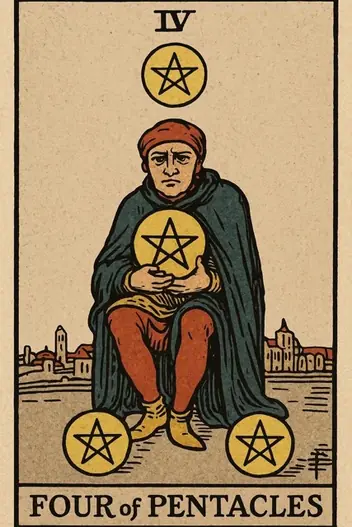
The Four of Pentacles represents the Jungian archetype of the Guardian, a psychological state where an individual prioritizes security, stability, and resource conservation above all else. This card embodies the mindset of calculated risk aversion, where the fear of loss outweighs the potential for gain. It is not a card of poverty, but of defensive wealth management—a life stage where you are clutching tightly to what you have, be it money, time, emotional energy, or identity.
The core challenge of this card is the paradox of possession: the more rigidly you hold something, the more it controls you. Psychologically, this manifests as a cognitive bias toward loss aversion, where the pain of losing a resource is felt twice as intensely as the pleasure of acquiring it. The Four of Pentacles asks you to examine whether your fortress is protecting you from external threats or imprisoning you from potential growth.
Main Dynamics and Interpretation
The upright Four of Pentacles describes a mindset of consolidation and defense. You are likely in a phase where you have accumulated resources—financial capital, a stable relationship, professional status—and your primary instinct is to fortify your position against any perceived threat. This is a rational survival strategy in times of economic uncertainty or personal vulnerability, but it carries a hidden cost: stagnation. By holding everything in place, you prevent the natural circulation of energy, which is essential for renewal.
From a decision-making perspective, this card signals high self-control but low experimentation. You are making choices based on scarcity thinking, even if your actual resources are abundant. The psychological state is one of hypervigilance, where you scan for potential losses rather than opportunities. The key insight is that security is not a static state; it is a dynamic process of adaptation. The Four of Pentacles warns that over-protection can become a self-fulfilling prophecy, where the very walls you build to keep threats out also keep growth and support from entering.
Ask your question and flip the cards
or simply focus on it
Four of Pentacles: Yes or No?
Leaning no.. The Four of Pentacles represents hoarding, control, and fear of loss, which psychologically indicates a defensive posture rather than openness or forward movement. The figure clutching the pentacles tightly embodies rigidity — the psyche’s attempt to maintain security by refusing to release or engage. This card suggests the answer is held back by a need to preserve what is already owned, whether resources, status, or emotional safety. In the reversed position, the answer can shift to leaning yes, as the loosening of grip signals a willingness to let go, share, or take a calculated risk. Critical caveat: the outcome depends on whether the person can distinguish between genuine protection and paralyzing fear — if the question involves risk, expect resistance unless the querent first addresses their underlying scarcity mindset.
Ask your specific question
Don't rely on generic meanings. Get a customized reading tailored specifically to your energies.
What Does Four of Pentacles Mean for Your Day?
The main vector of the day is containment and boundary-setting — you are being called to protect your energy, time, or finances from external demands. Focus on consolidating what you have already built, auditing your resources, and saying “no” without guilt to requests that drain you. Avoid the trap of miserliness or emotional withdrawal, where self-protection morphs into isolation and distrust of others. Be mindful of the urge to micromanage or control outcomes, as this signals anxiety rather than genuine stewardship. The energy supports stability, not growth — today is for fortifying, not expanding.
Love and Relationships
If you are not in a relationship:
You may be overvaluing your independence or emotional reserves to the point of isolation. Your criteria for a partner may be so rigid that you filter out genuine connection. The risk is perpetual solitude disguised as self-sufficiency.
If you are in a relationship:
You may be controlling shared resources—money, time, affection—or building emotional walls to avoid vulnerability. The dynamic can shift toward transactional exchange rather than mutual giving.
The primary relationship advice here is to practice conscious generosity. This does not mean reckless giving, but rather intentional sharing of your time, attention, and emotional resources. The Four of Pentacles often signals a power imbalance where one partner holds the "keys" to the relationship's stability. To break this, you must acknowledge that holding too tightly creates distance. Healthy relationships require a flow of reciprocity, not a hoarding of safety. If you feel your partner is withholding, examine your own defensive patterns first—your grip may be the very thing pushing them away.
Four of Pentacles as Feelings: What They Think of You
Through the lens of the Four of Pentacles, this person perceives you as a resource to be guarded — or as a potential threat to their stability. They associate you with something valuable they are afraid to lose, whether attention, validation, or material support, and their emotional posture is one of cautious ownership. Their hidden intention is to maintain control over the dynamic, often by withholding full commitment or emotional transparency to avoid vulnerability. Deep down, they fear that if they open up or give more, you will take too much and leave them empty. There is an internal conflict between genuine attachment and a compulsive need to protect their boundaries, which can make them appear stingy or distant even when they care. They are not indifferent; they are calculating, and their regard for you is entangled with anxiety about scarcity and loss.
What Does Four of Pentacles Mean for Work and Money?
Strategic Opportunities:
Consolidate your gains by auditing your current assets, skills, and client base. This is a prime time to create a financial buffer (emergency fund) or negotiate a contract that locks in stability.
Resource Management:
Specialize in a niche where your expertise is irreplaceable. Your defensive posture can be leveraged into authority and premium pricing if you focus on quality over quantity.
Calculated Risks:
Avoid over-investing in safety (e.g., multiple insurance policies, over-diversification). Beware of micromanagement that stifles team creativity or blocks innovation. Do not reject a calculated risk simply because it feels uncomfortable.
The financial warning of this card is that hoarding can lead to missed growth. In a professional context, this means you may be under-investing in marketing, training, or R&D out of fear. The strategic advice is to allocate a specific percentage of resources for experimentation (e.g., 10% of profits for innovation). This creates a controlled risk zone that protects your core while allowing for evolution. If you are in a leadership role, delegate authority to avoid becoming a bottleneck. Your strength is in systematizing security, not in being the sole gatekeeper.
Reversed Positions: What Changes?
When the Four of Pentacles appears reversed, the defense mechanisms have cracked—either through external pressure or internal exhaustion. The blocked potential is compulsive release: you may be overspending, over-sharing, or abandoning boundaries out of a reactive fear of being too controlling. This is not freedom; it is chaotic diffusion. For example, someone who hoarded money now spends recklessly, or someone who guarded their emotions now overshares with strangers. The psychological weakness is loss of impulse control and abandonment of structure.
To correct this imbalance, you must reclaim intentionality without returning to rigidity. The reversed card suggests that your previous defenses were unsustainable, but the solution is not full openness—it is selective vulnerability. Bold warning: Do not mistake release for liberation. The path forward is to re-establish boundaries that are permeable, not fortress-like. Identify one area where you can practice moderate risk: invest a small amount in a new venture, share one personal story with a trusted friend, or delegate one minor task. This rebuilds trust in your capacity to manage flow without losing control.
The Shadow Side of Four of Pentacles
The shadow of the Four of Pentacles manifests as pathological miserliness—not just with money, but with attention, praise, time, and emotional support. The cognitive bias is sunk cost fallacy: you hold onto people, projects, or possessions long after they have become liabilities because you have already invested so much. This leads to perfectionism disguised as prudence, where you delay decisions indefinitely to avoid potential loss. Another shadow form is passive-aggressive control, where you withhold resources (e.g., affection, information) to manipulate others.
The deeper fear is loss of identity: if you let go of what you have, who are you? This creates self-sabotage through over-protection of the status quo. For example, an executive refuses to innovate because the current system is "safe," slowly making the company obsolete. Or a person stays in a dead relationship because they are afraid of being alone. The pragmatic correction is to conduct a cost-benefit analysis of holding vs. releasing. Ask: "What is this possession costing me in terms of growth, relationships, or peace of mind?" The shadow dissolves when you realize that true security comes from adaptability, not accumulation.
Synthesis: What It All Adds Up To
The Four of Pentacles is not a "bad" card; it is a necessary survival instinct that has become maladaptive. Constructively, its energy is invaluable for building foundations, setting boundaries, and conserving resources during periods of uncertainty. The strategic advice is to use this card as a diagnostic tool: identify what you are holding too tightly and ask whether that grip is serving your long-term goals. The goal is not to become reckless, but to transform your fortress into a home—a place of security that welcomes growth, not a prison that excludes life.
To harness this archetype effectively, implement the "80/20 Rule of Retention": hold onto 80% of your resources for security, but actively invest 20% in growth, connection, and experimentation. This creates a dynamic equilibrium where you are protected from catastrophic loss while remaining open to evolution. In relationships, this means being generous without being depleted; in career, it means specializing without stagnating. The Four of Pentacles teaches that control is an illusion—the only real security is your ability to adapt to change while preserving your core values.
Your next step is to audit one area of your life where you are holding too tightly. Is it your savings? Your schedule? Your opinions? Your emotional walls? Identify the cost of that grip and practice a small release. The world will not collapse—it will simply make room for something new.
Your Next Step: Personal Context Matters
This psychological and strategic breakdown provides a deep understanding of archetypes. However, Tarot is never universal for everyone. To understand exactly how this dynamic applies to your specific situation, a reading tailored exclusively to you is necessary.
Download the Fortune Cards app or visit our platform to get a deep AI interpretation of your unique spread. Don't just read about the cards—use Fortune Cards to find out exactly what step you need to take next.
Try Tarot Spreads with Four of Pentacles
Interpretation by the Fortune Cards editorial team, based on the Rider–Waite tradition and Jungian archetypes. About our methodology · Updated: 2026-08-26
Top Combinations with Four of Pentacles
Discover how Four of Pentacles interacts with other major cards in the deck to form powerful messages.
All 77 Combinations with Four of Pentacles
Discover how this card interacts with every other card in the Tarot deck and reveal hidden meanings.
Table of Contents
- Main Dynamics and Interpretation
- Four of Pentacles: Yes or No?
- What Does Four of Pentacles Mean for Your Day?
- Love and Relationships
- Four of Pentacles as Feelings: What They Think of You
- What Does Four of Pentacles Mean for Work and Money?
- Reversed Positions: What Changes?
- The Shadow Side of Four of Pentacles
- Synthesis: What It All Adds Up To
- Your Next Step: Personal Context Matters
Explore Tarot Universe
Ready to find answers to your questions?
Start your first reading now and look at your situation with fresh clarity. The cards are ready to reveal deeper meaning.