Four of Pentacles and Ten of Pentacles Tarot as Feelings

- Arcana
- Four of Pentacles — Minor Arcana, Pentacles; Ten of Pentacles — Minor Arcana, Pentacles
- Elements
- Four of Pentacles — Earth; Ten of Pentacles — Earth
- Elemental interaction
- Same element — energies intensify each other
- Numerology
- 4 + 10 = 14 → 5
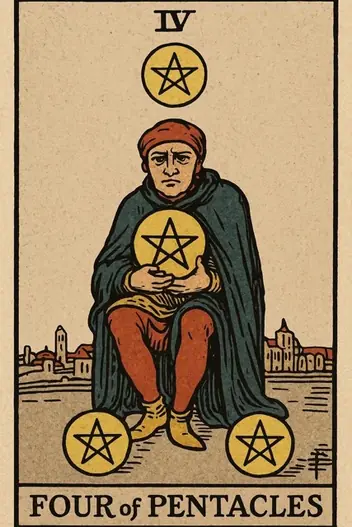
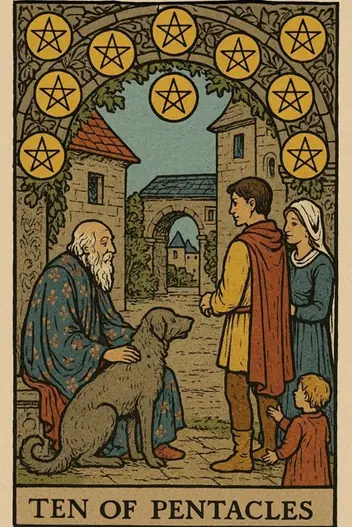
When the Four of Pentacles meets the Ten of Pentacles, we witness a psychological collision between the drive for immediate control and the desire for long-term stability. The Four of Pentacles represents the archetype of the "Hoarder"—a mindset focused on holding onto what you have, often out of fear of loss. In stark contrast, the Ten of Pentacles embodies the "Patriarch" or "Matriarch"—a vision of abundance passed down through generations, rooted in trust and communal wealth.
This combination forces a pragmatic question: Are you building a fortress to protect your resources, or are you building a dynasty that can outlast you? The tension here is not between poverty and wealth, but between scarcity thinking and generational vision. The Four clings; the Ten expands. When both appear together, the seeker must examine whether their current strategies for security are actually undermining their capacity to create lasting value.
What Do Four of Pentacles and Ten of Pentacles Mean Together?
The primary psychological dynamic is a battle between anxiety and aspiration. The Four of Pentacles signals a defensive posture—perhaps a recent loss, a fear of economic instability, or a compulsive need to micromanage finances. The Ten of Pentacles, however, points to a larger framework: family legacy, business succession, or long-term investments. When these energies merge, the seeker may be over-managing immediate resources at the expense of future growth.
This often manifests as risk aversion that borders on paralysis. For example, you might have a solid inheritance or a stable job (Ten of Pentacles), yet you refuse to invest, share, or delegate (Four of Pentacles). The cognitive bias at play is the endowment effect—valuing what you already possess more than what you could gain. To move forward, you must distinguish between prudent stewardship and fear-based hoarding.
A key insight: This pair can also indicate a generational pattern of control. If you grew up in a family where money was used as a tool for manipulation or conditional love, the Four of Pentacles may be your learned response. The Ten of Pentacles challenges you to rewrite that legacy—to create abundance that is shared, not guarded.
Your pair is already on the table. Ask your question and draw the clarifying card
or simply focus on it
Career and Finances
Strategic Opportunities:
Use your current resources (savings, skills, network) to fund a long-term project or business venture. The Ten of Pentacles rewards patient capital.
Strategic Opportunities:
Consider estate planning, trust funds, or succession strategies if you own a business. This pair supports creating systems that outlast you.
Calculated Risks:
Avoid over-leveraging or signing long-term contracts out of fear of missing out. The Four of Pentacles warns against impulsive moves disguised as "security."
In your career, this combination often signals a crossroads between a stable job and a legacy-building role. You may be offered a promotion with more responsibility (Ten) but feel the urge to cling to your current position for safety (Four). The strategic move is to negotiate terms that protect your downside while allowing for upside. For example, ask for a phased transition or a guaranteed severance clause.
Financially, this pair is a wake-up call to audit your relationship with money. Do you have a budget that accounts for both saving and investing? Are you prioritizing short-term liquidity over long-term asset growth? A common pitfall is over-saving in low-yield accounts while inflation erodes purchasing power. Instead, allocate a portion to diversified assets that align with your timeline (e.g., real estate, index funds, or education).
Uncover hidden insights
Let our advanced Tarot system interpret these archetypes specifically for your personal path.
Four of Pentacles and Ten of Pentacles in Love Tarot
If you are single:
This combination suggests you may be evaluating potential partners through a lens of material security or family approval. While practical, this can block emotional connection. Ask yourself: Are you protecting your heart, or are you building walls that keep out genuine intimacy?
If you are in a relationship:
You and your partner may be negotiating boundaries around shared resources or family obligations. The Four of Pentacles warns against one partner controlling the finances or emotional space, while the Ten of Pentacles calls for a shared vision of the future.
In a relationship context, the Four of Pentacles and Ten of Pentacles often reveal a power struggle over stability. One partner may feel the need to clutch tightly to routines, savings, or traditions (Four), while the other yearns for expansion, legacy building, or blending families (Ten). Effective communication here requires acknowledging each other's fears without judgment. If you are the "holder," recognize that your need for control may stem from past betrayals. If you are the "builder," avoid dismissing your partner's caution as mere stinginess.
Key relationship advice: Negotiate a "safety net" that allows for growth. For instance, agree to a specific percentage of shared income that is saved (Four) and another that is invested in shared experiences or future goals (Ten). This balances emotional security with relational expansion.
What If Four of Pentacles or Ten of Pentacles Appears Reversed?
When cards appear in a reversed position, the tension between them intensifies, but the direction shifts.
If the Four of Pentacles is reversed:
This indicates recklessness and impulsive spending in an attempt to prove your generosity. You may be destroying what you have built for years, out of a fear of being seen as greedy. Advice: return to basic financial planning. Your generosity should be conscious, not compensatory.
If the Ten of Pentacles is reversed:
An internal resistance to success manifests. You sabotage your own projects, fear the responsibility of legacy, or feel unworthy of stability. This is a classic "imposter" crisis at the moment of triumph. Advice: acknowledge your fear of a large scale. Work with a therapist on accepting your maturity and authority.
If BOTH are reversed:
Complete imbalance — chaos in finances and a rupture in family/business ties. This is the state of the "prodigal heir" who burns bridges. A logical way to correct this: introduce external auditing and strict boundaries. You need a mentor or financial advisor who can take on the role of a "healthy Four of Pentacles" until you restore self-control.
Shadow Side & Pitfalls
The shadow of this combination is toxic scarcity mixed with entitlement. The seeker may become a control freak who micromanages family finances, inheritance, or business partnerships to the point of alienating loved ones. Alternatively, they might use the promise of a "legacy" to manipulate others—e.g., dangling an inheritance to enforce compliance.
Cognitive biases to watch for: Loss aversion (fearing a small loss more than missing a large gain) and anchoring (fixating on the current value of assets rather than their potential). This can lead to paralysis by analysis—endlessly planning but never executing. If you see yourself here, ask: "Am I protecting my past or building my future?" The answer will reveal whether you are acting from wisdom or fear.
Synthesis: Strategic Conclusion
Your strategic task is to transform the energy of hoarding (Four of Pentacles) into the energy of stewardship (Ten of Pentacles). This is not an abandonment of control, but its evolution. Instead of keeping everything in a tight fist, learn to create systems and rules that operate on their own. Imagine you are not a guard with keys, but an architect who designed a building that protects itself.
Practical step: take one of your key processes (budget management, client onboarding, vacation planning) and delegate 80% of the operational tasks. Keep only strategic oversight and key decision-making for yourself. This will trigger anxiety (Four of Pentacles), but that very anxiety is the indicator that you are on the right path toward genuine, not illusory, stability.
Deep strategic advice:
apply the principle of "legacy." Ask yourself: "What do I want to leave behind in 10 years: a collection of assets or a thriving ecosystem?" The answer to this question will unlock your generosity and allow you to stop fearing the future, instead beginning to actively build it.
Applying This to Your Situation
The Four of Pentacles and Ten of Pentacles together deliver a clear message: True security is not in holding tight, but in creating systems that endure. Whether you are guarding a relationship, a career, or a financial portfolio, the path forward requires balancing practical caution with visionary trust. Your unique situation—your fears, your resources, your family history—will determine how this plays out.
For a deep, personalized interpretation of this exact combination for your specific question, use the Fortune Cards app. While this article provides the general archetype, the real insight comes when Tarot is applied to your life. The app tailors the meaning to your context, helping you move from generic advice to actionable strategy. Try it on the web or download it now to unlock your next step.
Interpretation by the Fortune Cards editorial team, based on the Rider–Waite tradition and Jungian archetypes. About our methodology · Updated: 2026-08-26
Other Combinations with Four of Pentacles
Other Combinations with Ten of Pentacles
Explore Individual Card Meanings
Table of Contents
Ready to find answers to your questions?
Start your first reading now and look at your situation with fresh clarity. The cards are ready to reveal deeper meaning.