Six of Cups and Four of Pentacles Reversed in Tarot
- Arcana
- Six of Cups — Minor Arcana, Cups; Four of Pentacles — Minor Arcana, Pentacles
- Elements
- Six of Cups — Water; Four of Pentacles — Earth
- Elemental interaction
- Friendly elements — energies support each other
- Numerology
- 6 + 4 = 10 → 1
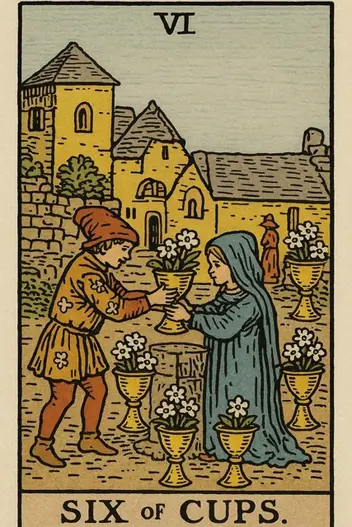
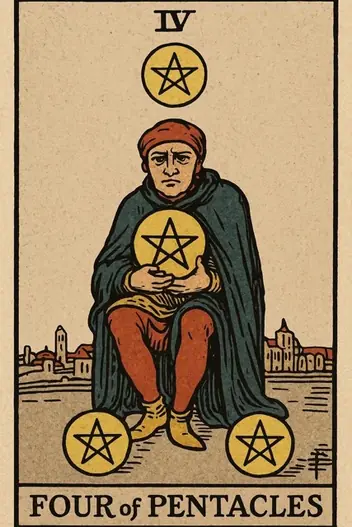
When the Six of Cups—the card of innocent memories, generosity, and emotional reconnection—collides with the Four of Pentacles—the archetype of holding tight, financial caution, and rigid boundaries—you get a potent psychological paradox. This pairing often surfaces when a person is attempting to preserve a past ideal while simultaneously fearing loss in the present. The result is a mindset that seeks comfort in what was, rather than building resilience for what is.
This combination demands a pragmatic assessment: Are you protecting a cherished memory, or are you hoarding emotional and material resources out of scarcity? The Jungian shadow here involves conflating sentimental value with real-world security, often leading to a defensive posture that blocks growth. The key is to acknowledge the past’s gifts without letting them become a prison.
Six of Cups and Four of Pentacles: How These Energies Interact
The fusion of the Six of Cups and Four of Pentacles creates a psychological state of guarded nostalgia. You may find yourself revisiting old relationships, past successes, or childhood comforts, but with a fear-based grip that prevents you from integrating these lessons into the present. This is not a simple "reminiscing" phase; it is a defensive retreat into a mental fortress built from "safer" times.
In practical terms, this energy often manifests as risk aversion disguised as loyalty. For example, you might cling to a outdated business model because it once brought you joy, or stay in a stagnant relationship because it reminds you of a happier period. The Four of Pentacles warns that this protective instinct, while understandable, can morph into emotional and financial hoarding. The mind rationalizes: "If I hold onto this memory or possession tightly enough, I won't have to face the uncertainty of change."
The pragmatic challenge is to separate true value from sentimental attachment. Ask yourself: Does this person, object, or memory still serve my current growth, or am I merely avoiding present discomfort? The healthiest expression of this pair is to use the Six of Cups' warmth to heal old wounds, while applying the Four of Pentacles' discipline to build secure foundations—not to build walls.
Your pair is already on the table. Ask your question and draw the clarifying card
or simply focus on it
Six of Cups and Four of Pentacles: Career and Money
Strategic Opportunities:
Leverage your past network or expertise to negotiate a stable, long-term contract. The Six of Cups indicates that trusted relationships from your past can open doors; the Four of Pentacles suggests you can secure those gains with careful planning.
Strategic Opportunities:
Use nostalgia as a branding tool—if you’re in a creative or service industry, marketing a sense of "timeless quality" or "return to fundamentals" can attract loyal clients. This is about monetizing a trustworthy reputation.
Calculated Risks:
Avoid over-valuing past assets or methods just because they feel safe. The Four of Pentacles warns against hoarding cash or inventory out of fear, or refusing to upgrade skills because "the old way worked fine." This can lead to financial stagnation.
In a professional context, this pair signals a tension between comfort and competitiveness. You may be offered a role that feels familiar or a project that reminds you of a past success. The strategic move is to accept the opportunity, but only with updated terms. For example, take the job that uses your old skills, but negotiate for new training or a clear growth path. Financially, the warning is clear: do not let sentimentality override sound fiscal judgment. Paying above market value for a "nostalgic" property or investment is a common pitfall here.
The pragmatic action is to audit your portfolio—both professional and financial. What are you holding onto that is no longer yielding returns? The Four of Pentacles' shadow is miserliness, while the Six of Cups' shadow is refusing to let go of a dead-end venture because of its history. Cut ties with what drains you, no matter how fond the memory.
Six of Cups and Four of Pentacles Love Outcome
If you are single:
This pairing suggests you may be idealizing a past partner or a "type" from your history, preventing you from seeing a new connection objectively. The risk is comparing a real person to a curated memory; you must ask if you’re seeking genuine intimacy or just a comfortable echo.
If you are in a relationship:
You or your partner may be withholding emotional or financial resources out of a fear of being hurt again. This creates a dynamic where past grievances are used as justification for present distance, rather than as lessons for better boundaries.
This combination often reveals a power struggle between vulnerability and control. One partner may want to recreate the "good old days" (Six of Cups), while the other feels suffocated by rigid expectations and guardedness (Four of Pentacles). The critical insight is that nostalgia can be a form of emotional blackmail—using shared history to demand compliance or to avoid addressing current issues.
Key relationship advice is to negotiate a "safe container" for honesty. The Six of Cups offers a genuine desire for connection, while the Four of Pentacles provides the structure for boundaries. A practical step is to set a specific time to discuss past hurts without blame, and then explicitly agree on what you’re both willing to invest (time, trust, resources) moving forward. Do not confuse holding onto a memory with holding onto a person.
Uncover hidden insights
Let our advanced Tarot system interpret these archetypes specifically for your personal path.
Six of Cups and Four of Pentacles Reversed: How to Read It
If the Six of Cups is reversed:
Nostalgia turns into destructive escapism. You aren't just remembering the past — you are living in it, denying reality. Warning: risk of impulsive decisions based on false memories. For example, quitting your job because "things were better before," without a real financial plan. Advice: fact-check your memories — was it really that good?
If the Four of Pentacles is reversed:
Control gives way to chaotic generosity or, conversely, complete financial irresponsibility. Inner resistance to structure leads you to spend resources to buy love or approval (the Six of Cups). This is the classic "lend money to be liked" scenario. Advice: implement a 24-hour rule before any emotionally-driven financial spending.
If BOTH are reversed:
Complete imbalance. The past is trauma, the present is emptiness. The person oscillates between the desire to give everything up and the fear of ending up with nothing. Corrective measure: a temporary moratorium on any important decisions. Focus on basic needs (food, sleep, physical activity) for 2-3 weeks to "reset" the nervous system and exit survival mode.
Negative Meaning of Six of Cups and Four of Pentacles
The shadow of this combination is a cognitive bias known as the "sunk cost fallacy" —the irrational belief that because you have invested time, emotion, or money into something in the past, you must continue to protect it. Here, the Six of Cups provides the emotional justification ("I owe it to my past self"), while the Four of Pentacles provides the rigid behavior ("I will not let go"). This leads to self-sabotage through over-protection.
A typical manifestation is emotional hoarding: you may hold onto grudges or unresolved feelings from years ago, believing that keeping them close protects you from being hurt again. In reality, this freezes your emotional development. In finance, it can appear as irrational attachment to a failing business or refusing to sell a depreciating asset because it was a gift or inherited. The Jungian shadow here is the "Wounded Child" archetype—the part of you that believes safety lies in never changing, never risking, and never releasing the past.
The most dangerous pitfall is mistaking control for security. The Four of Pentacles offers the illusion of stability, but when combined with the Six of Cups' backward glance, it creates a vicious cycle: you cling to what you know, the world changes, you feel more threatened, and you cling harder. Breaking this requires conscious exposure to small, safe risks—such as donating an old possession, revisiting a past trauma with a therapist, or investing a small amount in a new skill.
Six of Cups and Four of Pentacles: Tarot Advice
How to use the Six of Cups to unlock the Four of Pentacles? Answer: transform nostalgia into capital. Past experience is not a refuge, but a knowledge base. Your task is to take the archetype of the master from the Six of Cups (what you do best) and apply it to the current resources of the Four of Pentacles. If you were once successful in negotiations but now fear taking risks — do not try to repeat the same tactic. Instead, use old connections (Six of Cups) to obtain guarantees (Four of Pentacles).
Strategic advice: create a "safety fund" — not financial, but emotional. Identify 3-5 people or activities that give you a sense of unconditional support (Six of Cups). This is your "safety net." Now, with this foundation, you can afford to take a risk in one specific area (career, relationships) where the Four of Pentacles blocks development. The main condition: the risk must be measured. Do not quit your job, but ask for a new project. Do not end a relationship, but introduce a new tradition. Use the past as a springboard, not an anchor. Only then can you transform this combination from stagnation into sustainable growth.
Where to Go From Here
The core message of the Six of Cups and Four of Pentacles is that your past is a resource, not a residence. You can honor your history without being imprisoned by it. The healthiest path is to selectively retrieve the emotional warmth and loyalty of the Six of Cups, while applying the discipline and caution of the Four of Pentacles to build a present that is both secure and open to growth. The question is not whether to hold on, but what to hold on to—and why.
While this article provides the general archetype, the true magic happens when Tarot is applied to your unique situation. Your specific question, your personal history, and your current context will shift the meaning dramatically. Get a deep, personalized interpretation of this exact combination for your specific question right now by using the Fortune Cards app. You can use it on the web or download it to discover how these energies are playing out in your love life, career, or inner world—and what your next strategic move should be.
Interpretation by the Fortune Cards editorial team, based on the Rider–Waite tradition and Jungian archetypes. About our methodology · Updated: 2026-10-15
Other Combinations with Six of Cups
Other Combinations with Four of Pentacles
Explore Individual Card Meanings
Table of Contents
- Six of Cups and Four of Pentacles: How These Energies Interact
- Six of Cups and Four of Pentacles: Career and Money
- Six of Cups and Four of Pentacles Love Outcome
- Six of Cups and Four of Pentacles Reversed: How to Read It
- Negative Meaning of Six of Cups and Four of Pentacles
- Six of Cups and Four of Pentacles: Tarot Advice
- Where to Go From Here
Ready to find answers to your questions?
Start your first reading now and look at your situation with fresh clarity. The cards are ready to reveal deeper meaning.