Love Tarot: Seven of Wands and Six of Cups
- Arcana
- Seven of Wands — Minor Arcana, Wands; Six of Cups — Minor Arcana, Cups
- Elements
- Seven of Wands — Fire; Six of Cups — Water
- Elemental interaction
- Opposing elements — energies create tension
- Numerology
- 7 + 6 = 13 → 4
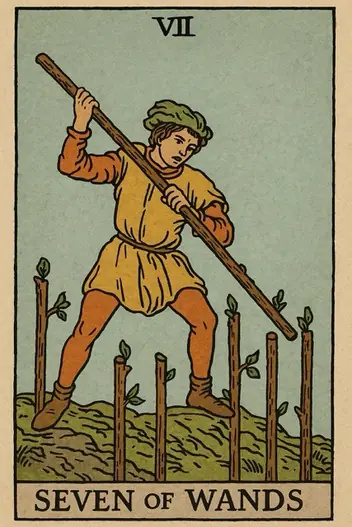
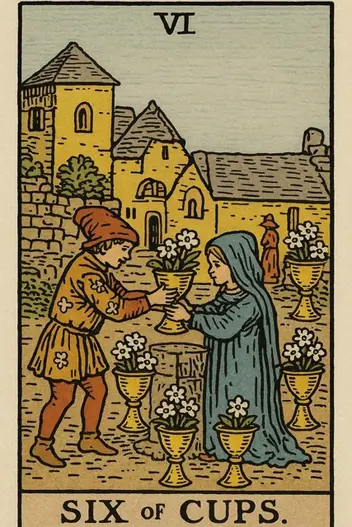
When the Seven of Wands—a card of defensive struggle, standing one’s ground, and protecting a hard-won position—meets the Six of Cups—a card of nostalgia, innocent memories, and giving without expectation—a fascinating psychological tension emerges. You are being asked to defend something from your past that still holds emotional weight, but you must do so without slipping into regression or sentimentality. This combination often appears when a person is re-engaging with an old dream, a past relationship, or a childhood value system, but finds themselves under attack—either from external critics or from their own internal doubts. The core challenge is to fight for what was once pure without letting the fight corrupt it.
Seven of Wands and Six of Cups Combination Meaning
The intersection of these two archetypes creates a defensive posture rooted in emotional history. Psychologically, this mirrors what Jung called the "child archetype" meeting the "warrior archetype"—you are protecting an inner sense of innocence or a cherished memory that feels threatened by the present. The Six of Cups provides the motivation: a desire to recapture a simpler, kinder time or to give something meaningful to another person. The Seven of Wands provides the method: a stance of vigilance, resistance, and refusal to back down. Together, they suggest that you are currently defending a relationship, project, or belief that originates from your past, and you are doing so with considerable energy.
However, this dynamic comes with a clear psychological warning. Nostalgia can distort risk assessment. You may be fighting to preserve something that no longer serves your growth, simply because it feels familiar or "safe." The Seven of Wands demands that you check your motives: Are you defending a genuine, living value, or are you defending a ghost? The healthiest expression of this pairing is guarding the essence of a past lesson or relationship while letting go of its outdated forms. The unbalanced version is fighting a battle that ended years ago, exhausting yourself for a memory.
Love and Relationships
If you are single:
This combination suggests you may be comparing new romantic prospects to a past relationship or childhood ideal. Be wary of projecting innocence onto someone who hasn't earned it. Your defensiveness may come from a fear of being hurt again, not from genuine attraction.
If you are in a relationship:
You and your partner may be renegotiating boundaries around an old conflict or a shared history. One of you is feeling attacked for wanting to revisit a happier time, while the other feels the need to stand firm against regression.
In relationships, the Seven of Wands and Six of Cups often signals a power struggle over the past. One partner may want to recreate an earlier, simpler phase of the relationship, while the other feels this is impossible or unfair. The key psychological insight is that you cannot defend a memory as if it were a present reality. This pairing asks for emotional intelligence in distinguishing between honoring a past connection and being trapped by it. If you are the one defending the past, ask yourself: "Am I fighting to protect the person I loved, or the person they used to be?" If you are the one pushing forward, recognize that your partner’s defensiveness comes from a place of vulnerability, not malice. The healthiest path is to create a new set of shared memories that incorporate the best of the old while respecting current boundaries.
Your pair is already on the table. Ask your question and draw the clarifying card
or simply focus on it
Career Meaning of Seven of Wands and Six of Cups
Strategic Opportunities:
Leverage your past reputation or a past success as a foundation for a current project. This is an excellent time to re-engage with former clients, mentors, or collaborators who remember your best work.
Strategic Opportunities:
Use your unique experience—especially a niche skill or "old-school" method—as your differentiator in a competitive market. Your history is your moat.
Calculated Risks:
Avoid over-investing in a "legacy" project that no longer has market demand. The nostalgia of the Six of Cups can blind you to the reality that the industry has moved on. Do not let loyalty to a past strategy drain your resources.
Professionally, this combination is a double-edged sword for decision-making. The Seven of Wands indicates that you are in a defensive position—perhaps your job, your department, or your business model is under threat. The Six of Cups suggests that your best defense lies in your track record, your established relationships, and your proven expertise. This is a time to stand firm on your past accomplishments, but only if they are still relevant. For financial planning, the warning is clear: do not pour money into preserving a business model or product out of emotional attachment. The most pragmatic move is to defend the core value of what you built—your brand, your network, your unique insight—while being willing to abandon the specific form it took in the past. This is a strategy of adaptation, not stubbornness.
Reversed Positions: What Changes?
When cards appear reversed, the dynamic becomes distorted but does not disappear—it transitions into a shadowy, unconscious form. This requires deeper self-analysis.
Seven of Wands reversed:
Defense becomes paranoid or, conversely, completely collapses. Warning: you either surrender without a fight, allowing others to violate your boundaries, or you fall into irrational aggression. Instead of defense—flight or reckless attack. Advice: you need to restore a sense of inner grounding before attempting to defend external boundaries.
Six of Cups reversed:
The past ceases to be a refuge and becomes a source of pain. This is a state of "toxic nostalgia," where you are fixated on traumas or losses. You are not protecting pleasant memories but fending off obsessive thoughts about the past. Advice: work with a therapist on separating from past experiences is necessary. The energy of the Seven of Wands here is spent on an internal struggle with ghosts.
BOTH reversed:
Complete imbalance. This is an identity crisis. You do not know what to defend (Seven of Wands reversed) and cannot remember what was valuable (Six of Cups reversed). A person feels adrift in a vacuum, without roots and without boundaries. A logical way to correct this: start small. Return to basic needs and build one, simplest boundary. Create one new, positive memory to replace the emptiness.
Deepen your understanding
Find out exactly what this reading means for your current life situation with our oracle.
What Are the Risks of Seven of Wands and Six of Cups?
The shadow manifestation of this pairing is reactive defensiveness driven by unprocessed grief. When the Six of Cups is blocked, the seeker may cling to a sanitized version of the past, refusing to see its flaws. When the Seven of Wands is blocked, the seeker may become aggressively combative toward anyone who challenges their nostalgic narrative. This creates a cognitive bias known as the "rosy retrospection" fallacy—believing the past was uniformly better than the present, and thus fighting to return to it. The result is self-sabotage through stubbornness: you alienate people who offer constructive criticism, you waste energy on lost causes, and you miss new opportunities because you are too busy defending old ones. The deepest pitfall is confusing loyalty with wisdom. Just because something was once good does not mean it is worth fighting for now.
Seven of Wands and Six of Cups Combined Message
How to constructively use the energy of the Seven of Wands to balance the Six of Cups? The key is to stop defending the past and start defending your potential in the future. The Seven of Wands is a powerful resource for setting boundaries. Direct it not toward preserving the old, but toward clearing space for the new.
Your strategic task is to transform nostalgia from a refuge into a foundation. Stop living in the past; start building upon it. Take the best from the Six of Cups—a sense of security, trust, warmth—and use the Seven of Wands to protect that quality in your current life. Defend not the specific circumstances of the past, but the values you found there.
A practical action plan: write down three things from your past that gave you a sense of security (e.g., "honesty in relationships," "time alone with yourself"). Now, using the energy of the Seven of Wands, create rituals and rules that protect these values NOW. If you need time alone with yourself—assert it with colleagues and family. If honesty is important—demand it, not by looking back at "how it used to be," but by focusing on "how it will be now."
A deep strategic advice: turn your defense into an offense. Do not wait for someone to attack your "garden of memories." Step beyond its borders and plant a new garden in the present. Use your combat readiness not to repel attacks, but to conquer new territory. Only then can you break free from stagnation and begin moving forward.
Applying This to Your Situation
The Seven of Wands and Six of Cups together deliver a clear message: honor your past, but do not be ruled by it. You are being called to defend something that matters to you, but you must first verify that what you are protecting is real and alive, not a ghost. The most powerful action you can take is to distinguish between the memory and the mission—keep the lesson, let go of the form.
While this analysis provides a deep archetypal understanding, the true insight comes when you apply it to your exact situation. Your specific question, your unique history, and your current context change everything. That is why you should use the Fortune Cards app right now. Whether on the web or downloaded to your phone, the app will give you a personalized, deep interpretation of this exact combination for the relationship, career, or life question you are holding. Stop guessing—get the clarity you need for your next step.
Interpretation by the Fortune Cards editorial team, based on the Rider–Waite tradition and Jungian archetypes. About our methodology · Updated: 2026-08-26
Other Combinations with Seven of Wands
Other Combinations with Six of Cups
Explore Individual Card Meanings
Table of Contents
Ready to find answers to your questions?
Start your first reading now and look at your situation with fresh clarity. The cards are ready to reveal deeper meaning.