Six of Cups
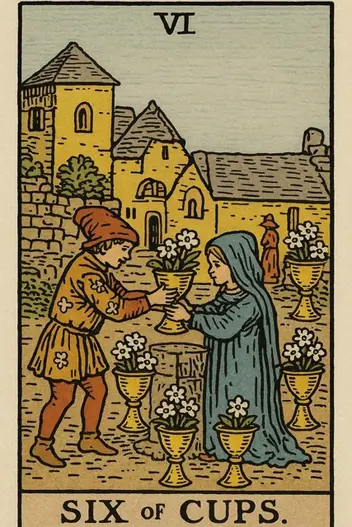
- Arcana
- Minor Arcana, Suit of Cups
- Element
- Water
- Decan
- the Sun in Scorpio
- Numerology
- 6
The Six of Cups represents the Jungian archetype of the Inner Child and the psychological state of nostalgic reflection. It is the card of revisiting past memories, emotional connections, and simple pleasures. The core challenge it presents is distinguishing between healthy remembrance and unproductive regression. It asks you to honor your past without letting it define or trap your present.
This card often signals a phase where emotional safety and familiarity are prioritized over growth and novelty. It can indicate a genuine need for healing old wounds, or a subtle resistance to the demands of adult reality. The key is to use the past as a resource for emotional grounding, not as a fortress against the future.
Six of Cups: Core Meaning and Interpretation
The Six of Cups provides a psychological resource of emotional security and trust. It allows you to access a mindset of unconditional giving and gratitude, often tied to formative relationships or childhood experiences. This can be strategically powerful for rebuilding trust in yourself or others, especially after a period of cynicism or burnout. This card grants the clarity to identify which past patterns are worth preserving and which are limiting.
In decision-making, the Six of Cups favors intuitive, heart-driven choices over cold logic. However, this is a double-edged sword. While it can lead to authentic connections, it also risks romanticizing the past and ignoring current red flags. The core dynamic is a choice between using memory as a compass or as a cage. The mature path involves extracting the emotional lesson—the feeling of safety or joy—and applying it to the present, rather than trying to recreate the exact circumstances.
This mindset often surfaces when you are facing a transition. It provides the psychological safety net needed to take a leap of faith. However, if over-relied upon, it can create a dependency on external validation from familiar sources, stunting your independence. The strategic use of this energy is to consciously choose when to look back for comfort and when to look forward for growth.
Ask your question and flip the cards
or simply focus on it
Is Six of Cups a Yes or a No?
Yes. But only when the inquiry concerns emotional reconnection, nostalgia, or gentle goodwill. The Six of Cups symbolizes a return to innocence, safe affection, and the archetype of the “inner child” seeking recognition. In a practical sense, the answer leans positive because the card reflects a desire for harmony rooted in past positive associations, not conflict or ambition. Reversed, the answer shifts to Leaning No, as the energy becomes one of emotional stagnation, clinging to outdated memories, or refusing to grow. The critical condition is that the outcome depends on whether both parties are genuinely willing to meet in the present, not merely replay a script from the past — if one person is idealizing rather than seeing you as you are now, the “yes” dissolves into disappointment.
Your unique Tarot reading
See how these cards interact with your destiny. Start a free personal reading now.
Card of the Day
The main vector of the day is gentle reciprocity — a moment to receive and offer small, sincere gestures of care without grand expectations. Focus on reconnecting with someone from your past who brings you peace, or on revisiting a hobby or memory that once filled you with uncomplicated joy. Take concrete actions like writing a handwritten note, sharing a meal with a loved one, or simply pausing to appreciate a familiar comfort. The trap to avoid is sentimental escapism — using nostalgia to avoid current responsibilities or to compare today unfavorably to a sanitized past. Beware of offering help that subtly expects something in return, as the Six of Cups’ innocence curdles into covert bargaining.
Six of Cups in Love and Relationships
If you are not in a relationship:
This card suggests you may be unconsciously seeking a partner who mirrors a past love or a childhood ideal. The risk is projecting an idealized image onto someone new. Your strategic advantage is knowing exactly what emotional qualities you value, allowing you to attract genuine, kind-hearted connections. Avoid settling for a nostalgic echo instead of building a new reality.
If you are in a relationship:
The Six of Cups points to a phase of rekindling affection and simple rituals of care. It signals a time to revisit the foundation of your bond—why you chose each other. The crucial boundary is avoiding the trap of "parent-child" dynamics, where one partner becomes overly dependent or the other becomes a caretaker. The practical advice is to consciously share joyful, low-pressure activities that remind you of your shared history, but also to actively create new memories together.
The main behavioral pattern here is a desire for emotional safety. The healthiest expression involves mutual vulnerability and sharing fond memories. The toxic expression is using the past to avoid addressing current problems. If you find yourself saying "it used to be better" instead of "how can we make it better now?", you are misusing this energy. Bold the main practical relationship advice: Actively schedule "play dates" with your partner or yourself, but always balance them with a conversation about future goals.
What Does Six of Cups Say About Their Feelings?
Through the archetype of the Six of Cups, this person perceives you as a source of emotional safety and uncomplicated warmth — you remind them of a time before cynicism or disappointment. They associate you with qualities they either lost or never fully experienced: genuine kindness, playful curiosity, and an absence of ulterior motive. Their hidden hope is that you can offer them a reprieve from adult pressures or relational wounds, while their buried fear is that you will eventually prove as conditional or rejecting as others have been. There is a clear internal conflict: they are drawn to your sweetness but may unconsciously resist deeper intimacy because they fear tainting the “pure” image they hold of you. If the card appears reversed in their position, their perception is tinged with suspicion — they may see you as naive, or they are projecting their own unprocessed past onto your present actions. Ultimately, they see you as a mirror of their own longing for unburdened connection, which can either deepen trust or trap you in a role that doesn’t reflect your full complexity.
Career and Finance
Strategic Opportunities:
Leverage your network of past colleagues and mentors. This is an excellent time to reconnect with people who know your work ethic and can offer a trusted recommendation. Your reputation is your currency now.
Resource Management:
Focus on roles that involve mentorship, customer retention, or heritage brands. Your ability to tap into feelings of loyalty and tradition is a unique asset. Projects that revive a classic product or service can be highly profitable.
Calculated Risks:
Avoid returning to a previous job or industry purely out of fear of the new. The salary might be comfortable, but the lack of growth is a hidden cost. The specific business warning is to avoid nepotism or hiring friends based on past loyalty alone. Objectively assess their current competence.
Financially, the Six of Cups urges a conservative, nostalgic approach. You may feel drawn to "safe" investments or familiar spending patterns. The strategic advice is to honor your need for security but to allocate a small percentage of your capital to a new, calculated venture. Bold financial warning: Beware of "poverty mindset" nostalgia—the belief that your past financial struggles define your future potential. Your current stability is a platform, not a prison.
Six of Cups Reversed: What Changes
When reversed, the Six of Cups indicates a blocked connection to the Inner Child or a resistance to healthy nostalgia. This manifests as cynicism, emotional detachment, or an inability to trust. You may be actively rejecting past relationships or memories, throwing the baby out with the bathwater. The warning is clear: you are cutting off a vital emotional resource.
Alternatively, this reversal can signal being stuck in an unhealthy attachment to the past. This is not the gentle nostalgia of the upright card, but a bitter rumination or an inability to move on from a trauma or a "golden age." The practical correction is to actively practice gratitude for the present moment. Engage in a small, new ritual that has no connection to your past. The way to rebalance is to consciously choose one lesson from your past and apply it to a current problem, then let the rest go.
What Are the Pitfalls of Six of Cups?
The shadow of the Six of Cups is emotional immaturity and passive dependence. The irrational behavior manifests as over-idealizing the past to avoid dealing with current responsibilities. You might find yourself procrastinating on adult decisions by indulging in nostalgia—re-watching old movies, revisiting old haunts, or contacting ex-partners for comfort. The cognitive bias is the "rosy retrospection" bias, which filters out all negative memories.
Another deep pitfall is using "innocence" as a weapon. This can appear as playing the victim or refusing to take responsibility by claiming you are "just a simple person" or "not cut out for the real world." This is a form of self-sabotage through avoidance. The fear underneath is of rejection and inadequacy in the present. To counter this, you must actively take one small, adult risk each week that has no connection to your comfort zone. The error in judgment is treating emotional safety as the only goal, instead of one tool among many.
Synthesis: Strategic Conclusion
The Six of Cups offers a profound psychological tool: the ability to access a state of pure, unguarded connection. To use this constructively, you must become a conscious curator of your memories. Do not let them be a random collection of regrets and yearnings. Instead, ask: "What specific feeling does this memory give me, and how can I create that feeling in my life today?" This transforms nostalgia from a passive escape into an active blueprint for a fulfilling present.
The strategic advice is to use the Six of Cups as a compass for your core values, not as a map to your past. It tells you what is fundamentally important to you: trust, simplicity, generosity, and joy. It is a card of emotional replenishment. When you feel depleted, this is the energy that allows you to recharge by connecting to what is genuinely good and pure. However, you must set a strict time limit on this reflection. Schedule 30 minutes for nostalgic journaling, then close the book and take one concrete action toward your future.
Ultimately, the Six of Cups is a card of integration. It asks you to bring your younger, more trusting self into your current, more complex life. The highest use of this energy is to act with the innocence of your heart and the wisdom of your experience. Do not abandon your past; but do not live in it. Carry its best gifts forward, and leave its chains behind. This is the path to genuine, sustainable fulfillment.
Applying This to Your Situation
This psychological and strategic breakdown provides a deep understanding of archetypes. However, Tarot is never universal for everyone. To understand exactly how this dynamic applies to your specific situation, a reading tailored exclusively to you is necessary.
Download the Fortune Cards app or visit our platform to get a deep AI interpretation of your unique spread. Don't just read about the cards—use Fortune Cards to find out exactly what step you need to take next.
Try Tarot Spreads with Six of Cups
Interpretation by the Fortune Cards editorial team, based on the Rider–Waite tradition and Jungian archetypes. About our methodology · Updated: 2026-08-26
Top Combinations with Six of Cups
Discover how Six of Cups interacts with other major cards in the deck to form powerful messages.
All 77 Combinations with Six of Cups
Discover how this card interacts with every other card in the Tarot deck and reveal hidden meanings.
Table of Contents
- Six of Cups: Core Meaning and Interpretation
- Is Six of Cups a Yes or a No?
- Card of the Day
- Six of Cups in Love and Relationships
- What Does Six of Cups Say About Their Feelings?
- Career and Finance
- Six of Cups Reversed: What Changes
- What Are the Pitfalls of Six of Cups?
- Synthesis: Strategic Conclusion
- Applying This to Your Situation
Explore Tarot Universe

Ready to find answers to your questions?
Start your first reading now and look at your situation with fresh clarity. The cards are ready to reveal deeper meaning.