Six of Cups and Ten of Swords Meaning in Tarot
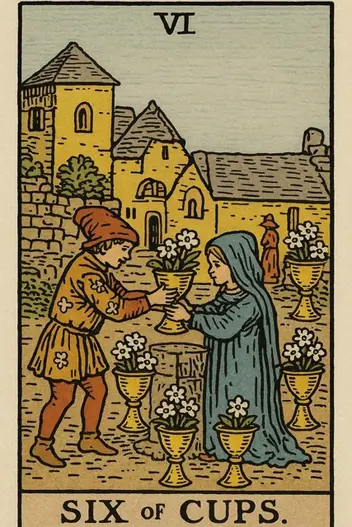

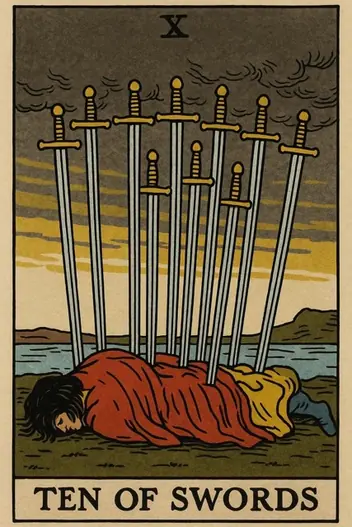
- Arcana
- Six of Cups — Minor Arcana, Cups; Ten of Swords — Minor Arcana, Swords
- Elements
- Six of Cups — Water; Ten of Swords — Air
- Elemental interaction
- Neutral elements — energies coexist without conflict
- Numerology
- 6 + 10 = 16 → 7
When the Six of Cups—a card of nostalgia, innocence, and past connections—meets the Ten of Swords—a card of brutal endings, rock bottom, and painful clarity—you are looking at a psychological collision. This combination signals that a cherished memory, an old relationship, or a comfortable pattern is being violently shattered. The mind is caught between wanting to retreat to a safer, simpler time and being forced to confront a harsh, unavoidable reality.
In pragmatic terms, this pairing asks you to distinguish between genuine emotional history and a romanticized fantasy that is no longer serving you. The Ten of Swords does not offer a gentle transition; it offers a definitive conclusion. The core challenge here is to accept the loss of what was so you can stop bleeding energy into what cannot be again.
Six of Cups and Ten of Swords Card Meaning Explained
The psychological state created by the Six of Cups and Ten of Swords is one of acute cognitive dissonance. Your emotional memory (Six of Cups) is replaying a highlight reel of a past relationship, job, or identity, while your present reality (Ten of Swords) is delivering a devastating blow that proves that chapter is over. This is not a time for hope or reconciliation; it is a time for ruthless honesty about why you are clinging to a corpse.
The key dynamic here is attachment versus acceptance. The Six of Cups represents the attachment to a "golden age" that may have never truly existed as you remember it. The Ten of Swords represents the painful but necessary data point that forces you to stop the cycle. From a Jungian perspective, this is the shadow of the Puer Aeternus (the eternal child) being confronted by the harsh reality of the Senex (the old man). You are being asked to grieve the fantasy so you can release the energy that is keeping you stuck in a loop of disappointment.
The real-world implication is clear: you cannot heal what you refuse to bury. This combination often appears when a seeker is waiting for an apology, a second chance, or a return to a former state of happiness that is logistically impossible. The most important psychological insight is that the Ten of Swords is not a punishment; it is a clarity event. It shows you exactly where the breaking point is, so you can stop investing resources into a lost cause.
Your pair is already on the table. Ask your question and draw the clarifying card
or simply focus on it
Six of Cups and Ten of Swords: Career and Money
Strategic Opportunities:
The opportunity to cut your losses permanently on a failing project, toxic workplace, or outdated business model. This is a clean break that frees up capital and mental energy.
Strategic Opportunities:
A chance to redefine your professional identity by accepting that your old role, industry, or reputation is dead. This allows you to pivot to something completely new.
Calculated Risks:
Do not chase sunk costs. Avoid the temptation to "fix" a broken deal, renegotiate a contract with a bad actor, or return to a former employer who burned you. The Ten of Swords is a definitive no.
In a career context, this pairing is a strategic warning against nostalgia-driven decisions. You may be tempted to return to a previous job, rehire a former employee, or revive an old business strategy because it "used to work." The pragmatic analysis is that the market, your skills, or the relationship has permanently changed. The Six of Cups can blind you to the fact that the opportunity is no longer viable. The most important financial warning is to avoid making emotional investments based on past loyalty. If a client or partner has shown you the "ten swords" (a final, decisive betrayal or failure), do not offer them a second drink. Use this energy to perform a ruthless audit of your professional network, cutting out anyone who has proven to be a source of repeated pain.
Six of Cups and Ten of Swords in Love and Relationships
If you are single:
This pairing warns against idealizing an ex or a past connection. You may be drawn to someone who reminds you of a former love, but the Ten of Swords signals that repeating that pattern will lead to the same painful ending. Focus on why the previous relationship ended, not on the good times.
If you are in a relationship:
This is a serious signal that a fundamental betrayal or breakdown has occurred. One partner may be clinging to "how things used to be" while the other has already mentally checked out. The relationship as you knew it is over; the only question is whether you can build something new from the ashes.
In a relationship dynamic, this combination often represents a power struggle rooted in unprocessed grief. One partner is using nostalgia as a weapon ("You used to be so caring, what happened?"), while the other is delivering the final blow of truth ("I can't do this anymore"). The key relationship advice is to stop re-litigating the past. If you are the one feeling betrayed, acknowledge the loss without demanding a return to the original state. If you are the one ending things, be clear and final—the Six of Cups energy will tempt you to soften the blow with false hope, which only prolongs the suffering. Bold boundaries are required here; the kindest thing you can do is let the ending be complete.
Uncover hidden insights
Let our advanced Tarot system interpret these archetypes specifically for your personal path.
Six of Cups and Ten of Swords Reversed: What Changes?
If the Six of Cups is reversed:
Blocked access to resources of the past. You are unable to learn from experience or cannot remember what once inspired you. This is a state of apathy where "closure" (the Ten of Swords) occurs without the possibility of processing it. Advice: Artificially evoke memories—keep a journal or reach out to old friends to reconnect with your true values.
If the Ten of Swords is reversed:
Resistance to the finale. You refuse to see the obvious end. This is a prolonged agony where the blow has already been struck, but you deny the pain. Warning: Such behavior leads to chronic stress and depression. You need to consciously accept the "death" of the old in order to begin recovery.
If BOTH are reversed:
Complete imbalance and chaos. The past offers no resource, and the future does not arrive. You are stuck in a "purgatory" of self-deception. Strategy: This is a signal for radical action. It is necessary to completely change your environment and routine. Any return to the old scenario will be destructive. The only way out is to exit the system and start from scratch, even without the support of past experience.
When Six of Cups and Ten of Swords Signal Trouble
The shadow manifestation of the Six of Cups and Ten of Swords is masochistic nostalgia. This is the cognitive bias where the seeker repeatedly revisits the scene of a psychological wound, hoping for a different outcome. You may find yourself re-reading old messages, driving past an ex's house, or dwelling on "what could have been." This is not healing; it is self-sabotage through rumination. The shadow here is the refusal to let go because the pain feels more familiar than the unknown.
Another major pitfall is victim identity. The Ten of Swords can be used as a badge of honor ("I was betrayed, I was destroyed"), while the Six of Cups provides the fuel for a martyr complex ("I was so good, I gave so much"). This combination can lead to a state of learned helplessness where you believe you are permanently damaged by a past event. The cognitive bias to watch for is the "sunk cost fallacy"—the irrational belief that because you invested so much time or emotion, you must continue to suffer. The shadow path keeps you stuck in a loop of blame and regret, rather than using the swords as a tool for decisive amputation.
Overall Meaning of Six of Cups and Ten of Swords
Constructive use of this pair's energy requires the courage to separate the wheat from the chaff. Your task is to take from the Six of Cups the pure sense of security and basic trust you experienced in the past, but to apply it toward building a new future, not toward reviving an old one. In this case, the Ten of Swords is not an enemy, but a surgeon amputating dead tissue.
Your strategic move is to perform a ritual of "grateful farewell." Make a list of what you valued in your past experience (people, projects, skills), mentally thank it for the lessons, and clearly articulate what exactly is ending right now. Do not try to save what is already dead. The energy you spend holding onto the past blocks the arrival of the new.
Use the pain of the Ten of Swords as a catalyst for purification. Finish all unfinished business, sever contracts that pull you backward, and delete contacts that evoke toxic nostalgia. Only by passing through this "death" will you make room for the next cycle, where the Six of Cups manifests as mature, conscious joy, rather than as dependence on the past.
Your Next Step: Personal Context Matters
The core message of the Six of Cups and Ten of Swords is that you must stop nursing a dead dream. The past is a reference point, not a destination. The only way to move forward is to accept the ending, grieve the loss of the idealized version, and take one concrete step toward a reality that is not defined by what you have lost.
While this article provides the general archetype, the true magic happens when Tarot is applied to your unique situation. The nuance of your specific question—whether it’s about a specific person, a career choice, or a family conflict—changes the meaning dramatically. Use the Fortune Cards app on the web or download it now to get a deep, personalized interpretation of this exact combination for your specific question. Stop guessing; start understanding your next move with clarity.
Interpretation by the Fortune Cards editorial team, based on the Rider–Waite tradition and Jungian archetypes. About our methodology · Updated: 2026-09-17
Other Combinations with Six of Cups
Other Combinations with Ten of Swords
Explore Individual Card Meanings
Table of Contents
- Six of Cups and Ten of Swords Card Meaning Explained
- Six of Cups and Ten of Swords: Career and Money
- Six of Cups and Ten of Swords in Love and Relationships
- Six of Cups and Ten of Swords Reversed: What Changes?
- When Six of Cups and Ten of Swords Signal Trouble
- Overall Meaning of Six of Cups and Ten of Swords
- Your Next Step: Personal Context Matters
Ready to find answers to your questions?
Start your first reading now and look at your situation with fresh clarity. The cards are ready to reveal deeper meaning.