Love Tarot: Six of Cups and Five of Swords
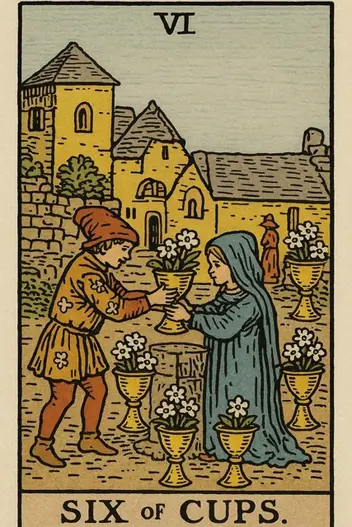

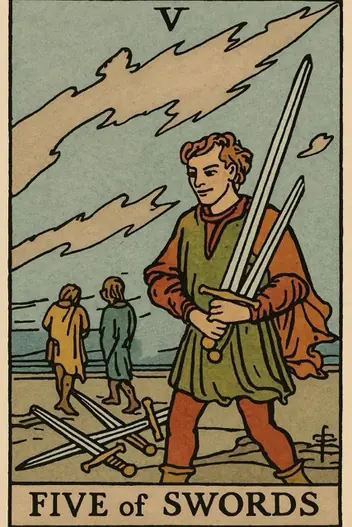
- Arcana
- Six of Cups — Minor Arcana, Cups; Five of Swords — Minor Arcana, Swords
- Elements
- Six of Cups — Water; Five of Swords — Air
- Elemental interaction
- Neutral elements — energies coexist without conflict
- Numerology
- 6 + 5 = 11 → 2
The collision of the Six of Cups and Five of Swords represents a powerful psychological tension: the desire to return to a safe, idealized past versus the harsh reality of a present conflict. The Six of Cups embodies nostalgia, innocence, and emotional generosity—a yearning for simpler times or a reconnection with a cherished memory. The Five of Swords, in contrast, is the archetype of victory at a cost, betrayal, and cold calculation—a card that often signals a win that leaves emotional wreckage in its wake.
When these two cards appear together, they suggest a situation where past attachments are being weaponized in a current power struggle, or where a seemingly kind gesture is masking a deeper competitive agenda. This combination forces a pragmatic question: Are you holding onto a memory that is now being used against you, or are you using your own past kindness as a shield to avoid confronting an uncomfortable truth?
Six of Cups and Five of Swords Combination Meaning
The core dynamic here is a conflict between emotional memory and strategic reality. The Six of Cups asks you to trust, share, and reconnect; the Five of Swords warns that someone—possibly you—is keeping score. This pairing often reveals a cognitive dissonance: you want to believe the best in someone (Six of Cups), but their actions suggest a winner-take-all mentality (Five of Swords). The psychological state is one of ambivalence—feeling pulled between the comfort of past loyalty and the sting of present defeat.
In practical terms, this combination signals a betrayal of trust wrapped in a familiar package. The person or situation involved may feel like "old times," but the underlying dynamic is toxic. Alternatively, it could represent your own internal conflict: you are trying to resolve a current argument by appealing to shared history, but that history is now a liability. The key insight is that nostalgia can blind you to power imbalances. You must ask yourself: Is this connection truly safe, or am I using fond memories to justify staying in a losing battle?
This energy demands emotional intelligence mixed with strategic caution. You cannot afford to be purely sentimental here. The Five of Swords requires you to assess the actual costs of winning or losing this interaction. Are you fighting for a relationship that no longer exists? Or are you refusing to let go of a past version of yourself that is no longer viable? The most pragmatic approach is to honor the memory without being ruled by it.
Your pair is already on the table. Ask your question and draw the clarifying card
or simply focus on it
What Do Six of Cups and Five of Swords Indicate for Your Career?
Strategic Opportunities:
Leverage your past network or a trusted mentor to resolve a current workplace conflict. Your history of goodwill can be a bridge, not a weapon.
Strategic Opportunities:
Use your knowledge of past project failures to avoid repeating the same mistakes. Data from previous cycles is your best asset.
Calculated Risks:
Do not enter a negotiation assuming past loyalty will protect you. The Five of Swords suggests someone is ready to undercut you for personal gain.
In the professional realm, this combination is a red flag for office politics and competitive environments. The Six of Cups can represent a return to a former role, company, or client, while the Five of Swords warns that the landscape has changed. What worked before may now be a weakness. For example, you might be offered a job at a previous employer, but the culture may have shifted to a cutthroat, zero-sum atmosphere. The financial warning here is clear: do not trade on past relationships without verifying the present terms.
For entrepreneurs and freelancers, this pairing suggests a conflict between brand loyalty and market reality. You may feel a sentimental attachment to a product, service, or client relationship, but the numbers tell a different story. The strategic move is to honor the past contributions while making a hard, data-driven decision about the future. If you are in a negotiation, do not assume the other party will reciprocate your goodwill. The Five of Swords advises you to protect your interests, document agreements, and walk away if the terms are not fair, regardless of history.
Six of Cups and Five of Swords in Love Tarot
If you are single:
This combination warns against idealizing a past partner or a new connection that feels like "coming home." Be wary of someone who uses shared history to manipulate your trust. The chemistry may be real, but the motives may not be.
If you are in a relationship:
You may be stuck in a cycle of rehashing old arguments. One partner is clinging to a "golden past" while the other is focused on winning the current fight. This is a sign to stop keeping score and address the root conflict.
In romantic dynamics, the Six of Cups and Five of Swords together often point to a relationship where one person feels they are sacrificing for the other, while the other feels they are constantly being defeated. This is a classic power struggle disguised as care. For example, a partner may say, "I’m doing this for us," but the underlying action is controlling or dismissive. The critical relationship advice here is to distinguish between genuine generosity and passive-aggressive debt collection.
If you are in a relationship, avoid using past favors as ammunition in current disagreements. This combination signals that unresolved resentment is poisoning the well. Instead, ask: "What am I truly afraid of losing?" The answer is often not the person, but the fantasy of a conflict-free past. The path forward requires honest communication about what each person actually needs now, not what they needed then.
Ask your specific question
Don't rely on generic meanings. Get a customized reading tailored specifically to your energies.
Shadow Side & Pitfalls
The shadow manifestation of this combination is emotional manipulation disguised as kindness. You—or someone in your life—may be using past generosity as a tool for control. For example, "After everything I did for you, how can you disagree with me?" This is a cognitive bias known as the sunk cost fallacy: you continue investing in a losing situation because you have already given so much. The Six of Cups can also trigger rose-colored retrospection, where you selectively remember only the good parts of a relationship, ignoring the conflicts that led to the current breakdown.
Another major pitfall is self-sabotage through guilt. You may feel obligated to "save" a person or project from the past, even when it is clearly toxic. This is a shadow of the Six of Cups—codependency—meeting the shadow of the Five of Swords—ruthlessness. The result is a cycle where you give too much, feel resentful, then lash out in a way that destroys the very connection you were trying to preserve. The most dangerous move here is to believe that winning the argument is the same as healing the relationship. It is not. The real win is recognizing when to walk away with your dignity intact.
Reversed Six of Cups and Five of Swords Explained
If the Six of Cups is Reversed:
Blocked potential or detachment from roots. You cannot or will not rely on past experience. In combination with the upright Five of Swords, this indicates blind aggression. You rush into battle without strategy or support. Advice: stop. You need to find at least one anchor point in the past before engaging in conflict.
If the Five of Swords is Reversed:
Internal resistance, weakness, or secret defeat. You cannot or will not fight. The energy of the Six of Cups takes over — you simply retreat into memories, surrendering without a fight. Warning: this is a path of passive aggression and accumulating grievances. You are not solving the problem; you are burying it deeper.
If BOTH are Reversed:
Complete imbalance of dynamics. This is a state of "neither war nor peace." You can neither let go of the past nor end the current conflict. The situation stagnates in a swamp of fruitless regrets and unspoken grievances. Logical way to correct it: make a decision. Either you consciously sever the connection with the past (accept the loss), or you consciously enter into an open dialogue (accept the conflict). Half-measures are destructive.
Synthesis: Strategic Conclusion
How to constructively use the energy of this pair? You need to transform "nostalgia" into "strategic experience" and "aggression" into "decisiveness." The Six of Cups provides you with a valuable archive of data: you know what worked before, what mistakes have already been made, which people have been tested by time. The Five of Swords gives you the tool for tough but necessary decisions.
Strategic advice: use the past as a map, not as a refuge. If you are in a conflict, do not recall "how good it was" to start crying. Recall "how we solved the problem then" to find an algorithm for action. The energy of the Five of Swords should be directed not at destroying an opponent, but at destroying outdated behavioral patterns. Your goal is not to win a war, but to exit a toxic system.
The main conclusion: this combination demands that you grow up. Stop being a "child" who cries over a lost paradise, and become an "adult" who makes complex decisions, relying on the experience of the past, but not being bound by it. The only way to balance these energies is to accept the loss. Acknowledge that the "good old days" are over. Once you do this, the aggression of the Five of Swords will cease to be destructive and will become the energy for building a new, more stable foundation. Your strength lies in the ability to let go of the past in order to win the future.
Where to Go From Here
The core message of the Six of Cups and Five of Swords is this: You cannot build a future on the ruins of an idealized past. Honor the memories that shaped you, but do not let them become a prison. The conflict you face is not about winning—it is about choosing between what is familiar and what is healthy. Whether in love, career, or personal growth, the path forward requires you to separate genuine care from emotional debt.
To discover exactly how this combination applies to your unique situation, use the Fortune Cards app. While this article gives you the general archetype, the true magic happens when Tarot is applied to your specific question. The app can provide a deep, personalized interpretation of this exact combination for your relationship, career, or life decision right now. Download the Fortune Cards app or use it on the web to get your tailored reading today.
Interpretation by the Fortune Cards editorial team, based on the Rider–Waite tradition and Jungian archetypes. About our methodology · Updated: 2026-08-26
Other Combinations with Six of Cups
Other Combinations with Five of Swords
Explore Individual Card Meanings
Table of Contents
Ready to find answers to your questions?
Start your first reading now and look at your situation with fresh clarity. The cards are ready to reveal deeper meaning.