Four of Cups and Six of Cups Reversed in Tarot

- Arcana
- Four of Cups — Minor Arcana, Cups; Six of Cups — Minor Arcana, Cups
- Elements
- Four of Cups — Water; Six of Cups — Water
- Elemental interaction
- Same element — energies intensify each other
- Numerology
- 4 + 6 = 10 → 1
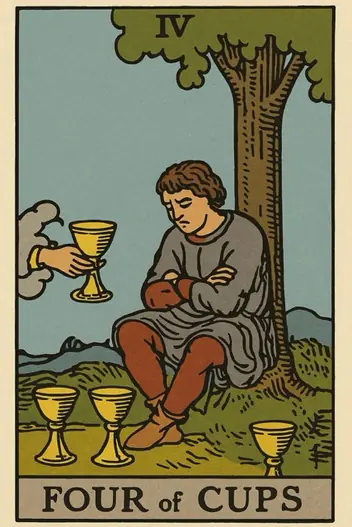
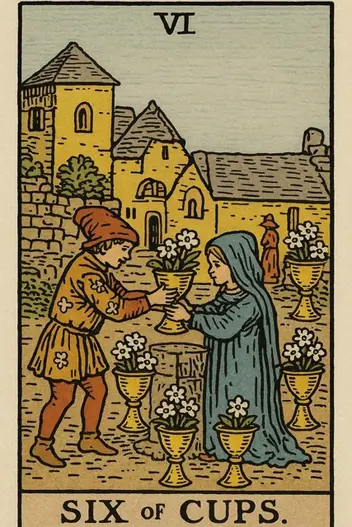
When the Four of Cups meets the Six of Cups, we witness a collision between emotional withdrawal and sentimental recall. The Four of Cups represents a state of apathy, contemplation, and missed opportunities—the feeling that nothing new is worth your attention. The Six of Cups, conversely, evokes innocence, nostalgia, and reconnecting with past joys or people. Together, they create a psychological paradox: you are simultaneously disengaged from the present while being drawn back to what once was. This combination often signals a critical decision point where your emotional history can either anchor you in growth or trap you in a comfortable but stagnant past.
Four of Cups and Six of Cups Card Meaning Explained
At its core, this pairing reveals a mindset of selective attention. The Four of Cups suggests you are actively filtering out present-moment opportunities—perhaps because they feel repetitive, unworthy, or overshadowed by past experiences. The Six of Cups then introduces a memory-driven lens that colors your current perception. You might be idealizing a previous relationship, job, or life phase, comparing it unfavorably to your current reality. This creates a cognitive bias known as "rosy retrospection": the tendency to remember the past as better than it actually was, while ignoring its flaws.
Psychologically, this combination indicates a defense mechanism against vulnerability. By fixating on what you’ve already experienced, you avoid the risk of engaging with something new that might disappoint you. The strategic challenge here is to distinguish between genuine emotional wisdom and escapist nostalgia. The Six of Cups can offer valuable lessons from your past—but only if you’re willing to apply them to the present, rather than retreating into a fantasy. The key action is to acknowledge your emotional withdrawal, then consciously shift focus to what is actually available now, even if it feels less familiar.
Four of Cups and Six of Cups for Career and Money
Strategic Opportunities:
Revisit old professional networks or mentors—a past contact may offer a bridge to a new opportunity. This is a good time to renegotiate terms on an existing project or contract, leveraging your experience.
Strategic Opportunities:
Use your past successes as proof of competence when pitching new ideas or applying for roles. The Six of Cups supports leveraging your track record without being trapped by it.
Calculated Risks:
Avoid accepting a job or deal solely because it reminds you of a past "golden era." Be wary of romanticizing a previous role or company while ignoring the reasons you left. Do not make financial decisions based on sentimentality alone—run the numbers objectively.
In your professional life, this combination suggests a tension between comfort and growth. You may feel bored or undervalued in your current role (Four of Cups), but a tempting offer from a former colleague or a return to an old industry (Six of Cups) could appear. The strategic move is to evaluate the opportunity on its current terms, not on the emotional memory attached to it. Ask yourself: “If this chance came from a stranger, would I still take it?” If the answer is no, you’re likely being seduced by nostalgia. Financially, this pair warns against impulsive spending on items that trigger past memories (e.g., buying an old car you once loved without checking its condition). Focus on pragmatic budgeting and future-proofing your investments rather than chasing emotional comfort.
Your pair is already on the table. Ask your question and draw the clarifying card
or simply focus on it
Four of Cups and Six of Cups as Feelings
If you are single:
This pair often indicates you are comparing new prospects to an idealized past partner or relationship. You may be rejecting perfectly good connections because they don’t trigger the same emotional high as a previous experience. Challenge yourself to evaluate people on their current merits, not against a memory.
If you are in a relationship:
You or your partner may be emotionally checked out, using past grievances or nostalgia as a shield against present intimacy. This can manifest as passive-aggressive withdrawal or a tendency to say "I miss how things used to be" without taking action to improve the current dynamic.
In relationships, the Four of Cups and Six of Cups together signal a dangerous emotional stalemate. One partner may feel ignored or unappreciated (Four of Cups energy), while the other retreats into nostalgic memories of a "better time" (Six of Cups). This creates a feedback loop of disconnection: the more one withdraws, the more the other clings to the past. The most effective intervention is direct, non-accusatory communication. For example, instead of saying "You never pay attention to me," try "I feel disconnected lately. Can we talk about what we both miss from our early days and how we can recreate that feeling now?" Bold honesty about your own apathy or nostalgia is the first step to breaking the cycle. If you’re single, resist the urge to ghost or ignore new connections because they don’t perfectly match a memory—give them a real chance to surprise you.
Uncover hidden insights
Let our advanced Tarot system interpret these archetypes specifically for your personal path.
Four of Cups and Six of Cups Reversed Meaning
If the Four of Cups is Reversed:
This removes the blockage of apathy. The person stops "sleepwalking" and begins to see opportunities. However, paired with an upright Six of Cups, this can lead to reckless impulsive action. You grab at the first opportunity that reminds you of a pleasant past, without checking its relevance. Advice: Slow down. Don't confuse "awakening" with "fever."
If the Six of Cups is Reversed:
This indicates an internal resistance to memories or a rejection of valuable experience. The person is so stuck in the Four (apathy) that they actively repress any positive memories that could serve as a resource. This exacerbates the depressive state. Advice: Intentionally return to your past successes, write them down to remind yourself of your own effectiveness.
If BOTH are Reversed:
Complete imbalance. The person simultaneously rejects the present (Four) and destroys the past (Six). A state of total disorientation and cynicism arises. This requires not a strategy, but basic cognitive restructuring. Advice: The only logical way to fix this is to introduce strict discipline. Make a schedule for the week and follow it, without relying on emotions. Only action will pull you out of this tailspin.
The Shadow Side of Four of Cups and Six of Cups
The shadow of this combination is emotional stagnation disguised as reflection. You may convince yourself you are “taking time to think” when you are actually avoiding decisive action out of fear or entitlement. The Four of Cups’ apathy can morph into passive resentment—blaming external circumstances for your lack of fulfillment while refusing to engage with available options. Meanwhile, the Six of Cups’ nostalgia can become toxic idealization: you might view past relationships, jobs, or life phases as perfect, conveniently forgetting the pain or boredom that accompanied them. This cognitive distortion leads to decision paralysis—you reject the present because it’s not “as good” as a memory that never really existed. The biggest pitfall is using the past as an excuse to stay stuck in a comfortable but unsatisfying present. Watch for signs of self-sabotage like ghosting, procrastination, or suddenly reviving old grudges.
Four of Cups and Six of Cups: Tarot Advice
How to constructively use the energy of this pair? The key lies in translating nostalgia from an emotional into an analytical plane. The Six of Cups is not merely "good memories"—it is a database of your successful strategies. The Four of Cups is not just "laziness"—it is an indicator that the current reward system is not working. Your task is to make these cards work for you, not against you.
The "Archaeologist" Strategy:
Imagine the past as an archaeological layer. You are not trying to live in it; you are searching it for artifacts (skills, connections, knowledge) that can be used in a modern context. Take one vivid memory of success from the Six and ask yourself: "What specific action did I take then? What quality did I manifest? How can I apply this same principle, but in a new form, today?" This shifts the focus from passive experience to active construction.
In this synthesis, the Four of Cups becomes not an enemy, but a filter. It grants you a pause, so you don't grasp at the first illusion that appears. Use this pause for analysis, not apathy. A deep strategic counsel: accept the fact that past experience is a map, not the territory. You can consult the map, but you must walk on new, unfamiliar ground. Only then will the energy of nostalgia become fuel for movement, rather than an anchor holding you in place.
Applying This to Your Situation
The Four of Cups and Six of Cups together ask you to stop comparing your present to an idealized past. The core message is that nostalgia is a compass, not a destination—it can guide you toward what you truly value, but you must still navigate the present with fresh eyes. Your next step is to acknowledge your apathy or withdrawal, then actively choose one small opportunity in front of you—even if it feels underwhelming.
To apply this insight to your unique situation, use the Fortune Cards app. While this article explains the general archetype, the true magic happens when Tarot is tailored to your specific question—whether it’s about a relationship, career move, or personal block. The app provides a deep, personalized interpretation of this exact combination for your current context, helping you turn psychological insight into actionable strategy. Download it now or use it on the web to get your custom reading.
Interpretation by the Fortune Cards editorial team, based on the Rider–Waite tradition and Jungian archetypes. About our methodology · Updated: 2026-09-17
Other Combinations with Four of Cups
Other Combinations with Six of Cups
Explore Individual Card Meanings
Table of Contents
- Four of Cups and Six of Cups Card Meaning Explained
- Four of Cups and Six of Cups for Career and Money
- Four of Cups and Six of Cups as Feelings
- Four of Cups and Six of Cups Reversed Meaning
- The Shadow Side of Four of Cups and Six of Cups
- Four of Cups and Six of Cups: Tarot Advice
- Applying This to Your Situation
Ready to find answers to your questions?
Start your first reading now and look at your situation with fresh clarity. The cards are ready to reveal deeper meaning.