Seven of Wands
- Arcana
- Minor Arcana, Suit of Wands
- Element
- Fire
- Decan
- Mars in Leo
- Numerology
- 7
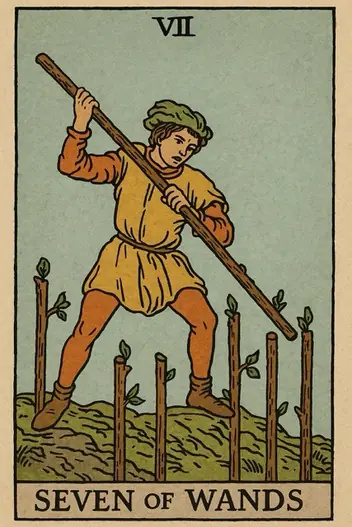
The Seven of Wands represents the archetype of the Underdog Defender—a figure standing on higher ground, warding off attacks from below. In Jungian terms, this card embodies the Hero’s Crucible, a moment where your boundaries are tested, and you must assert your will against external opposition. This is not a card of aggression, but of strategic resilience: you have chosen a hill to die on, and now you must hold it.
The central challenge of this card is resource allocation under pressure. You are outnumbered or outgunned, but you hold a positional advantage. The core psychological task is to distinguish between threats that require a response and distractions that drain your energy. This card asks you to be defensive without being paranoid, and to fight only for what is genuinely worth protecting.
Seven of Wands: Core Meaning and Interpretation
The Seven of Wands upright signals a phase of active defense. You have likely achieved a level of competence or status that now attracts scrutiny, competition, or outright challenge. This is a healthy stress response: your nervous system is alert, your focus is narrowed, and you are mobilizing resources to protect your interests. The psychological state is one of controlled vigilance, where paranoia is kept in check by clear priorities.
The key insight is that not every attack requires a counterattack. The card’s image—a single figure on a hill—suggests you have the high ground. Use it to assess which battles are worth your energy. Your primary resource here is positional leverage: your expertise, reputation, or past efforts have placed you in a defensible spot. Do not abandon your stronghold to chase every opponent. Instead, let them exhaust themselves on your defenses. The pragmatic mindset is to conserve energy for decisive strikes rather than spreading yourself thin.
Ask your question and flip the cards
or simply focus on it
Is Seven of Wands a Yes or a No?
Leaning yes.. The Seven of Wands signals a defensive posture, not a flat refusal. The figure on the card stands on high ground, wielding a staff against six others rising from below—this indicates that the answer is conditional on your willingness to fight for it. In a yes/no context, the energy is one of sustained effort rather than easy flow; the outcome favors you if you can hold your position without backing down. Reversed, the card suggests you may be abandoning the fight prematurely or feeling overwhelmed, shifting the answer toward no unless you can reclaim your stance. The critical caveat: the result depends entirely on whether you can maintain psychological boundaries and refuse to internalize opposition as rejection.
Ask your specific question
Don't rely on generic meanings. Get a customized reading tailored specifically to your energies.
Card of the Day
The main vector of the day is defensive momentum—you are being asked to protect your progress, not to advance further. Focus on consolidating your gains and reinforcing your personal limits, especially where others may try to undermine or encroach on your work. Take specific actions like saying “no” to additional requests, repeating your position calmly, and physically stepping back to observe the battlefield from a higher vantage point. Avoid the trap of over-explaining your stance or getting drawn into emotional arguments, as the card warns that others’ aggression is often a projection of their own insecurity. Also avoid isolating yourself so completely that you miss potential allies who share your high ground.
Seven of Wands in Love and Relationships
If you are not in a relationship:
You are likely attracting partners who test your boundaries. This card suggests you need to define your standards clearly before engaging. Do not compromise your core values just to gain approval. The right partner will respect your defensive stance, not resent it.
If you are in a relationship:
The dynamic is about power balance and boundary negotiation. You may feel the need to defend your autonomy or personal space against a partner’s demands. This is healthy if handled with communication, but dangerous if it turns into a cold war of silent resentment.
The behavioral pattern here is defensiveness as a shield, not a weapon. In relationships, the Seven of Wands warns against turning every disagreement into a battle for dominance. The practical advice is to distinguish between a genuine threat to the relationship and a simple difference of opinion. Use active listening to lower the stakes before you raise your defenses. If you feel attacked, pause and ask: “Is this about me, or about something we need to solve together?” Emotional intelligence means knowing when to hold the line and when to lower the shield.
What Does Seven of Wands Say About Their Feelings?
This person perceives you as a formidable, self-possessed figure—someone who occupies a position they either envy or feel threatened by. You evoke in them a mix of respect and competitive tension; they see you as someone who has something they want, whether that is status, clarity, or emotional independence. Their hidden intention is to test your resilience, to see if you will hold your ground or waver under pressure—your steadiness both fascinates and unsettles them. They may harbor a fear that you are inaccessible or judgmental, yet they are also drawn to the challenge you represent. Internally, they are conflicted: part of them wants to knock you off your pedestal, while another part secretly hopes you will prove unshakeable, as your stability offers them a reference point for their own growth. The core dynamic is not hostility, but a psychological sparring match where they are measuring their own worth against your perceived certainty.
Career and Finance
Strategic Opportunities:
A career breakthrough is possible if you defend your niche. You have a specialized skill or unique insight that competitors are trying to undermine. Double down on your expertise rather than diversifying into weaker areas.
Resource Management:
Your financial stability depends on consolidating gains. This is a time to protect existing assets, not to chase high-risk investments. Reinforce your current income streams before expanding.
Calculated Risks:
Avoid overextending your resources in turf wars. Office politics or market battles can drain your capital and morale. Know when to disengage from a losing fight.
The decision-making framework here is simple: prioritize defense over expansion. In a competitive environment, the Seven of Wands advises you to strengthen your moat—whether that’s through better contracts, stronger client relationships, or more efficient processes. The financial warning is clear: do not spend money to prove a point. Every dollar used to fight a competitor should be justified by a clear, measurable return. If the battle is purely about ego, you have already lost.
Seven of Wands Reversed: What Changes
When the Seven of Wands appears reversed, the defensive posture becomes dysfunctional. The high ground is abandoned, or the defender becomes paranoid and isolated. Instead of strategic resistance, you see overreaction to minor threats or, conversely, passive surrender when you should have fought. This reversal signals blocked potential: you have the resources to defend yourself, but you are either too exhausted to use them or too proud to ask for help.
The warning in this position is about burnout and self-sabotage. You may be fighting battles that no longer matter, or you may have given up on a position worth holding. The logical correction is to reassess your priorities with ruthless honesty. Ask yourself: “Am I defending something real, or am I just afraid of change?” If the latter, it is time to lower your shield and adapt. If the former, mobilize support—the reversed card often indicates a refusal to delegate or accept help. You cannot hold the hill alone forever.
What Are the Pitfalls of Seven of Wands?
The shadow of the Seven of Wands manifests as paranoid defensiveness. You see enemies everywhere, interpreting neutral events as personal attacks. This leads to cognitive biases like hostile attribution bias, where you assume malicious intent in others’ actions. The result is chronic stress, social isolation, and wasted energy on imaginary threats. Another common pitfall is perfectionism disguised as defense: you refuse to release work or ideas because you fear criticism, effectively sabotaging your own progress.
Self-sabotage also appears as a refusal to compromise. The defender becomes rigid, mistaking flexibility for weakness. This can destroy relationships and career opportunities. The deeper fear is often vulnerability: you are not defending a position, but your ego. To counteract this, practice reality-testing: ask a trusted colleague or friend if your perception of a threat is accurate. The shadow wants you to fight alone; the light asks you to discern wisely.
Synthesis: Strategic Conclusion
The Seven of Wands is a card of controlled conflict—it is not an invitation to war, but a call to protect what you have built with discipline and intelligence. To use this energy constructively, you must first clearly define your non-negotiables. What is worth fighting for? A core value? A key relationship? A professional reputation? Write it down. Then, assess your current defenses: are they robust enough, or are you relying on bluffing and hope?
Strategic advice: adopt a “cost-benefit” mindset for every confrontation. Before reacting, calculate the emotional, social, and financial cost of the battle. If the potential gain does not exceed the cost, disengage gracefully. This is not cowardice; it is resource optimization. The Seven of Wands rewards those who fight smart, not those who fight often. The ultimate victory is not the defeat of your opponents, but the preservation of your energy for what truly matters.
Finally, build alliances before you need them. The lone defender on the hill is a powerful image, but in reality, isolation is a liability. Invest in relationships that will have your back when the attacks come. This card’s deepest lesson is that true strength is not in standing alone, but in knowing when to stand with others.
Applying This to Your Situation
This psychological and strategic breakdown provides a deep understanding of archetypes. However, Tarot is never universal for everyone. To understand exactly how this dynamic applies to your specific situation, a reading tailored exclusively to you is necessary.
Download the Fortune Cards app or visit our platform to get a deep AI interpretation of your unique spread. Don't just read about the cards—use Fortune Cards to find out exactly what step you need to take next.
Try Tarot Spreads with Seven of Wands
Interpretation by the Fortune Cards editorial team, based on the Rider–Waite tradition and Jungian archetypes. About our methodology · Updated: 2026-08-26
Top Combinations with Seven of Wands
Discover how Seven of Wands interacts with other major cards in the deck to form powerful messages.
All 77 Combinations with Seven of Wands
Discover how this card interacts with every other card in the Tarot deck and reveal hidden meanings.
Table of Contents
- Seven of Wands: Core Meaning and Interpretation
- Is Seven of Wands a Yes or a No?
- Card of the Day
- Seven of Wands in Love and Relationships
- What Does Seven of Wands Say About Their Feelings?
- Career and Finance
- Seven of Wands Reversed: What Changes
- What Are the Pitfalls of Seven of Wands?
- Synthesis: Strategic Conclusion
- Applying This to Your Situation
Explore Tarot Universe
Ready to find answers to your questions?
Start your first reading now and look at your situation with fresh clarity. The cards are ready to reveal deeper meaning.