Seven of Wands and Two of Pentacles Together in Tarot
- Arcana
- Seven of Wands — Minor Arcana, Wands; Two of Pentacles — Minor Arcana, Pentacles
- Elements
- Seven of Wands — Fire; Two of Pentacles — Earth
- Elemental interaction
- Neutral elements — energies coexist without conflict
- Numerology
- 7 + 2 = 9
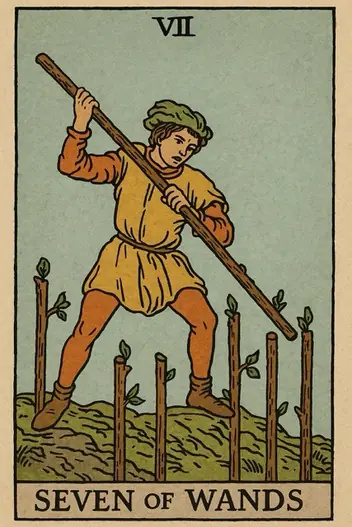
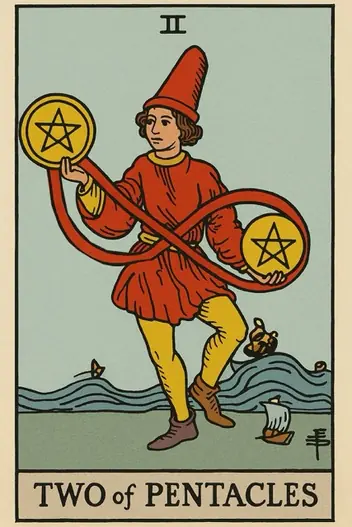
When the Seven of Wands—the archetype of standing your ground, defending your position, and asserting boundaries—collides with the Two of Pentacles—the archetype of juggling multiple priorities, adapting to change, and managing resources—the result is a high-stakes psychological dance. You are not merely fighting for a single front; you are fighting to keep multiple spinning plates from crashing down while someone or something challenges your footing.
This combination reveals a person who is actively defending their capacity to manage life’s chaos. It is not a passive state of overwhelm, but a conscious, strategic struggle. The core question becomes: How do you protect your priorities without dropping everything else? The answer lies in ruthless prioritization and emotional compartmentalization.
Seven of Wands and Two of Pentacles Combination Meaning
The psychological state created by this pairing is one of guarded agility. You are hyper-aware that external pressures (the Seven of Wands’ “attackers”) are threatening your carefully maintained equilibrium (the Two of Pentacles’ balancing act). This is not a time for grand, sweeping changes; it is a time for defensive maneuvers and micro-adjustments. The mind is sharp, but it can easily tip into paranoid defensiveness if you over-identify with the need to protect every single aspect of your life.
The core dynamic is a resource allocation problem. You have a limited amount of energy, attention, and time (Two of Pentacles). The Seven of Wands demands that you use that energy to push back, say “no,” and reinforce your borders. The key is to identify which battles are worth your energy and which are distractions. The cards together suggest you are likely winning the fight, but at a high cost of mental bandwidth. You may feel like you are constantly reacting rather than acting, which is a cognitive drain.
In real-world terms, this could mean a professional who is defending their workload from a demanding boss while simultaneously managing a side project and family obligations. It is a survival mindset that requires constant recalibration. The psychological danger is burnout from over-vigilance. The strategic victory lies in learning to let some small balls drop so you can keep the essential ones in the air.
Career and Finances
Strategic Opportunities:
Re-negotiate your workload. Use the defensive energy of the Seven of Wands to assert your capacity limits. This is a powerful time to ask for a deadline extension or to delegate a task. Your current position is strong enough to demand respect.
Strategic Opportunities:
Leverage your adaptability. Your ability to juggle multiple projects (Two of Pentacles) is your biggest asset right now. Use it to protect your most valuable project from being sidelined by less important tasks. Focus on the one or two tasks that generate the most value.
Calculated Risks:
Avoid taking on new commitments. The biggest risk is overloading your system. Saying “yes” to a new opportunity now will likely cause you to drop a critical existing ball. Guard your calendar with suspicion.
In a career context, this is a defensive posture with high operational demands. You are likely in a role that requires you to manage competing priorities while simultaneously defending your decisions or your team’s output. Financially, the advice is clear: do not make large, volatile investments. The Two of Pentacles favors balancing and adjusting existing budgets, not making bold moves. The Seven of Wands warns against financial defensiveness—don’t hoard money out of fear, but do protect your cash reserves.
The strategic tip is to use a “triage” mindset. Identify the one financial obligation or career goal that is most under attack. Focus your defensive energy there. Boldly cut any expense or project that is not essential to your core survival. This is a time for conservation, not expansion.
Your pair is already on the table. Ask your question and draw the clarifying card
or simply focus on it
Seven of Wands and Two of Pentacles in Love Tarot
If you are single:
This combination suggests you are protecting your emotional availability while being pulled in multiple directions. You may be dating multiple people or have a demanding life that makes commitment feel like a threat to your stability. The advice is to defend your time ruthlessly—only invest in a connection that respects your boundaries and doesn’t feel like another “ball to juggle.”
If you are in a relationship:
You are likely in a period where you feel the need to defend your personal space and autonomy within the partnership. There may be external stressors (work, family, finances) that make you feel like you are constantly negotiating for your own needs. Communication can feel like a tug-of-war.
In relationships, this pairing often points to a power struggle over time and priorities. One or both partners feel they are fighting for attention or fighting for control over the shared schedule. The psychological dynamic is about boundary negotiation. You may be unconsciously projecting your external stress onto your partner, turning them into an “opponent” when they are actually an ally.
The key relationship advice is to separate the external threats from the internal ones. Ask yourself: Am I fighting my partner, or am I fighting the world and taking it out on my partner? Boldly state your need for a “time-out” to recalibrate. Use the Two of Pentacles’ flexibility to schedule quality time, rather than fighting for spontaneous connection. The win here is not about winning an argument, but about protecting the core of the relationship from your own burnout.
Uncover hidden insights
Let our advanced Tarot system interpret these archetypes specifically for your personal path.
Shadow Side & Pitfalls
The shadow of this combination is paralyzing defensiveness and self-sabotage through overcommitment. The cognitive bias at play is loss aversion—you become so focused on not losing ground that you fail to see opportunities for strategic retreat or collaboration. You may start fighting phantom enemies, seeing threats in neutral situations because you are already on high alert.
Another pitfall is fragmentation of identity. The Two of Pentacles can make you feel like you are “many selves” trying to manage many roles, while the Seven of Wands demands a singular, unified front. This can lead to imposter syndrome—you feel like a fraud because you are barely holding it together. The irrational action is to isolate yourself, believing that no one can help you juggle or defend. This is a prime setup for burnout and resentment.
Finally, there is a risk of poor judgment under pressure. When you are constantly defending and juggling, your decision-making becomes reactive and short-sighted. You might make a snap decision to quit a job or end a relationship simply to reduce the load, when a more measured approach (like asking for help) would be far more effective. The shadow demands you slow down, even when the world is screaming at you to fight.
What If Seven of Wands or Two of Pentacles Appears Reversed?
If the Seven of Wands is Reversed:
Defense becomes reckless or meaningless. You either surrender without a fight or, conversely, attack where it's unnecessary. Advice: Re-evaluate whether the threat is truly real. You may be wasting energy on an imaginary enemy while ignoring real problems.
If the Two of Pentacles is Reversed:
Inner resistance and chaos. You cannot maintain balance; resources are slipping through your fingers. Warning: This state leads to procrastination and overload. Stop trying to do everything at once. Choose one task and see it through to completion.
If BOTH are Reversed:
Complete dynamic imbalance. You simultaneously feel under attack and incapable of managing the situation. This leads to paralysis of the will. Logical method for correction: a complete reset of priorities. Temporarily abandon all secondary obligations to regain control over basic functions (daily routine, finances).
Synthesis: Strategic Conclusion
The energy of the Seven of Wands should be directed not toward total defense, but toward selective protection of key positions. Ask yourself: what exactly am I defending? If it is your self-esteem, reputation, or a key project — stand your ground to the end. But if you are defending a habitual order of things that has already become obsolete — allow the Two of Pentacles to redistribute resources toward something new.
Strategic advice: use the "divide and conquer" tactic. Break a large problem down into small tasks. The Seven of Wands will help you repel attacks on each of them individually, while the Two of Pentacles will help maintain the overall balance. Do not try to solve everything at once — this will lead to exhaustion.
The deep insight of this union is that true strength lies not in rigidity, but in adaptability. You can win a battle by standing still, but the war is won by those who know when to retreat and regroup. Accept that some "losses" (time, money, relationships) are the price for a strategic advantage.
Where to Go From Here
The core message of the Seven of Wands and Two of Pentacles is this: You have the strength to defend your stability, but only if you choose your battles wisely. You are not a victim of circumstance; you are a strategic operator managing a complex system. The victory lies not in fighting every battle, but in protecting your most essential priorities with ruthless efficiency.
Your next step is to apply this archetype to your specific life. The general interpretation is powerful, but the true insight comes when you ask: What exactly am I defending? What is the one ball I cannot afford to drop?
To get that personalized clarity, use the Fortune Cards app. This article gives you the map, but the app gives you the compass. By inputting your specific question—about a relationship, a career move, or a financial decision—the app will deliver a deep, custom interpretation of this exact combination for your unique situation. You can use it on the web or download it to your phone. Stop guessing. Start strategizing. Download Fortune Cards now.
Interpretation by the Fortune Cards editorial team, based on the Rider–Waite tradition and Jungian archetypes. About our methodology · Updated: 2026-08-26
Other Combinations with Seven of Wands
Other Combinations with Two of Pentacles
Explore Individual Card Meanings
Ready to find answers to your questions?
Start your first reading now and look at your situation with fresh clarity. The cards are ready to reveal deeper meaning.