Ten of Cups and Four of Pentacles Tarot as Feelings
- Arcana
- Ten of Cups — Minor Arcana, Cups; Four of Pentacles — Minor Arcana, Pentacles
- Elements
- Ten of Cups — Water; Four of Pentacles — Earth
- Elemental interaction
- Friendly elements — energies support each other
- Numerology
- 10 + 4 = 14 → 5
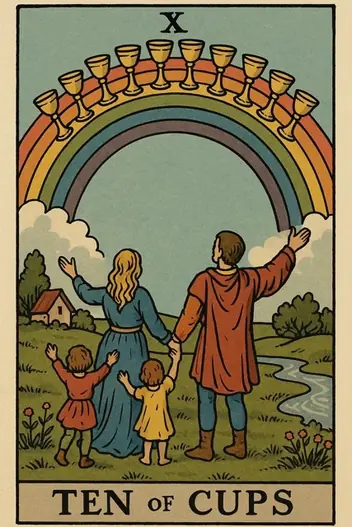
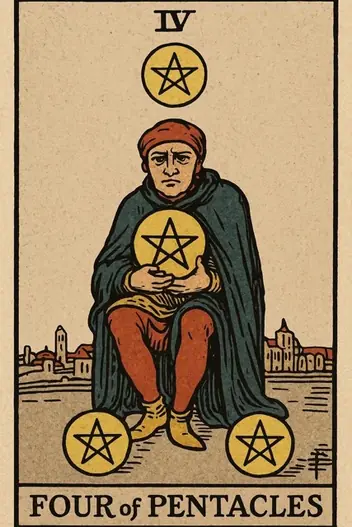
The collision of the Ten of Cups and the Four of Pentacles represents a fundamental tension between emotional fulfillment and material control. The Ten of Cups embodies the archetype of the "Happy Family"—a state of complete emotional harmony, unconditional love, and communal joy. In contrast, the Four of Pentacles is the archetype of the "Miser"—a posture of holding tight, defending resources, and resisting change. When these two meet, the question becomes: can you build a lasting emotional home without suffocating it with rigid control?
Psychologically, this pairing often signals a defensive optimism. You may deeply desire a stable, loving environment (Ten of Cups), but your method of securing it involves hoarding—whether of money, time, attention, or emotional energy (Four of Pentacles). The risk is that the very structures you build to protect your happiness actually prevent it from breathing. This is not a card of poverty, but of fear-based abundance: you have enough, but you are afraid to spend it on the relationships that matter.
What Do Ten of Cups and Four of Pentacles Mean Together?
The core dynamic here is a psychological paradox: the seeker wants the open-hearted joy of the Ten of Cups but operates from the closed-fist mentality of the Four of Pentacles. This creates a self-limiting feedback loop where emotional safety is pursued through material or emotional hoarding. The Four of Pentacles asks, "What are you afraid to lose?" while the Ten of Cups asks, "What are you willing to share to feel whole?" The answer often reveals a core fear of vulnerability—the belief that if you let go of control, the emotional paradise you've built will collapse.
In practical terms, this combination suggests a person who has achieved a level of material or relational stability but is now over-managing it. They may be the breadwinner who controls all financial decisions, or the partner who dictates the terms of family harmony. The psychological cost is emotional stagnation: the Ten of Cups promises flow and connection, but the Four of Pentacles creates a dam. The key insight is that security is not the same as safety. You can have a locked-down environment and still feel profoundly insecure if trust and generosity are absent.
The real-world implication is a need to distinguish between protecting and possessing. The Ten of Cups thrives on shared experiences and mutual support; the Four of Pentacles thrives on boundaries and autonomy. The healthy integration requires you to loosen your grip on what you think guarantees happiness and instead invest in the relationships that actually produce it. This is a call to strategic generosity—not reckless spending, but calculated acts of openness that strengthen your emotional foundation.
Career and Finances
Strategic Opportunities:
Use your emotional intelligence to build a team culture of loyalty and trust (Ten of Cups). Your ability to create a "family-like" work environment is a competitive advantage. Invest in team-building or mentorship programs.
Strategic Opportunities:
Leverage your risk-awareness (Four of Pentacles) to negotiate a long-term contract or secure a stable asset. This is an excellent time to lock in a fixed-rate mortgage or a multi-year client agreement.
Calculated Risks:
Avoid over-protecting your position to the point of stagnation. If you are a business owner, do not refuse to hire help or invest in growth because you fear losing control. If you are an employee, do not refuse a promotion because it requires more emotional labor.
In your career, this combination signals a leader or manager who is solid but rigid. You may be excellent at maintaining stability and ensuring everyone is paid on time, but you may struggle with innovation and delegation. The Four of Pentacles energy can make you a bottleneck: you hold onto tasks, information, or authority because you fear the chaos that change might bring. Meanwhile, the Ten of Cups energy wants a team that feels like a family—but a family where one person holds all the keys is dysfunctional. The strategic financial warning is this: do not let your aversion to loss prevent you from making gains. Boldly, the most profitable move is to spend on relationships: invest in a coach, a key hire, or a client appreciation event. Your financial security will not be threatened by generosity; it will be expanded by it. For freelancers or entrepreneurs, this is a call to raise your rates and fire problem clients—you are undervaluing your emotional labor in exchange for perceived safety.
Your pair is already on the table. Ask your question and draw the clarifying card
or simply focus on it
What Do Ten of Cups and Four of Pentacles Say About Love?
If you are single:
This pairing suggests you may be evaluating potential partners through a risk-management lens. You want the fairy-tale connection (Ten of Cups), but your Four of Pentacles energy makes you scrutinize their financial stability, reliability, or emotional availability to the point of analysis paralysis. The advice: invest in one genuine possibility rather than hoarding all your options.
If you are in a relationship:
You are likely in a dynamic where one partner prioritizes emotional harmony while the other prioritizes financial or logistical control. This can create a power imbalance where the "provider" feels burdened and the "nurturer" feels stifled. The task is to negotiate a shared vision that honors both needs.
In relationships, this combination often reveals a caretaker-rescuer dynamic. The Ten of Cups partner may be the "emotional glue," while the Four of Pentacles partner is the "financial anchor." While this can work, it often leads to resentment if roles become rigid. The Four of Pentacles partner may feel they are sacrificing their joy for stability, while the Ten of Cups partner may feel their emotional needs are being managed like a budget. The key relationship advice is to actively create "spending rituals": set aside time, money, or attention that is given freely without strings attached. This could be a weekly date night where money is not discussed, or a shared savings goal for a dream experience. Boldly, the healthiest path is to treat your relationship like a garden, not a vault: you must water it with resources, not just protect it from storms.
Reversed Positions: What Changes?
If the Ten of Cups is Reversed:
The emotional foundation is cracking at the seams. The "ideal family" turns out to be a sham, and "happiness" becomes routine. Paired with the upright Four of Pentacles, this looks like a desperate attempt to hold a crumbling world together. You cling to money and control because love has already left. Advice: Acknowledge that the house is built on sand, and stop wasting resources on reinforcing it. Begin searching for a new emotional anchor.
If the Four of Pentacles is Reversed:
Control is lost. This can be either liberation (you've stopped obsessing over every ruble) or financial catastrophe (you've lost all your savings). Paired with the upright Ten of Cups, this creates an anxious instability. You are happy, but feel the ground slipping from beneath your feet. Warning: Your carelessness could destroy what you are building. Urgently attend to basic financial planning, but without fanaticism.
If BOTH are Reversed:
Complete imbalance. Emotional emptiness (reversed Ten) and financial chaos (reversed Four). This is the state of "being left with nothing". You have lost both love and money. The logical way to correct this: This is a point of maximum vulnerability, but also maximum growth. You need to rebuild both your emotional and material foundations from scratch. Start small: create one safe ritual for yourself (e.g., a cup of tea in the evening) and set aside a first small sum. Rebuild both spheres in parallel, without trying to "patch up" one first.
Get a personalized interpretation
Unlock the combined meaning of your cards in the context of your unique question — for free.
Ten of Cups and Four of Pentacles: Warning Signs
The shadow of this combination is emotional materialism—the belief that if you can just control the external variables (money, schedules, routines, boundaries), you can guarantee internal happiness. This leads to a cognitive bias of over-valuation: you overestimate the importance of what you hold (savings, routines, control) and underestimate the cost of what you withhold (love, spontaneity, trust). The Four of Pentacles can become hoarding disorder applied to relationships: you save up compliments, affection, or time as if they are scarce resources, when in reality, generosity creates abundance.
Another major pitfall is the martyr complex. You may feel you are the only one "holding it together" for the family or team, leading to burnout and resentment. The Ten of Cups promises collective joy, but the shadow Four of Pentacles makes you the sole guardian of that joy, turning you into a control freak. This is self-sabotage because it alienates the very people you are trying to protect. Psychologically, this is a defense mechanism against the fear of emotional exposure: if you let others contribute, you might discover they don't care as much as you do, or worse, that your role is not as essential as you think. The path out of this shadow is radical delegation: consciously give away a piece of your control each week, and observe that the world does not collapse.
What Is the Overall Message of Ten of Cups and Four of Pentacles?
How can one constructively use the energy of the Ten of Cups to balance the Four of Pentacles? The answer is paradoxical: you need to learn to be vulnerable. The Ten of Cups is not a fortress, but a garden. A garden cannot be locked in a basement; it needs to be watered, letting in the sun and the bees. Your task is to transform the fear of loss (Four of Pentacles) into conscious care (Ten of Cups).
Strategic advice: conduct an audit of your "assets"—both material and emotional. Ask yourself: "What is it that I am protecting that actually brings me joy?" If you are spending 80% of your energy defending what brings you 20% of your happiness, your resource management system is inefficient. You need not to tighten your grip, but to redistribute resources.
Practical step: create a "risk fund." Allocate 10% of your budget (financial or temporal) to something that may not pay off but brings you genuine pleasure. This could be a hobby, a trip, or a new project. Allow yourself to be imperfect and inefficient in this area. This will relieve the tension of the Four of Pentacles and give air to your Ten of Cups. Remember: true security is not the absence of risk, but the ability to adapt to any change while maintaining inner harmony.
Applying This to Your Situation
The core message of the Ten of Cups and Four of Pentacles is that true emotional security is built on trust and flow, not on walls and locks. You have the foundation; now you must learn to inhabit it without suffocating it. The question is not whether you have enough, but whether you are willing to spend what you have on what you love. Your next step is to identify one area—financial, emotional, or relational—where you can loosen your grip and invest in connection without a guarantee of return.
Ready to see how this applies to your exact situation? General interpretations are useful, but your life is specific. The Fortune Cards app gives you a deep, personalized tarot reading that factors in your unique question, your current energy, and the full context of your spread. Whether you are asking about a relationship decision, a career move, or a financial dilemma, the app delivers actionable, Jungian-based insights tailored to you. Download Fortune Cards now or use it on the web to unlock the precise meaning of the Ten of Cups and Four of Pentacles for your life—and take your next step with clarity and confidence.
Interpretation by the Fortune Cards editorial team, based on the Rider–Waite tradition and Jungian archetypes. About our methodology · Updated: 2026-09-24
Other Combinations with Ten of Cups
Other Combinations with Four of Pentacles
Explore Individual Card Meanings
Table of Contents
- What Do Ten of Cups and Four of Pentacles Mean Together?
- Career and Finances
- What Do Ten of Cups and Four of Pentacles Say About Love?
- Reversed Positions: What Changes?
- Ten of Cups and Four of Pentacles: Warning Signs
- What Is the Overall Message of Ten of Cups and Four of Pentacles?
- Applying This to Your Situation
Ready to find answers to your questions?
Start your first reading now and look at your situation with fresh clarity. The cards are ready to reveal deeper meaning.