Ten of Cups and Nine of Swords Tarot Combination
- Arcana
- Ten of Cups — Minor Arcana, Cups; Nine of Swords — Minor Arcana, Swords
- Elements
- Ten of Cups — Water; Nine of Swords — Air
- Elemental interaction
- Neutral elements — energies coexist without conflict
- Numerology
- 10 + 9 = 19 → 1
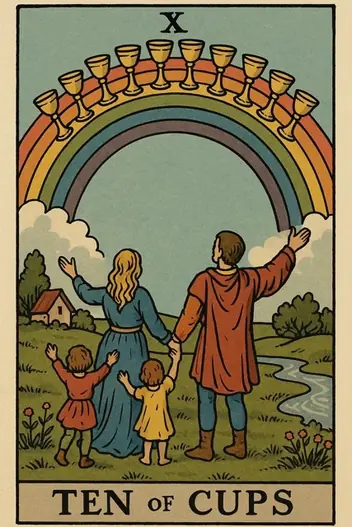
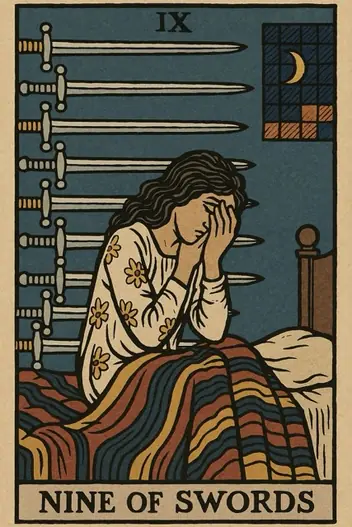
When the Ten of Cups—the card of emotional fulfillment, family harmony, and the idealized happy ending—collides with the Nine of Swords—the card of anxiety, nightmares, and mental anguish—we encounter a powerful psychological paradox. This combination represents the tension between what we think we should feel and what we actually feel. It’s the internal conflict of having a life that looks perfect on the outside while suffering from doubt, fear, or regret on the inside.
From a Jungian perspective, this pairing often signals a disconnect between the Persona (the social mask) and the Shadow (the repressed fears). The seeker may be clinging to an external image of success or happiness while ignoring the internal turmoil that demands attention. The strategic challenge here is not to abandon the dream of the Ten of Cups, but to integrate the anxieties of the Nine of Swords as a signal for necessary change, not as proof of failure.
Ten of Cups and Nine of Swords Card Meaning Explained
The core dynamic of the Ten of Cups and Nine of Swords is a cognitive dissonance between reality and expectation. The Ten of Cups represents the archetype of the "Happy Family" or the "Fulfilled Dream"—a state of emotional completion. The Nine of Swords represents the "Nightmare"—the 3 AM panic about what is wrong, what could go wrong, or what already has. When combined, the seeker is likely experiencing a gap between their external circumstances and their internal state.
This is not a card of simple misfortune. It is a card of psychological conflict. The mind (Nine of Swords) is actively sabotaging the heart (Ten of Cups). The most important insight here is that the anxiety is often about the very thing the seeker most desires. For example, someone in a stable relationship may fear losing it; someone who has achieved career success may fear it is all a facade. The solution is not to suppress the fear, but to interrogate its source. Is the fear a rational warning, or a pattern of self-sabotage?
Practically, this combination demands stoic realism. The seeker must learn to hold two opposing truths: their life may be objectively good (Ten of Cups), and they may still feel deep, subjective pain (Nine of Swords). Acknowledging this duality is the first step toward genuine healing. The path forward requires moving from passive worry to active problem-solving, often by addressing a specific, unspoken issue that the anxiety is trying to highlight.
Ten of Cups and Nine of Swords in Career Readings
Strategic Opportunities:
Use your anxiety as a diagnostic tool. If you are worried about a project, it likely means you care deeply. Channel that energy into meticulous planning and risk mitigation rather than rumination.
Strategic Opportunities:
This is an excellent time to review your long-term goals. The Ten of Cups asks: "Does your career align with your values?" The Nine of Swords asks: "What are you afraid will happen if it doesn't?" Use this tension to recalibrate.
Calculated Risks:
Do not make major financial decisions based on fear. The Nine of Swords can exaggerate threats. Avoid selling assets, quitting a job, or making large purchases impulsively. Wait until you have objective data.
In a professional context, this combination often appears when a person has achieved a "dream job" or financial stability but feels imposter syndrome or burnout. The Ten of Cups represents the external success—the promotion, the team harmony, the stable income. The Nine of Swords represents the internal cost—the sleepless nights, the fear of being exposed, the pressure to maintain the status quo.
The strategic move here is to separate rational risk from irrational fear. Ask yourself: Is my anxiety based on a tangible threat (e.g., a toxic boss, an unsustainable workload) or on a vague sense of unworthiness? If it's the former, take concrete action—update your resume, set boundaries, or plan an exit. If it's the latter, invest in your resilience—therapy, mentorship, or simply acknowledging that success often feels uncomfortable. Financially, this is a time for conservative management. The Nine of Swords can create panic selling or hoarding. Stick to your long-term plan and avoid making decisions at 2 AM.
Your pair is already on the table. Ask your question and draw the clarifying card
or simply focus on it
Ten of Cups and Nine of Swords as Feelings
If you are single:
This combination warns against projecting a "perfect relationship" fantasy onto a new connection. You may be ignoring red flags because you desperately want the ideal. Focus on whether the person is actually compatible, not just whether they fit your dream.
If you are in a relationship:
You or your partner may be suffering in silence. One person feels the relationship is perfect, while the other is secretly anxious, resentful, or overwhelmed. This is a clear signal to initiate a difficult but necessary conversation.
In existing relationships, this pairing often reveals a dynamic of emotional inequality. One partner may be performing happiness (Ten of Cups) while the other is drowning in unspoken fears (Nine of Swords). The key psychological insight is that you cannot fix anxiety with more perfectionism. Trying to create a flawless environment to soothe your partner’s fears will only exhaust you both. Instead, establish a boundary around emotional honesty. Allow space for one partner to say, "I am anxious, even though everything looks fine," without the other partner taking it as a personal failure.
The most strategic relationship advice here is to stop trying to "fix" the anxiety. Instead, listen to what the worry is trying to communicate. Is it about trust? About unfulfilled needs? About fear of the future? Address the root cause, not the symptom. For singles, this is a warning against idealization. The Nine of Swords reminds you that every relationship contains risk; the goal is not to find a risk-free partner, but to find one whose risks you are willing to accept.
Ten of Cups and Nine of Swords Reversed Meaning
When cards appear in a reversed position, the inner conflict either surfaces or transforms.
- If the Ten of Cups is reversed (e.g., blocked potential or disappointment): This means the illusion of "perfect happiness" has collapsed. External harmony is shattered — divorce, job loss, business failure. However, the Nine of Swords (upright) still holds you in its grip of anxiety. You have not only lost what you had, but you also fear that things will never get better. Advice: Acknowledge the loss and allow yourself to grieve. Only by going through this can you build a new, more resilient reality.
- If the Nine of Swords is reversed (e.g., internal resistance or weakness): The upright anxiety subsides, but apathy and denial emerge. You tell yourself, "I don't care about this," but in reality, you are suppressing the fear. The Ten of Cups (upright) is still nearby, but you cannot enjoy it because you have shut down your emotions. This is a state of emotional numbness. The risk is missing real problems that require your attention.
- If BOTH are reversed (complete dynamic imbalance): Chaos and disorientation. There is neither external harmony nor inner peace. You feel lost and don't know what to believe. A logical way to correct this: Return to basic needs. Forget about "happiness" and "fears." Focus on your daily routine, physical activity, and minimal social contact. Rebuild the foundation before attempting to construct the walls.
Deepen your understanding
Find out exactly what this reading means for your current life situation with our oracle.
Negative Meaning of Ten of Cups and Nine of Swords
The shadow side of this combination is masochistic perfectionism. The seeker may subconsciously believe that if they worry enough, they can prevent disaster. This is a cognitive bias known as magical thinking—the belief that anxiety itself is a form of control. In reality, this pattern leads to chronic stress and the erosion of genuine happiness. The Ten of Cups becomes a prison of expectations, and the Nine of Swords becomes a self-fulfilling prophecy.
Another major pitfall is projecting the Nine of Swords onto others. Instead of owning their own anxiety, the seeker may blame their partner, boss, or family for their unhappiness. "If only they were different, I would be happy." This externalization prevents any real change. The shadow also manifests as passive-aggressive behavior—smiling on the outside while festering on the inside. The core psychological trap is the belief that admitting fear means admitting failure. The truth is the opposite: acknowledging the shadow is the only path to authentic fulfillment.
Ten of Cups and Nine of Swords: Tarot Advice
How can one constructively use the energy of the Ten of Cups to balance the Nine of Swords? It is necessary to stop fighting anxiety and begin using it as a signal, not as a command. The Ten of Cups is your goal, your comfort zone. The Nine of Swords is your inner watchdog, barking at every rustle. Your task is not to silence the dog (that's impossible), but to learn to distinguish a real threat from a false alarm.
Strategic advice:
Apply the method of "Paradoxical Intention." Instead of fearing that happiness will collapse, begin mentally rehearsing the scenario of its downfall. What will you do? What resources do you have? How will you recover? As soon as you stop fearing loss, fear loses its power. You will see that even in the worst-case scenario, you will survive. This knowledge will give you the freedom to enjoy the present moment.
The second key step is materializing abstract happiness. The Ten of Cups is a very powerful but ephemeral archetype. To prevent the Nine of Swords from destroying it, you need to translate it into concrete actions. Instead of simply "wishing for harmony in the family," institute a weekly ritual. Instead of "fearing project failure," create a checklist of critical control points. Turn emotion into structure. This is the only way to calm the anxious mind and give your happiness a solid foundation.
Your Next Step: Personal Context Matters
The core message of the Ten of Cups and Nine of Swords is that genuine happiness requires the courage to face your fears. You cannot have the dream without confronting the nightmare. The path forward is not to choose one card over the other, but to use the anxiety of the Nine of Swords as a compass to refine the vision of the Ten of Cups. Your peace of mind is worth more than a perfect facade.
While this article provides a deep psychological framework, the true power of Tarot lies in its application to your specific situation. A general interpretation can guide you, but only a personalized reading can reveal the exact source of your conflict and the precise action you need to take. Use the Fortune Cards app to get a deep, personalized interpretation of this exact combination for your specific question. Whether you access it on the web or download it, the app will analyze your unique context—your relationship history, career path, and emotional patterns—and deliver a strategic, actionable reading that cuts through the noise. Stop wondering what the cards mean for everyone else. Find out what they mean for you.
Interpretation by the Fortune Cards editorial team, based on the Rider–Waite tradition and Jungian archetypes. About our methodology · Updated: 2026-08-26
Other Combinations with Ten of Cups
Other Combinations with Nine of Swords
Explore Individual Card Meanings
Table of Contents
- Ten of Cups and Nine of Swords Card Meaning Explained
- Ten of Cups and Nine of Swords in Career Readings
- Ten of Cups and Nine of Swords as Feelings
- Ten of Cups and Nine of Swords Reversed Meaning
- Negative Meaning of Ten of Cups and Nine of Swords
- Ten of Cups and Nine of Swords: Tarot Advice
- Your Next Step: Personal Context Matters
Ready to find answers to your questions?
Start your first reading now and look at your situation with fresh clarity. The cards are ready to reveal deeper meaning.