Love Tarot: Nine of Swords and Two of Pentacles

- Arcana
- Nine of Swords — Minor Arcana, Swords; Two of Pentacles — Minor Arcana, Pentacles
- Elements
- Nine of Swords — Air; Two of Pentacles — Earth
- Elemental interaction
- Opposing elements — energies create tension
- Numerology
- 9 + 2 = 11 → 2
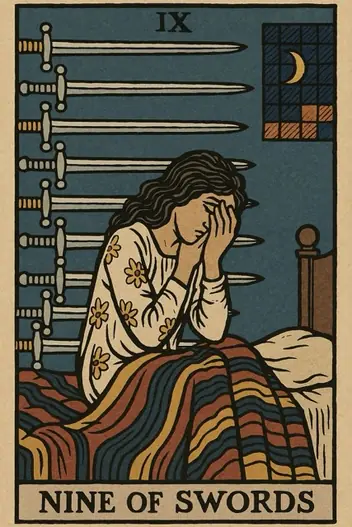
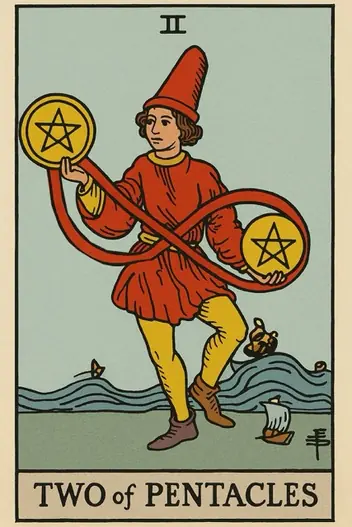
When the Nine of Swords—the card of nocturnal anxiety, overthinking, and mental anguish—meets the Two of Pentacles—the card of balancing resources, adapting to change, and managing competing priorities—the result is a high-stakes psychological drama. This pairing often points to a person who is trying to keep multiple balls in the air while their mind is screaming that everything is about to crash. It’s not a combination of external catastrophe, but of internal overwhelm meeting external demand.
Psychologically, this is the clash between the Anxious Mind (Nine of Swords) and the Adaptive Ego (Two of Pentacles). The seeker may be functionally competent on the outside—paying bills, showing up to work, maintaining relationships—while privately wrestling with catastrophic thoughts, guilt, or insomnia. The core dynamic is cognitive dissonance: the world sees a juggler, but the self feels a drowning person.
Nine of Swords and Two of Pentacles Combination Meaning
The fusion of these two cards reveals a person who is highly aware of their responsibilities but is emotionally exhausted by the mental load of managing them. The Nine of Swords brings a pattern of rumination—replaying worst-case scenarios, fearing failure, or feeling haunted by past mistakes. The Two of Pentacles adds the pressure of constant adaptation: shifting deadlines, financial juggling, or relationship compromises that require split-second decisions.
In practice, this combination often appears when someone is burning the candle at both ends while telling themselves they have it under control. The danger here is perfectionism disguised as resilience. The seeker may refuse to ask for help, believing that admitting overwhelm would confirm their deepest fear: that they are not capable. The real insight is that the anxiety is not a signal to stop, but a signal to reprioritize. The Two of Pentacles demands flexibility, not martyrdom.
This is not a card pair that predicts disaster. Rather, it describes a psychological bottleneck where the seeker’s internal narrative (Nine of Swords) is making the logistical juggling (Two of Pentacles) feel ten times harder than it actually is. The solution lies in cognitive reframing and practical delegation.
What Do Nine of Swords and Two of Pentacles Say About Love?
If you are single:
This combination suggests you may be overthinking a new connection to the point of paralysis. You might be juggling dating with other life pressures and feeling guilty about not giving it your full attention. Stop analyzing every text; focus on presence, not perfection.
If you are in a relationship:
This pairing points to a partner who is emotionally withdrawn due to stress, not due to lack of love. You may be balancing work, family, or health issues while your partner feels neglected. The anxiety is mutual, but misdirected.
In relationships, the Nine of Swords and Two of Pentacles often signal a disconnect between verbal reassurance and emotional reality. One or both partners may be saying "I'm fine" while lying awake at night worrying about money, job security, or the future of the relationship. The key is to stop pretending you can handle everything alone. Couples therapy, scheduled check-ins, or simply admitting "I'm overwhelmed" can break the cycle of silent suffering. Avoid the trap of assuming your partner should intuitively know what you need; the Two of Pentacles demands explicit communication.
Remember:
The anxiety here is often about external pressures, not the relationship itself. Don't let financial stress or career chaos become a scapegoat for relationship issues. Separate the two domains.
Your pair is already on the table. Ask your question and draw the clarifying card
or simply focus on it
Career and Finances
Strategic Opportunities:
Prioritize one project at a time. The Two of Pentacles rewards focus, not multitasking. Use the anxiety of the Nine of Swords as a motivator to create a concrete to-do list, not a spiral.
Strategic Opportunities:
Delegate or outsource tasks that drain your mental energy. If you're juggling multiple clients or deadlines, identify the 20% of work causing 80% of your stress. Offload it.
Calculated Risks:
Avoid making financial decisions at 2 AM. The Nine of Swords amplifies irrational fear. Wait 24 hours before accepting a new job offer, making a big purchase, or signing a contract.
Professionally, this combination is a red flag for burnout disguised as productivity. You may be working long hours, but the quality of your output is suffering because your mind is fragmented. The Nine of Swords often accompanies impostor syndrome—you fear being exposed as incompetent, so you overcompensate by taking on more work. This is a recipe for diminishing returns.
Financially, this pair warns against "robbing Peter to pay Paul." The Two of Pentacles is about balance, but the Nine of Swords can push you into panic-driven decisions: taking out high-interest loans, dipping into emergency funds, or ignoring bills until they become crises. Create a simple, automated system for bills and savings. Remove the mental load. The goal is not to eliminate anxiety, but to prevent it from dictating your financial strategy.
Ask your specific question
Don't rely on generic meanings. Get a customized reading tailored specifically to your energies.
Shadow Side & Pitfalls
The shadow manifestation of this pairing is chronic catastrophizing combined with indecision. The seeker may become paralyzed by the fear of making the wrong choice, so they freeze—juggling nothing, dropping everything. This is the cognitive bias known as "analysis paralysis" : the Nine of Swords supplies endless worst-case scenarios, while the Two of Pentacles demands a quick pivot. The result is self-sabotage through inaction.
Another pitfall is using busyness as an escape from emotional pain. The seeker may overload their schedule to avoid sitting with their anxiety, only to find that the anxiety follows them into every task. This is not productivity; it is avoidance dressed up as responsibility. Watch for signs of physical exhaustion, irritability, or a sudden loss of interest in hobbies. The shadow here is the belief that "if I just do more, I'll feel safe." In reality, doing more without addressing the underlying fear only deepens the cycle.
What If Nine of Swords or Two of Pentacles Appears Reversed?
If the Nine of Swords is reversed, the sharpness of anxiety subsides, but this is not always positive. Often, it signifies a transition from an acute phase of panic to a chronic, sluggish depression or apathy. You are no longer thrashing about, but you are also not taking action. In this scenario, the energy of the Two of Pentacles can lead to reckless squandering of resources — you start "juggling" not tasks, but pleasures, trying to drown out a dull ache.
If the Two of Pentacles is reversed, it signals a complete loss of balance and an internal resistance to any change. The person literally "drops the balls." Instead of hyperactivity, a stupor sets in. The combination with the upright Nine of Swords becomes extremely heavy: the person is aware of the full scale of the problems but lacks the strength to even move to solve them. This is a state of paralysis of the will.
If BOTH cards are reversed, we see a total imbalance. Anxiety has sunk deep into the subconscious, and external activity is reduced to zero. This is the most dangerous combination, pointing to a risk of deep depression and social isolation. The method for correction is a forced return to the simplest rituals. Make the bed, drink a glass of water, go outside for 5 minutes. Do not try to solve everything at once. Restore balance through micro-actions that require no cognitive load.
What Is the Overall Message of Nine of Swords and Two of Pentacles?
How to constructively harness the energy of this pair? Your task is not to get rid of anxiety (it can be a source of energy), but to redirect it into structure. The Nine of Swords provides heightened sensitivity to risks. The Two of Pentacles provides the ability to adapt quickly. Combine these into one skill—anticipatory planning.
Instead of frantically juggling tasks that are already "on fire," use your anxiety to create a "risk map" for the week ahead. Write down 3-5 things that worry you the most. Then, using the flexibility of the Two of Pentacles, create a "Plan B" for each of these scenarios. This will shift your psyche from "firefighting" mode to "prevention" mode.
A deep strategic counsel: deliberately lower the bar. You are not obligated to do everything perfectly. Your goal is not to keep all the balls in the air, but to choose the one most valuable and let the rest fall. This is not a defeat. This is strategic prioritization. Only by releasing control over the secondary will you gain true power over the primary.
Applying This to Your Situation
The Nine of Swords and Two of Pentacles together tell a story of a capable person who is being crushed by their own expectations. The core message is not to stop juggling, but to lighten the load and trust your adaptability. You are not failing; you are simply carrying too much mental weight. The solution is practical: prioritize, delegate, and give yourself permission to be imperfect.
However, this general interpretation is just the archetype. The true power of Tarot lies in how these cards interact with your specific life situation. Your question, your history, and your current circumstances will shape the meaning. That is why I recommend using the Fortune Cards app for a deep, personalized reading of this exact combination. Whether you access it on the web or download it, the app will analyze your unique context—your relationship history, career stage, and emotional patterns—to give you actionable, tailored advice. Stop guessing. Get clarity on your specific path right now.
Interpretation by the Fortune Cards editorial team, based on the Rider–Waite tradition and Jungian archetypes. About our methodology · Updated: 2026-08-26
Other Combinations with Nine of Swords
Other Combinations with Two of Pentacles
Explore Individual Card Meanings
Table of Contents
- Nine of Swords and Two of Pentacles Combination Meaning
- What Do Nine of Swords and Two of Pentacles Say About Love?
- Career and Finances
- Shadow Side & Pitfalls
- What If Nine of Swords or Two of Pentacles Appears Reversed?
- What Is the Overall Message of Nine of Swords and Two of Pentacles?
- Applying This to Your Situation
Ready to find answers to your questions?
Start your first reading now and look at your situation with fresh clarity. The cards are ready to reveal deeper meaning.