Nine of Swords
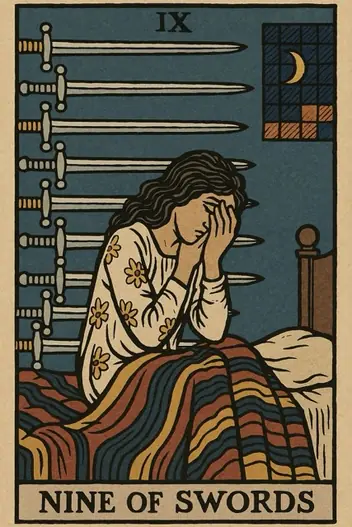
- Arcana
- Minor Arcana, Suit of Swords
- Element
- Air
- Decan
- Mars in Gemini
- Numerology
- 9
The Nine of Swords represents the Jungian archetype of the Nightmare, where the unconscious mind projects unresolved fears into conscious awareness. This card depicts the psychological state of catastrophizing—the cognitive distortion where a person amplifies risks, imagines worst-case scenarios, and becomes paralyzed by anticipatory anxiety. It is not a card of external disaster, but of internal narrative collapse.
In a reading, this card signals that the primary challenge is not the objective situation, but the mind's interpretation of it. The swords in the imagery do not physically wound the figure; they hang on the wall as mental constructs. This is the moment when overthinking replaces action, and the prefrontal cortex—responsible for executive function—is hijacked by the amygdala's fear response. The core lesson is to distinguish between real threats and manufactured dread.
Nine of Swords: Core Meaning and Interpretation
The upright Nine of Swords is a productivity and clarity killer. It manifests as a cycle of rumination—replaying past mistakes or projecting future failures without resolution. Psychologically, this is the default mode network running unchecked, creating a loop of self-criticism and hopelessness. The key insight here is that this state is self-generated, not imposed by external forces. The card challenges you to audit your thoughts for cognitive biases, specifically confirmation bias (looking for evidence that supports your fear) and catastrophic thinking (assuming the worst possible outcome is inevitable).
The resource this card provides is stark self-awareness. It forces you to confront the gap between perceived danger and actual risk. Strategically, the Nine of Swords demands a reality check: write down the specific fear, then list objective evidence for and against its likelihood. This act of externalizing internal dialogue breaks the feedback loop. It also warns against decision-making under duress—any choice made in this state is likely defensive and suboptimal. The pragmatic action is to pause, sleep on it, and let the cortisol spike subside before acting.
Ask your question and flip the cards
or simply focus on it
Is Nine of Swords a Yes or a No?
No. The Nine of Swords embodies the archetype of the "Nightmare" — a state where the mind turns against itself, amplifying fears and regrets into paralyzing certainty. In a yes/no context, this card signals that the current path is blocked by self-generated anxiety, not external reality; the answer is no because the questioner is not in a state to perceive or receive a favorable outcome. Reversed, the card softens to a Leaning Yes — the nightmare is beginning to lift, but only if the person consciously reframes their catastrophic thinking into manageable steps. Critical caveat: the answer remains no unless the questioner first addresses the root psychological pattern — the compulsive need to replay past failures — and stops seeking external validation for internal wounds.
Get a personalized interpretation
Unlock the combined meaning of your cards in the context of your unique question — for free.
Card of the Day
The Nine of Swords announces a day where your inner critic will be louder than any external voice — expect intrusive thoughts, hypervigilance, and a tendency to catastrophize minor setbacks. Your primary focus should be on distinguishing thoughts from facts: write down your worst fear, then ask yourself what concrete evidence supports it. The trap to avoid is isolation — your mind will tell you that no one understands, but reaching out to one grounded person is the antidote. Do not numb the anxiety with distraction or substances; instead, sit with the discomfort for exactly five minutes and notice how the narrative shifts. Energy today is not prophetic, it is psychological: you are reliving an old wound, not predicting the future.
Nine of Swords in Love and Relationships
If you are not in a relationship:
This card suggests you may be projecting past betrayals onto future possibilities. You are not choosing partners based on compatibility, but based on a script of "what could go wrong." This leads to avoidance or premature rejection.
If you are in a relationship:
The Nine of Swords indicates communication breakdown fueled by assumption. You or your partner is interpreting silence as rejection, a delayed reply as disinterest, or a disagreement as a threat to the relationship's survival.
The core behavioral pattern here is emotional hypervigilance. You are scanning for threats rather than seeking connection. This creates a self-fulfilling prophecy: your anxiety pushes your partner away, confirming your fear of abandonment. The practical relationship advice is to establish a "no mind-reading" rule: state your interpretation of your partner's actions aloud and ask for clarification. Bold the main practical relationship advice: Replace assumption with direct inquiry. This breaks the cycle of misinterpretation and rebuilds trust through concrete evidence.
What Does Nine of Swords Say About Their Feelings?
They perceive you through the lens of their own unprocessed guilt or grief — you are less a person to them and more a mirror reflecting their deepest regrets. You evoke in them a mix of dread and longing: they see your stability or clarity as a reminder of what they feel they have ruined or lost. Their hidden fear is that you see through their facade, and their hidden hope is that you will forgive them without them having to confess. There is an internal conflict here — they are simultaneously drawn to your strength and repelled by the shame it stirs in them. Their perception of you is not about you; it is a projection of their own inability to sleep at night. If you feel accused or burdened by their gaze, recognize that you are simply holding space for a ghost they refuse to face.
Career and Finance
Strategic Opportunities:
Use this card's energy to conduct a thorough risk audit of your current project or investment. The heightened sensitivity can catch flaws others miss.
Resource Management:
Channel the anxiety into contingency planning. Draft a "worst-case scenario" response plan—this transforms fear into preparedness.
Calculated Risks:
Do not make major financial decisions while in this state. The Nine of Swords amplifies loss aversion, leading to overly conservative choices that miss genuine opportunities.
The professional risk here is analysis paralysis. You may over-prepare for a presentation or deal, only to miss the window of action. The cognitive bias at play is the negativity effect—you weigh potential losses three times more heavily than potential gains. Bold financial warnings or strategic advice: Avoid debt restructuring, large purchases, or quitting your job impulsively under this card's influence. Instead, set a 48-hour cooling-off period for any significant financial move. Use the anxiety as a signal to delegate decision-making to a trusted colleague or advisor, removing emotional weight from the equation.
Nine of Swords Reversed: What Changes
When the Nine of Swords appears reversed, the internal pressure cooker is venting, but not necessarily in a healthy way. The blocked potential here is repressed anxiety that surfaces as physical symptoms: insomnia, tension headaches, or irritability. The person may deny their fear, saying "I'm fine," while their body screams otherwise. This is dissociation from the shadow—refusing to acknowledge the nightmare, which only strengthens its hold. The warning is clear: ignoring the problem does not solve it. The logical correction is to schedule a structured worry session—set a timer for 15 minutes, write down all fears, then close the notebook. This compartmentalizes the anxiety without letting it leak into all areas of life.
The reversed card also indicates a shift from internal to external blame. Instead of catastrophizing about their own failure, the individual may project the nightmare onto others—seeing colleagues as saboteurs or partners as untrustworthy. This is a defense mechanism to preserve self-esteem, but it damages relationships. To correct this imbalance, practice radical responsibility: ask, "What is my contribution to this fear?" and "What evidence do I have that the other person intends harm?" The goal is to reintegrate the projected fear and own your part in the dynamic.
What Are the Pitfalls of Nine of Swords?
The shadow of the Nine of Swords is masochistic rumination—a compulsive need to suffer mentally as a form of penance for past mistakes. This manifests as perfectionism's dark twin: not the drive to excel, but the fear that any flaw is catastrophic. The cognitive bias is emotional reasoning ("I feel doomed, therefore I am doomed"). The irrational behavior includes staying in a toxic job or relationship because leaving feels like "failure," even though staying ensures continued suffering.
Another major pitfall is sleep deprivation as a coping mechanism. The card's imagery of a figure in bed, awake and tormented, highlights how people use late-night worry to avoid confronting daytime decisions. This is a self-sabotage loop: lack of sleep impairs judgment, which leads to poor decisions, which fuels more anxiety. The shadow also includes guilt-tripping others—using your visible distress to manipulate sympathy or avoid accountability. To counter this, establish a strict boundary between worry hours and rest hours. If you wake at 3 AM with dread, get up, write it down, and return to bed. Do not engage in the narrative.
Synthesis: Strategic Conclusion
The Nine of Swords is not a card of doom, but a diagnostic tool for cognitive hygiene. Its constructive use lies in transforming anxiety into data. When this card appears, you are being given a map of your mind's weakest points—the specific fears that your ego has not integrated. The strategic approach is to treat each fear as a hypothesis to be tested, not a truth to be accepted. Write down: "I am afraid that X will happen. What is the probability? What is my plan if it does?" This shifts the brain from the limbic system (fear) to the prefrontal cortex (planning).
The deeper lesson is about sovereignty over your inner narrative. You cannot control external events, but you can control the story you tell yourself about them. The Nine of Swords asks you to stop being the victim of your own thoughts and become the editor of your mental script. Practically, this means scheduling "worry time" into your day—a dedicated 20-minute slot to review fears, then closing the book. This trains the brain that anxiety is a task, not an identity.
Finally, this card is a call to build resilience through exposure. The fear of the nightmare is often worse than the nightmare itself. By deliberately facing small, manageable risks (e.g., having a difficult conversation, submitting imperfect work), you desensitize the amygdala and break the pattern of avoidance. The Nine of Swords, when mastered, becomes a tool for radical self-honesty—a necessary step toward psychological maturity.
Applying This to Your Situation
This psychological and strategic breakdown provides a deep understanding of archetypes. However, Tarot is never universal for everyone. To understand exactly how this dynamic applies to your specific situation, a reading tailored exclusively to you is necessary.
Download the Fortune Cards app or visit our platform to get a deep AI interpretation of your unique spread. Don't just read about the cards—use Fortune Cards to find out exactly what step you need to take next.
Try Tarot Spreads with Nine of Swords
Interpretation by the Fortune Cards editorial team, based on the Rider–Waite tradition and Jungian archetypes. About our methodology · Updated: 2026-08-26
Top Combinations with Nine of Swords
Discover how Nine of Swords interacts with other major cards in the deck to form powerful messages.
All 77 Combinations with Nine of Swords
Discover how this card interacts with every other card in the Tarot deck and reveal hidden meanings.
Table of Contents
- Nine of Swords: Core Meaning and Interpretation
- Is Nine of Swords a Yes or a No?
- Card of the Day
- Nine of Swords in Love and Relationships
- What Does Nine of Swords Say About Their Feelings?
- Career and Finance
- Nine of Swords Reversed: What Changes
- What Are the Pitfalls of Nine of Swords?
- Synthesis: Strategic Conclusion
- Applying This to Your Situation
Explore Tarot Universe
Ready to find answers to your questions?
Start your first reading now and look at your situation with fresh clarity. The cards are ready to reveal deeper meaning.