Ten of Wands and Nine of Swords Meaning in Tarot
- Arcana
- Ten of Wands — Minor Arcana, Wands; Nine of Swords — Minor Arcana, Swords
- Elements
- Ten of Wands — Fire; Nine of Swords — Air
- Elemental interaction
- Friendly elements — energies support each other
- Numerology
- 10 + 9 = 19 → 1
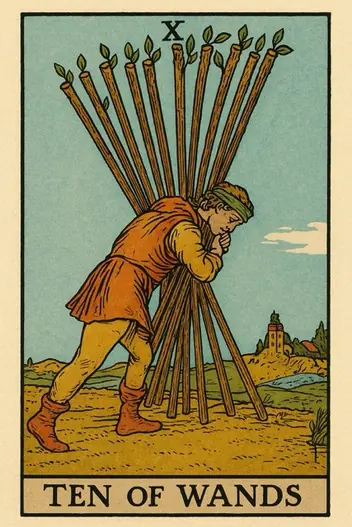
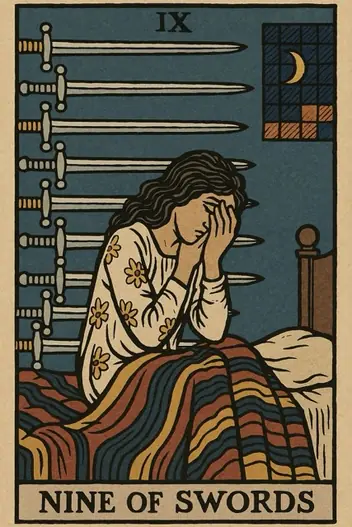
When the Ten of Wands—the card of burden, duty, and exhaustion—collides with the Nine of Swords—the card of anxiety, nightmares, and mental anguish—the result is a psychological state where your workload has become indistinguishable from your inner critic. This is not merely a busy period; it is a crisis of sustainability and self-worth. You are likely carrying obligations that no longer serve you, while simultaneously torturing yourself with worst-case scenarios about failing to meet them.
This combination forces a confrontation between your external responsibilities and your internal thought patterns. The Ten of Wands asks, "Why are you still carrying this?" while the Nine of Swords whispers, "Because if you drop it, everything will collapse." Together, they reveal a feedback loop: you take on more to prove your worth, then lie awake at night terrified you cannot handle it. The pragmatic path forward is to separate objective reality from catastrophic thinking and to start delegating, renegotiating, or releasing what is not truly yours to hold.
Ten of Wands and Nine of Swords Card Meaning Explained
The core dynamic here is cognitive dissonance between effort and outcome. The Ten of Wands represents the tangible weight of your commitments—projects, deadlines, family duties, or financial obligations. The Nine of Swords represents the psychological cost: the 3 AM panic, the obsessive replaying of mistakes, and the feeling that you are one misstep away from disaster. Together, they create a state where your productivity is undermined by your own mental chatter.
Psychologically, this mirrors the archetype of the Martyr and the Worrier. The Martyr in you refuses to set boundaries, believing that suffering is the price of being reliable. The Worrier then amplifies every small failure into evidence of incompetence. The key insight is that the burden is not the problem—the lack of trust in your own ability to manage it is. You may actually be more capable than you think, but your anxiety is distorting your perception of risk. The strategic action is to audit your commitments with cold objectivity: list what you must do, what you can defer, and what you can eliminate. Then, address the anxiety separately, perhaps through cognitive reframing—asking, "What is the actual probability of my worst fear happening, and what would I do if it did?"
Your pair is already on the table. Ask your question and draw the clarifying card
or simply focus on it
Ten of Wands and Nine of Swords as Feelings
If you are single:
This combination warns against projecting your own anxieties onto a potential partner. You may be so focused on your own burdens that you interpret a new connection as another obligation rather than a source of support. Pause before deciding you are "too busy" for love.
If you are in a relationship:
A clear sign of imbalanced emotional labor. One partner is carrying the weight of the relationship’s logistics, finances, or emotional support, while the other is overwhelmed by guilt or worry about not doing enough.
In relationships, the Ten of Wands and Nine of Swords point to a toxic cycle of unspoken expectations and silent resentment. The partner holding the wands feels unappreciated and exhausted, while the partner holding the swords feels inadequate and anxious about their contribution. The solution is radical transparency. Rather than assuming your partner knows you are overwhelmed, schedule a non-confrontational check-in. Use "I" statements: "I am feeling the weight of managing our finances, and it is causing me anxiety. Can we review the division of responsibilities together?" Bold boundary-setting is not selfish; it is a prerequisite for intimacy. If you are single, this pairing suggests you may be subconsciously avoiding relationships because you fear they will add to your mental load. Instead, ask yourself: "What would it look like to choose a partner who lightens my load, rather than adding to it?"
Get a personalized interpretation
Unlock the combined meaning of your cards in the context of your unique question — for free.
Ten of Wands and Nine of Swords in Career Readings
Strategic Opportunities:
Use this pressure as a catalyst to delegate or automate repetitive tasks. The burnout is a signal, not a badge of honor.
Strategic Opportunities:
This is an ideal time to renegotiate deadlines or scope of work. Your anxiety is often a sign that you are exceeding your capacity, not that you are incompetent.
Calculated Risks:
Do not take on new projects or financial commitments until you have cleared your current backlog. The risk of overextension is high.
In your career, this combination is a clear red flag for burnout. You are likely in a role where you are the "go-to" person, but the recognition is not matching the effort. The Nine of Swords suggests that your perfectionism is your worst enemy—you are reworking tasks that are already good enough, or catastrophizing about feedback that hasn't even been given. Financially, be wary of taking on debt to manage short-term stress. The impulse to "buy your way out" of overwhelm (e.g., hiring expensive help, buying tools you don't need) can lead to long-term strain. Instead, focus on core financial hygiene: review your budget for non-essentials you can cut to reduce the mental load of money management. Your career growth depends not on doing more, but on doing what matters with less anxiety. If you are self-employed, this is a strong signal to raise your rates or fire a difficult client—the cost to your mental health is not worth the revenue.
When Ten of Wands and Nine of Swords Signal Trouble
The shadow side of this combination is learned helplessness and self-fulfilling prophecy. When you believe you are always overwhelmed, you stop looking for escape routes. You may unconsciously sabotage your own success to confirm your anxiety—missing a deadline because you were "too stressed," or picking a fight with a partner to validate your belief that "no one helps me." The cognitive bias here is catastrophizing: assuming the worst outcome is the most likely one, which leads to paralysis. Another pitfall is martyrdom as identity—you may derive a sense of moral superiority from your suffering, making it hard to let go of the burden. Watch for passive-aggressive behavior (e.g., sighing loudly, dropping hints) instead of direct requests for help. The shadow also manifests as physical neglect: skipping meals, losing sleep, or ignoring health symptoms because you are "too busy" to rest. This is not strength; it is a slow erosion of your capacity to function.
Ten of Wands and Nine of Swords Reversed Meaning
If the Ten of Wands is reversed:
You have shed the burden, but have not resolved the underlying anxiety. Warning: you may become reckless. Quitting without a safety net, ending relationships in anger. Your task is not simply to leave, but to plan your exit.
If the Nine of Swords is reversed:
You are suppressing anxiety, pretending everything is fine. Advice: internal resistance is not strength, but weakness. If you ignore your body's signals (insomnia, headaches), they will manifest as psychosomatic symptoms.
If BOTH are reversed:
Complete imbalance. You are simultaneously overloaded and afraid to admit it. The logical way to correct this is an emergency pause. Take a 3-day "time-out," turn off your phone, and soberly assess what on your to-do list is truly critical and what is merely an illusion of urgency.
Overall Meaning of Ten of Wands and Nine of Swords
Constructive use of this combination requires cold rationality. Do not attempt to "calm" the Nine of Swords — it will not work. Instead, use it as an overload indicator. Every time you feel panic, ask yourself: "What specific task can I cancel or postpone right now?" The main strategic advice — manage not the anxiety, but the volume of work. Reduce your commitments by 50%, and the anxiety will subside on its own because it will have no fuel left.
The Ten of Wands here plays the role of a cure for paranoia. Instead of "thinking" about the problem, start acting — but not chaotically, following the principle of "one task per day." Your goal is not to finish everything, but to make it to the evening without a panic attack. Psychologically, this is a transition from a reactive mode (reacting to fears) to a proactive one (planning rest). Remember: your most important job today is to prevent burnout. Only a restored mind can make sound decisions. Use the energy of the Ten to implement rituals: 8 hours of sleep, 3 meals, and 1 hour without screens. This is not a luxury, but a strategic necessity.
Applying This to Your Situation
The Ten of Wands and Nine of Swords are a powerful signal that your current strategy of "just push through" is failing. The core message is this: You are not a machine, and your anxiety is not a weakness—it is data. It is telling you that your load is too heavy, your boundaries are too weak, or your expectations of yourself are unrealistic. The path forward requires both external action (delegating, prioritizing) and internal work (challenging catastrophic thoughts). Do not try to fix everything at once. Start with the one burden that, if lifted, would reduce the most anxiety.
For a truly personalized interpretation of this combination, specific to your unique situation—whether it’s a love question, career dilemma, or personal crossroads—use the Fortune Cards app. While this article provides the general archetype, the real insight comes when the cards are read through the lens of your exact question and life context. Click here to get a deep, AI-driven reading of the Ten of Wands and Nine of Swords for your specific concern, right now. Available on web and as a download.
Interpretation by the Fortune Cards editorial team, based on the Rider–Waite tradition and Jungian archetypes. About our methodology · Updated: 2026-10-15
Other Combinations with Ten of Wands
Other Combinations with Nine of Swords
Explore Individual Card Meanings
Table of Contents
- Ten of Wands and Nine of Swords Card Meaning Explained
- Ten of Wands and Nine of Swords as Feelings
- Ten of Wands and Nine of Swords in Career Readings
- When Ten of Wands and Nine of Swords Signal Trouble
- Ten of Wands and Nine of Swords Reversed Meaning
- Overall Meaning of Ten of Wands and Nine of Swords
- Applying This to Your Situation
Ready to find answers to your questions?
Start your first reading now and look at your situation with fresh clarity. The cards are ready to reveal deeper meaning.